Procurement teams, hospital pharmacists, and oncologists who work with A.K. Pharma regularly give variations of the same answer when asked why they keep coming back — reliability, product knowledge, and consistent availability.
Reliability: When A.K. Pharma commits to supplying a medicine, it supplies it. That sounds basic, but in specialty medicine distribution it is genuinely rare. Buffer stock management, proactive communication about supply chain status, and responsiveness when a patient’s treatment timeline is at stake are things that distinguish a genuine specialty distributor from one that treats these medicines as just another line item.
Product knowledge: The team at A.K. Pharma understands what it distributes. That means knowing that Rafinlar (Dabrafenib) and Meqsel (Trametinib) must always be ordered together as a mandatory combination regimen. It means knowing that Imfinzi (Durvalumab) and Imjudo (Tremelimumab) are both required for the STRIDE protocol in unresectable HCC. It means knowing that certain medicines require AERB-licensed nuclear medicine coordination. This understanding is not incidental — it is the difference between a partner and a supplier.
Authorised sourcing: Every medicine A.K. Pharma supplies comes from manufacturer-authorised distribution channels — AstraZeneca, Novartis, Pfizer, Roche, Sanofi, Bayer, Janssen, and others. There are no grey market sources, no parallel imports from unverified channels, no ambiguity about where the stock originated.
What to Look for in a Medicine Distributor in Delhi for Specialty Medicines
If you are evaluating a specialty medicine distributor in Delhi for your hospital, oncology centre, or pharmacy, these are the questions that matter:
1. Do they hold the correct drug licences? A wholesale pharmaceutical distributor in India must hold a valid licence under the Drugs and Cosmetics Act. For cold chain biologics and certain controlled medicines, additional approvals may be required. Ask to see documentation. A distributor who cannot provide it clearly is already telling you something.
2. Are they sourcing from manufacturer-authorised channels? For imported originator medicines — Tagrisso, Enhertu, Dupixent, Venclexta — ask specifically whether the distributor sources from the manufacturer’s authorised Indian distribution network. Grey market sourcing is more common than it should be, and it carries real risks around authenticity and storage history.
3. How do they handle cold chain? Ask about cold room capacity, temperature monitoring systems, backup power, and delivery protocols for refrigerated medicines. Do they provide temperature logs with shipments? For biologics like Dupixent, Enhertu, Imfinzi, and Fasenra, this is non-negotiable.
4. Can they maintain consistent supply? For patients on continuous therapy — daily targeted therapy tablets, monthly biologic injections, quarterly hormonal treatments — supply consistency directly affects clinical outcomes. Ask about buffer stock practices and what happens when a product is in short supply nationally.
5. Do they understand what they distribute? A distributor who treats Venetoclax the same as Vitamin C tablets is a liability. The right specialty distributor knows the clinical context of every medicine they supply — and proactively flags relevant information.
Serving Delhi and India — 25 Years of Specialty Medicine Distribution
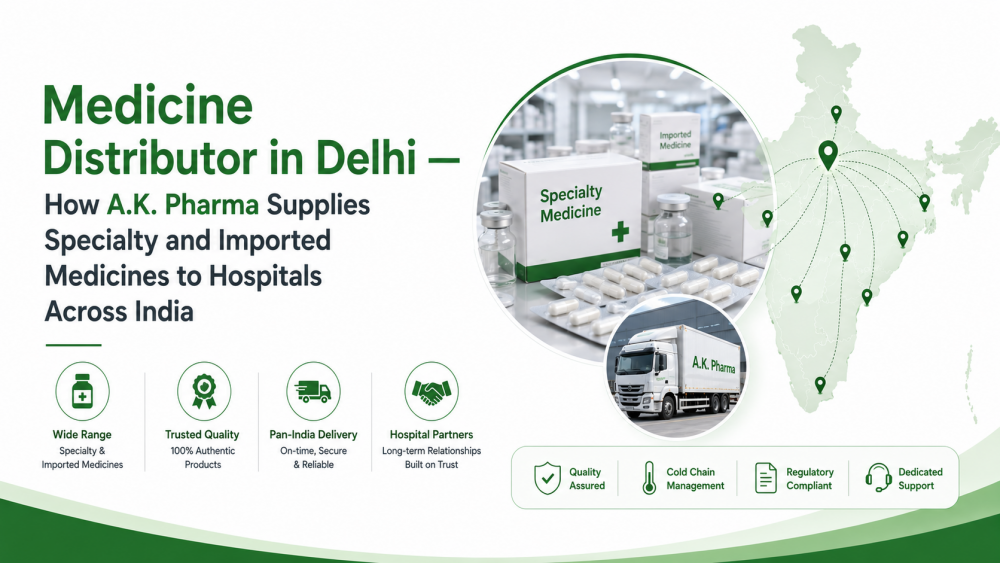
A.K. Pharma’s base is Shastri Nagar, New Delhi — one of Delhi’s established pharmaceutical distribution hubs, well-connected to the city’s major hospitals, oncology centres, and logistics networks. But the supply reach extends across India. Hospitals and pharmacies in Mumbai, Kolkata, Chennai, Bangalore, Hyderabad, and beyond order from A.K. Pharma when they need genuine imported specialty medicines with reliable supply.
Delhi’s position at the intersection of India’s import infrastructure, major hospital networks, and pharmaceutical logistics makes it the natural home for a specialty medicine distributor serving the national market. A.K. Pharma has been at the centre of that network for 25 years — and in 2026, with the Indian oncology market projected to reach USD 30 billion by 2034 and precision medicine adoption accelerating across hospital networks, the demand for reliable specialty medicine distribution has never been higher.