Product engineering has always been about creating things that function properly for the user while remaining scalable, reliable, and maintainable for the business. There has been a noticeable shift in the last few years, however, in how product development teams design, build, test, and improve products. Much of this shift is due to AI.
This is not an overnight, everything has changed type of shift, but rather, it has been an ongoing integration of smarter tools and systems into day-to-day activities. As AI is transforming business operations, its influence is naturally extending into product engineering as well, reshaping how teams make decisions, collaborate, and continuously improve products.
AI has permeated product engineering solutions and is now present in almost every phase of the engineering process. Let’s look at the engineering process step by step.
Product engineering is getting more data-aware
In the past, product decisions were mainly influenced by experience, intuition, and analysis after launch, albeit to a lesser extent. AI has improved the quality and speed of using large amounts of data at any given moment.
By analyzing user behavior in real time, teams will no longer have to wait weeks to gather data on user navigation through a product (where they are dropping off, which features they interact with the most). AI systems can also continue to analyze the data in order to help identify trends that may not yet be visible to teams.
These insights into what is happening now do not replace the need for human decision-making but help provide engineers and product managers with better context into what is currently happening.
Faster prototyping and iteration cycles
One way AI has fundamentally altered how products are engineered is through speed. AI allows for faster coding, but it also supports faster thinking and experimentation with different ideas.
It’s also now possible for teams to create early versions of interfaces, workflows, or backend processes much faster than before. This results in much less time spent on initial planning stages and much more time spent testing concepts in real-world scenarios.
There is also the added benefit of changing how product teams think about developing new products. Rather than digging into trying to “get everything right” the first time out, product teams can now focus on building small chunks of functional features and improving on those small functional pieces of a feature over time.
Product teams will find themselves encouraged to work in a more experimental way; they will use actual user feedback while developing products, rather than incorporating it after the fact.
Smarter debugging and maintenance
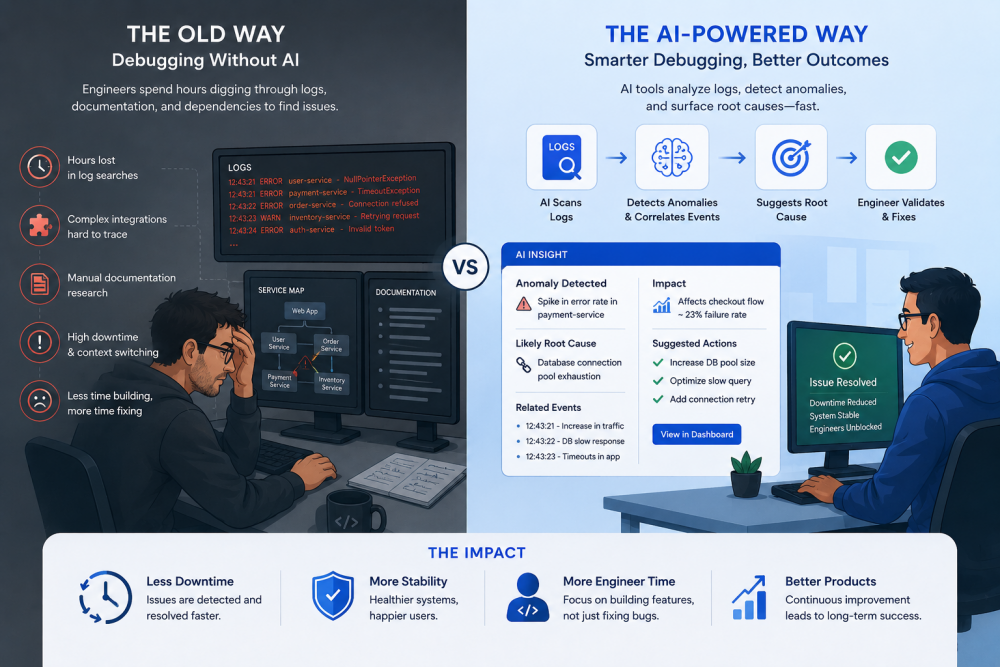
As a software engineer, I can attest to time being consumed by debugging throughout the development process with large software systems. Oftentimes, the issue at hand is very straightforward; however, there are other times that the issue is located deep within logs or is hidden behind complex integrations between services.
In addition, AI tools and frameworks are now being integrated to provide help in log scanning for anomalies and root cause detection; however, these tools and frameworks will still require that engineers conduct additional research, reducing the time engineers spend searching through documentation manually.
For product engineering solution teams, this will result in less downtime in production systems, more system stability, and, ultimately, give engineers more time to enhance and develop their product rather than always being called upon to fix ongoing issues.
Better understanding of user experience
Product engineering has always focused on user experience, but AI is providing teams with a deeper understanding of user experience.
While teams have always traditionally measured user experience through page views and clicks, AI can now additionally measure the intent of users by measuring behavioral patterns, like
(1) pausing before clicking on a button,
(2) switching between two pages multiple times,
(3) following an unusual usage pattern.
By using AI, teams can identify friction points in their products. In many cases, friction points may be simplified existing product features as opposed to developing new features. In both cases, AI will help uncover small signals that wouldn’t normally be found.
Supporting developers in everyday coding
With artificial intelligence entering the realm of engineering, it has begun assisting in writing and reviewing code. Rather than take over for developers, it functions more like a tool to help expedite day-to-day tasks.
More frequently, developers rely on AI to provide assistance in doing things such as offering code snippets, locating possible errors in the code and explaining portions of a codebase that an engineer may be unfamiliar with.
The value of this assistance can be felt by large groups of engineers working together on a complicated system. When new engineers are able to quickly understand what is already present and experienced engineers can devote their time to developing overall architecture.
Improving collaboration between teams
The term product engineering isn’t limited to engineers; it also encompasses design, product management, quality assurance, other members of the development team, and business stakeholders.
AI tools have opened up new ways for communication between groups in product development. AI has enabled the conversion of user stories into technical drafts, the summarization of feedback from different sources, and even the creation of documentation directly from a codebase.
These advancements help make it possible for those involved with product development to remain aligned without the need to go back and forth multiple times in order to clarify any questions that arise. It also minimizes the probability of making mistakes during product development.
Making systems more adaptive
Today, manufacturers and developers of new products need to adopt an approach toward continuous evolution and improvement of their products to maintain customer loyalty. Users want a unique, tailored experience that evolves with their preferences.
Artificial intelligence provides an opportunity for development teams to create products that will evolve based on user activity and environment. AI systems are capable of making many different types of adjustments (i.e., providing new recommendations, changing layout according to user behavior, and prioritizing feature availability/indexing) to provide the best possible experience for the user.
This adds a level of complexity to product development but also allows for the development of products that can be easily updated and adapt to a user’s ever-changing needs over time. Context and Environment: Artificial Intelligence.
Changing how teams think about scale
Previously, when we talked about scaling products, we were primarily focused on planning infrastructure, performance, and maximum load capacity. While these are still very important considerations when building any type of product, with the evolution of Artificial Intelligence (AI), there are some additional factors to consider when thinking about scaling up a product.
For example, part of the process associated with scaling up a product is to ensure that the intelligent features in the product (such as recommendation systems, automation workflows, and predictive features) will continue to operate effectively as user-generated data grows.
In scaling products with AI, the engineer will need to consider not only the architecture of the product but also the accuracy of the product’s data, how well the product’s model is trained, and how the product can continue to learn over time.
More focus on experimentation and feedback loops
The transition from traditional long-release timelines to more rapid testing and iteration cycles has changed how product development teams work. With AI, product development teams can analyse the outcomes of A/B tests, the activity of users and various performance metrics much more frequently and quickly than in the past, allowing product development teams to make more timely and confident product-related decisions.
As well as developing product features based on user feedback rather than assumptions about what users want from a product, the use of AI allows for the development of a continuous improvement cycle whereby products are improved based on actual use as opposed to assumptions about how products should perform.
Human judgment still matters the most
Given how much has changed, one might think that product engineering has already been completely automated by now, but this is not so.
While artificial intelligence is able to analyze data, propose ways to improve products, and improve productivity, it doesn’t possess an understanding of business context, the emotional state of end-users, or long-term strategic direction in the same way that human beings do.
Therefore, engineers will continue to be accountable for decisions that relate to the development of new products (what to build, why to build it, and how it will support the achievement of larger business objectives); however, with the assistance of AI, the overall process will be better informed and more efficient.
Final thoughts
AI technology doesn’t replace product engineering but instead changes how product engineers work from day to day. AI technology is being used in ways that help product engineers learn more about their users or customers; it will help product engineers build products more quickly and debug them more efficiently, and it allows for improved collaboration amongst teams who develop products.
The true transformation that is taking place is in the way that teams operate and behave rather than just with the tools themselves. As product engineering continues to shift away from individual tasks into an ongoing process of improvement based on feedback from real customers using the products developed, this cultural change is what will dictate how products are going to be constructed in the future.