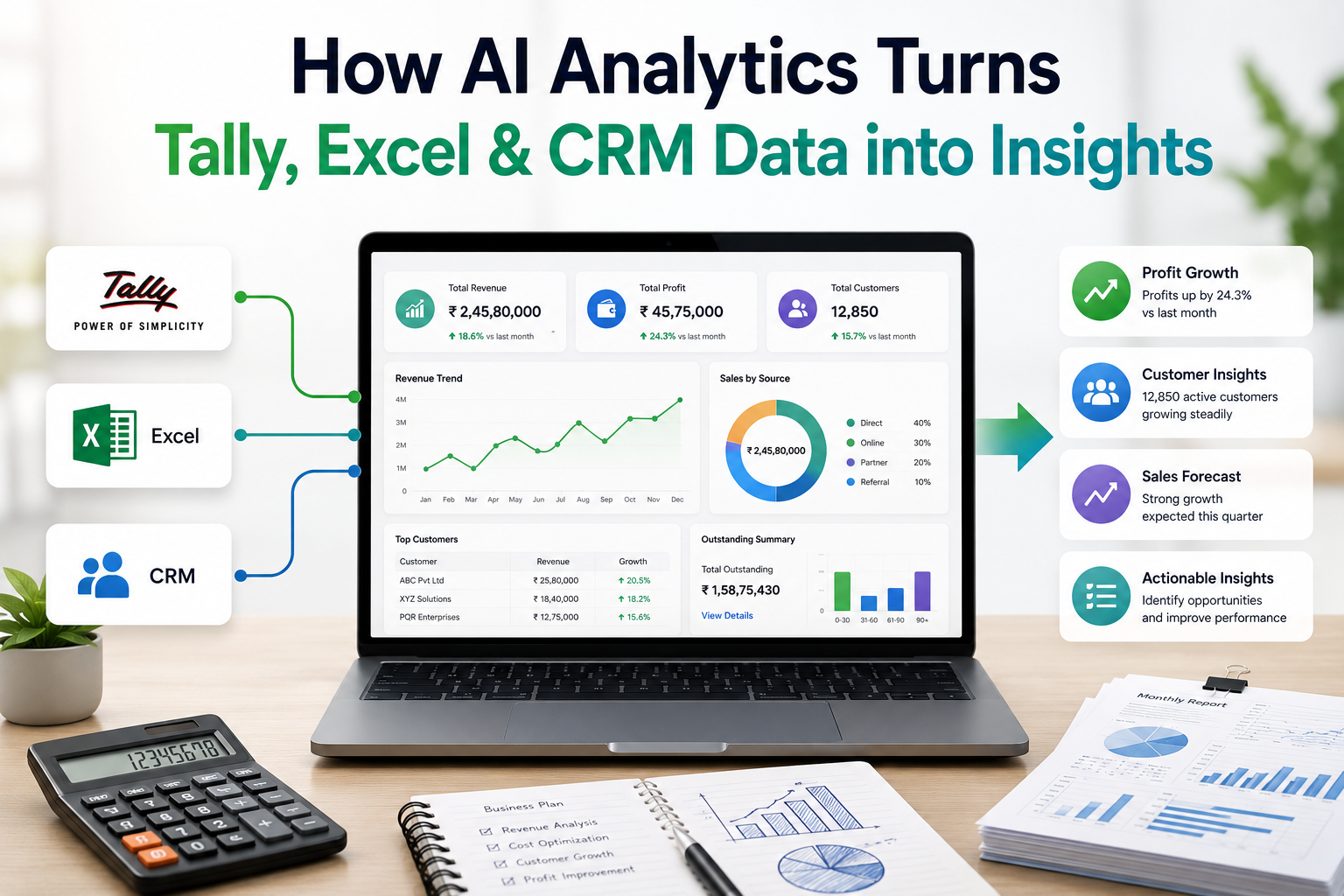
Last year, a friend who runs a mid-sized distribution business told me something that stuck with me. He said, “I have data coming from everywhere, but I still can’t answer a basic question like ‘ Are we actually making money on this product line?”
He had Tally for accounts. Zoho CRM for his sales team. Four or five Excel files that different team members maintained. And yet genuine business questions went unanswered for weeks, sometimes months, until someone had the bandwidth to pull everything together manually.
That’s not an unusual story. That’s Tuesday for most growing businesses in India.
We’ve Been Treating Symptoms, Not the Problem
For years, the answer to “we need better reporting” was to hire an analyst, build more Excel templates, or buy a fancier CRM. And those things help, to a point. But none of them fix the root issue, which is that Tally, Excel, and your CRM were each built to do their own job, not to talk to each other.
So you end up with what I’d call the copy-paste economy. Someone exports from Tally. Copies it into a master sheet. Pulls the CRM pipeline report. Adjusts for the deals that closed after the export. Reconciles with the ops tracker. By the time it’s done, the data is already three days old, and the person who built it is too exhausted to actually analyze it.
This isn’t a people problem. Everyone involved is working hard. It’s a systems problem, and it’s quietly one of the most expensive inefficiencies a growing business carries.
What AI Analytics Brings to the Table
Forget the buzzword version for a second. In plain terms, AI analytics tools do a few things that manual reporting genuinely cannot:
- They connect directly to your existing data sources Tally, Excel files, Zoho or HubSpot without asking you to rebuild everything from scratch
- They refresh automatically, so the dashboard you’re looking at reflects yesterday, not last month
- They spot patterns you weren’t specifically looking for, like a product whose margins started compressing six weeks ago, or a customer segment with a quietly worsening payment cycle
- They let you ask questions in plain language and get a usable answer back, no formula-writing required
- They flag anomalies duplicate entries, unusual invoice amounts, sales numbers that fall outside expected ranges before those things become real problems
None of this is science fiction. These tools exist, they work with Indian accounting and CRM systems, and implementation doesn’t require a dedicated IT team or a data warehouse migration.
How It Actually Works Across Your Three Core Systems
Tally: From Compliance Tool to Business Intelligence
Most businesses use Tally to stay compliant with GST filings, closing entries, reports for the CA. Totally valid. But there’s so much more sitting in those ledgers. Five years of vendor payment history. Seasonal expense patterns. The exact months where cash flow tightens and why. When AI analytics connects to that data, finance stops just reporting the past and starts informing what happens next.
One practical example: AI can track your debtor aging trends over rolling quarters and flag when collection cycles for specific customer types are getting longer. Your accounts team probably suspects this is happening. Now they can prove it and act on it.
Excel: Keep the Files, Lose the Manual Dependency
Nobody is getting rid of Excel. And honestly, why would you? Those files carry institutional knowledge formulas built over years, structures the operations team understands intuitively. The problem isn’t Excel itself. The problem is when Excel becomes the final word on business performance instead of one input among many.
AI analytics tools can ingest those sheets, clean up inconsistencies across versions, and plug them into a live reporting layer. The file stays exactly as it is. The difference is it’s no longer sitting on a shared drive waiting for someone to remember to update it.
CRM Data: Finally Being Used Predictively
Sales teams put a lot into their CRM call logs, deal stages, client notes, follow-up schedules. And then most of that data gets used for exactly one thing: checking whether deals are moving. That’s such a small fraction of what’s possible.
Run that CRM data through AI analytics alongside your actual revenue and margin numbers from Tally, and patterns emerge fast. Which lead sources produce customers who actually pay on time. Which deal sizes tend to stall at proposal stage. Which customer profiles churn within 12 months regardless of how the onboarding went. That kind of visibility changes how sales strategy gets built and how resources get allocated.
The Shift Feels Small at First
When businesses first connect their systems through an AI analytics layer, the initial reaction is usually pretty understated. “Oh, that’s the number I was trying to find last week.” Or, “I didn’t realize that the vendor was causing so many delays.”
It takes a few weeks before the bigger shift becomes visible, which is that leadership stops spending meeting time arguing about whose version of the numbers is correct and starts actually using the time to make calls. That’s the change that compounds. Decisions get made on fresher information. Problems surface earlier. The reactive firefighting that eats up so much management energy starts to ease, not because the problems disappear, but because you see them coming with enough lead time to do something about it.
So Where Does a Business Actually Begin?
Don’t start with a technology evaluation. Start with a question.
Pick the one thing your leadership team genuinely doesn’t know but wishes they did every single week. It could be true product-level profitability after accounting for logistics and returns, which sales reps are closing deals that actually stick rather than churn within 90 days, or why cash flow gets tighter in Q3 even when revenue is rising.
Take that question to any AI analytics vendor worth talking to. Ask them to show you, specifically, using your data or a close simulation of it, how their platform would answer it. If they can’t do that in a demo, they’re not the right fit.
The data your business has been generating across Tally, Excel, and your CRM is genuinely valuable. Most businesses are just one good system away from being able to use it properly.