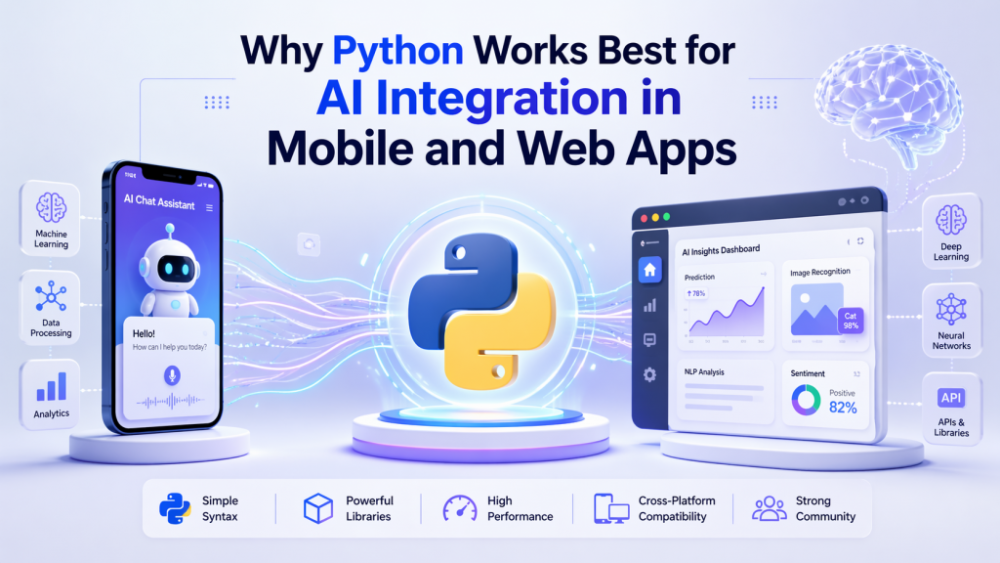
I have been writing software for over a decade, and if there is one thing I have learned from working across different tech stacks and project types, it is that language choice can make or break an AI project. I have watched teams spend months fighting the wrong tool. I have also watched other teams ship production AI features in weeks because they made one smart early decision. They picked Python.
I am not saying Python is perfect for every use case. But for Python specifically for AI integration in mobile and web applications, it offers a combination of advantages I genuinely have not seen replicated anywhere else. The numbers back this up, too. According to the 2025 Stack Overflow Developer Survey, Python saw a 7-percentage-point jump in adoption from 2024 to 2025, directly tied to its dominance in AI, data science, and backend development. Here is what I mean.
What Makes Python The Ideal Framework for AI-Driven Web and Mobile Apps
1. Rich AI and Machine Learning Ecosystem
When working with TensorFlow for the first time on a Django-driven web app, what immediately struck me was how much had already been done. There was no need to design the network architecture myself. No need to think up any matrix manipulation techniques. Everything was there, fully documented and well-maintained.
That has been the case in several projects where, depending on whether I’m embedding a sentiment classifier into a mobile backend system, setting up a computer vision layer for a website that requires heavy graphics processing, or playing around with a recommender engine, all my needs are satisfied with Python packages. TensorFlow, PyTorch, scikit-learn, Keras. They are not mere examples. They’re used by real-world engineers.
For anyone building AI features into a product for the first time, this breadth of available tooling removes a huge amount of early risk. You are rarely starting from zero.
Also Read: 12 Powerful Python Application Examples for Real-World Use
2. Easy Integration with Backend Systems
One of the less-discussed advantages of Python is how well it integrates with existing backend infrastructure. Early in my career, I worked on a project where the AI model lived in one service and the web backend in another, in a different language and on a different team, with constant friction at the API boundary.
When I shifted to building those systems entirely in Python, that friction mostly disappeared. Flask and Django make it straightforward to expose AI models as REST endpoints. Database connections to PostgreSQL, MySQL, and MongoDB are all handled cleanly. The AI logic, business rules, and data layer can live in a coherent codebase rather than a patchwork of incompatible services.
For mobile apps, especially, this matters. The mobile frontend just calls an API. It does not care what is behind it. But the people maintaining the backend care very much that the AI inference layer and the application logic speak the same language. Python makes that the default, not the exception.
3. Faster Development and Prototyping
I have prototyped AI features in Python in an afternoon that would have taken me three days in Java. That is not an exaggeration. It is just what clean syntax and a rich standard library do to development speed.
This is probably most visible in the early stages of a project. When a stakeholder wants to see whether a recommendation algorithm improves engagement before committing to a full build, I can quickly deliver something that works and is testable. That speed of iteration changes the conversation from whether this is technically possible to refining based on what we are actually seeing.
When you look at real Python app examples across different industries, you will notice how many of them started as rapid prototypes that proved the concept before full investment was committed. That pattern is not coincidental. It is Python doing what it does best.
4. Strong Support for Data Processing
Before any AI model gives you useful output, someone has to do the unglamorous work of cleaning, structuring, and transforming raw data. I have spent more hours than I would like on data preprocessing pipelines. Python has made that process significantly less painful over the years.
Pandas help with all the tabulation that needs to be done regularly. NumPy handles most numeric operations. When projects grow too large for in-memory computation, PySpark helps apply the same way of thinking to distributed environments without rethinking the entire data-processing algorithm from scratch.
For web and mobile apps processing user-generated data in real time, think behavioral events, transaction streams, and content interactions, having a reliable data tooling that does not require dropping into a lower-level language is a real practical advantage. It keeps the team focused on product problems rather than infrastructure problems.
5. Scalability for AI Applications
I used to hear the Python is slow argument frequently. I hear it less now, partly because it has been consistently disproved in production, and partly because I think developers have gotten better at understanding what scalability actually requires.
The inference layer of an AI application can be containerized and orchestrated just like any other service. Python works fine with Docker and Kubernetes. Uvicorn and Gunicorn handle real concurrent load in production. And for the compute-heavy parts, model inference, matrix operations, Python connects to optimized C extensions and CUDA-based GPU runtimes that do the heavy lifting where it matters.
I have seen Python-backed AI features handle millions of requests per day without drama. The architecture matters more than the language choice at that scale. And Python’s deployment story is mature enough that you are not fighting the runtime to get there.
6. Active Community and Continuous Innovation
Something I genuinely appreciate about working in Python is that I am rarely the first person to encounter a problem. The community is enormous and active, and it skews heavily toward AI and data work. When a new model architecture gets published in a research paper, a Python library implementing it tends to appear within weeks.
That matters in a field moving as fast as AI. I have worked in ecosystems where you would wait months for official language support for a new framework. In Python, the turnaround from interesting research to something I can actually use in a project is short enough that it changes how I approach technology evaluation.
The community also produces quality documentation and worked examples at a pace I have not seen matched elsewhere. When I am integrating something new, a vector database, an embedding model, or a new inference runtime, someone has usually already written a clear implementation guide.
7. Cross-Platform Compatibility
Most of the products I work on today have multiple surfaces: a mobile app, a web dashboard, maybe a third-party integration. One of the things that used to slow teams down was maintaining consistent AI behavior across those different clients.
This is easily done in Python by ensuring all the intelligence is in a single backend module. All iOS and Android applications, as well as the website, can use the same Python API. They will all get the same predictions, classifications, and recommendations. Whenever I make changes, those changes will be instantly reflected everywhere.
For teams maintaining multiple product surfaces simultaneously, this is more than a convenience. It is a genuine reduction in coordination overhead and a meaningful improvement in the speed at which AI improvements reach users.
My Honest Take
With many years of experience in programming languages and a few years in AI, whenever the task involves machine learning, natural language processing, or predictions in a mobile or web-based application, my go-to programming language is still Python.
That is not blind loyalty. I have used other stacks for other things. But for this specific combination of requirements, powerful AI tooling, clean backend integration, fast iteration, solid data processing, and real-world scalability, Python consistently delivers. I don’t expect that to change anytime soon.
If you are in the planning stages of an AI-integrated product and have not yet locked in a language, I strongly encourage you to spend time with Python before committing to another language. The ecosystem alone will save you weeks.