Introduction
A draught coming through, a gap that won’t stay filled, a pipe rattling because there’s nothing holding it in place. You grab the can, spray it in, and that’s that. Job done.
But Soudal expanding foam is actually a lot more useful than most people give it credit for. We sell a lot of it here at Dortech Direct, and the customers who get the most out of it are the ones who know when and where to use it properly — not just as a last resort. Whether you’re fitting windows, insulating a loft, or trying to meet fire regs on a commercial job, there’s likely a Soudal foam that was made for exactly that situation. This article walks you through the five main ones.
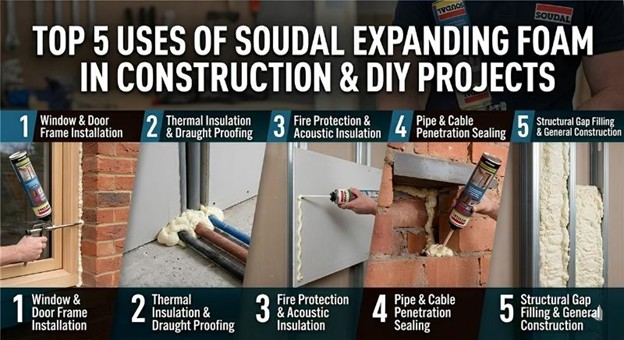
1. Window & Door Frame Installation
This is probably the most common professional use, and if you fit windows or doors for a living, you already know the problem. Once the frame is in, there’s nearly always an awkward gap between it and the surrounding brickwork or timber. It’s rarely a clean, even gap either — it’s usually lumpy and uneven, and mortar or silicone just can’t fill it properly on their own.
That’s where expanding foam earns its place. Soudal foam sticks to almost everything — brick, block, timber, uPVC, aluminium — and expands to fill whatever shape the gap happens to be. Once it’s cured, you get a solid bond that keeps out draughts, damp, and cold. It’s not glamorous, but it makes a real difference to the finished installation.
If you’re doing this regularly, it’s worth switching to a gun-grade foam rather than the handheld straw cans. You get much better control over how much comes out, which means less mess and less risk of the frame getting pushed out of position by overexpansion.
2. Thermal Insulation & Draught Proofing
A lot of heat escapes through gaps you can’t see. Around loft hatches, behind skirting boards, through holes where pipes come through external walls — these small spots add up, especially in older houses. Soudal expanding foam has an insulation value of 36mW/mK, which makes it genuinely useful here, not just as a filler but as an actual thermal barrier.
For DIYers, the easy wins are things like draughty skirting boards, gaps around floorboards, and the edges around the loft hatch. A single handheld can is usually enough to sort these, and the difference you feel in a room can be pretty noticeable. For tradespeople doing retrofit work where full cavity or external wall insulation isn’t on the cards, targeted foam application in the right spots can genuinely improve a property’s heat retention without a major project.
The key is knowing where the heat is actually escaping. Focus on anywhere that has a through-hole to an unheated space or the outside world.
3. Fire Protection & Acoustic Insulation
This is where the Soudal range really steps up compared to a standard handheld can. The B1 and B2 Fire & Acoustic variants are properly tested and certified to EN1366-4 standards — up to 4 hours fire resistance for B1, up to 2 hours for B2, depending on how it’s used. That’s not just a marketing claim; it’s what you need on a commercial job where Building Control will want to see compliance.
The way it works in a fire is that the foam chars and swells when exposed to heat, blocking the gap rather than letting flames or smoke pass through. That’s the whole point of passive fire protection — keeping fire contained to one area so people have time to get out safely. If you’re doing any work through fire-rated walls or floors, this is the product you need, not a standard foam from a builder’s merchant.
On the acoustic side, the 58 dB rating is worth paying attention to if you’re dealing with noisy plumbing, party walls, or inter-floor sound. Filling the void around a soil pipe or sealing a party wall penetration with this foam makes a real difference to the noise that gets through.
4. Pipe & Cable Penetration Sealing
Any time a pipe, cable, or conduit goes through a wall, floor, or roof, there’s a gap around it. Usually not a huge one, but enough to let in cold air, damp, and the occasional mouse. On fire-rated constructions, that gap is also a potential route for fire and smoke to spread — which is a serious problem if it hasn’t been dealt with properly.
For plumbers and electricians, foam is a quick and tidy way to seal service entries. It bonds directly to the pipe and the surrounding wall without needing a primer, and it fills the gap completely even when the hole isn’t a neat circle. For fire-rated walls and floors, you’ll want to use the Soudal B2 Fire & Acoustic Expanding Foam (Gun Grade) specifically — it’s tested for exactly this kind of penetration seal and gives you the compliance you need on commercial jobs. Far better than stuffing it with off-cuts or leaving it open.
One thing to bear in mind: if you’re sealing around anything flexible or live, go easy. Too much foam pressing on cable insulation or a flexible joint isn’t ideal. And if the foam is going to be exposed to sunlight once cured, paint or seal over it — UV will break it down over time if it’s left uncovered.
5. Structural Gap Filling & General Construction
Once you’ve used expanding foam on a few jobs, you start spotting situations where it’s just the right tool. Internal door linings that need steadying while fixings go in. Voids behind plasterboard that you want to fill before boarding up. Battens in masonry where a conventional fixing isn’t practical. It sticks to almost everything without primer — brick, block, concrete, timber, metal, most plastics — and once it’s trimmed, flush and plastered or painted over, you’d never know it was there.
For roofing work, it’s handy around flashings, under ridge tiles, and around roof lights where gaps can be awkward to fill neatly with any other product. Just make sure whatever you’re using is rated for exterior use, and once the foam has cured and been trimmed, cover it up — leaving it exposed doesn’t look great and it won’t last as long.
Basically, if you’ve got a gap, a void, or something that needs holding in place while something else cures — Soudal foam is worth reaching for before you start looking for a more complicated solution.
Final Thoughts
Right product, right place — that’s really all there is to it. A standard can covers most basic jobs, but for windows, fire regs, heat loss, or pipe sealing, there’s a Soudal foam made for it. Not sure which one? Give the Dortech Direct team a shout and we’ll sort you out.
Frequently Asked Questions
Q. Can it be used outside?
Yes, but paint or seal over it once cured. Sunlight breaks it down if left exposed.
Q. How long does it take to cure?
Touch-dry in 10–20 minutes, fully cured in about an hour. Mist the surface with water first if conditions are dry — it speeds things up.
Q. What’s the difference between B1 and B2?
Both are fire-rated. B1 is the higher spec (up to 4 hours resistance), B2 gives up to 2 hours. Check your project spec or ask Building Control if you’re unsure which you need.
Q. Can it be sanded or painted?
Yes. Trim it back once cured, sand smooth, and it takes emulsion, gloss, or masonry paint without any issue.