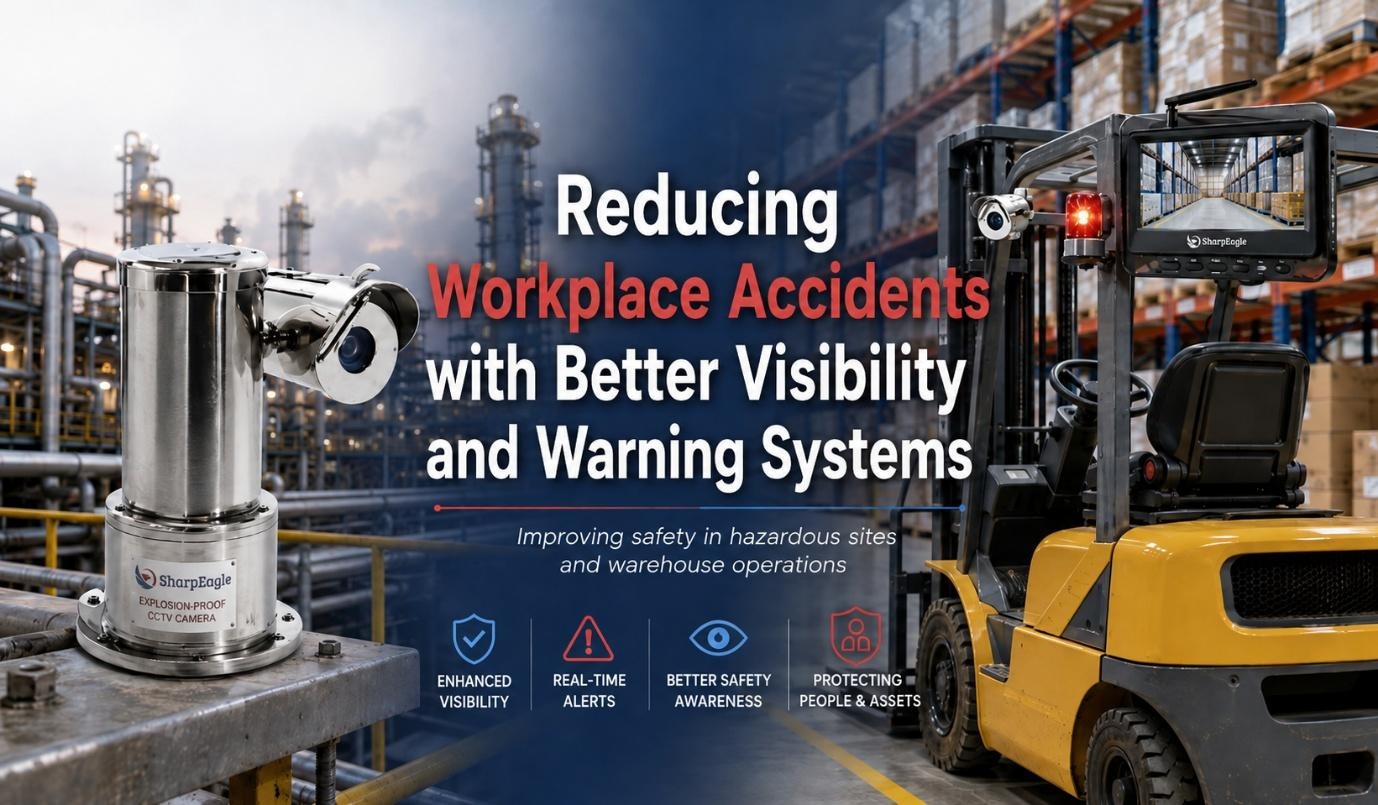
Introduction
Workplace accidents rarely happen because of one single mistake. In most industrial environments, they are the result of poor visibility, blind spots, unclear communication, moving vehicles, hazardous zones, or delayed awareness of risk. Whether it is a forklift reversing in a warehouse, a worker entering a restricted zone, or a maintenance team operating near a hazardous process area, visibility plays a major role in preventing incidents before they happen.
For industries such as oil and gas, manufacturing, logistics, warehousing, ports, chemical processing, and construction, safety cannot depend only on rules and training. Employees need the right visual aids, monitoring tools, warning systems, and safety technologies to make better decisions in real time.
This is where better visibility and warning systems become essential. They help workers see risks earlier, help operators control equipment more safely, and help HSE teams monitor high-risk areas more effectively.
Why Visibility Is a Core Part of Workplace Safety
Many workplace accidents happen in areas where people and machinery operate close to each other. Forklifts, cranes, trucks, loaders, and other moving equipment can create serious risks if operators have limited visibility. Similarly, hazardous industrial areas such as fuel storage zones, chemical plants, refineries, and offshore facilities require constant monitoring because risks may not always be visible from a safe distance.
Poor visibility can lead to:
- Vehicle and pedestrian collisions
- Forklift reversing accidents
- Blind spot incidents
- Unsafe entry into restricted areas
- Delayed response to leaks, spills, or abnormal activity
- Poor supervision of hazardous zones
- Miscommunication between operators and ground staff
- Increased risk during night shifts or low-light operations
Improving visibility is not just about seeing more. It is about giving workers the right information at the right time so they can avoid danger.
The Role of Warning Systems in Accident Prevention
Warning systems act as visual and audible reminders that danger is nearby. In busy industrial environments, workers may become familiar with hazards and gradually stop noticing them. Warning lights, safety alarms, zone indicators, and camera-based systems help reinforce awareness.
For example, a forklift blue spot light alerts pedestrians that a forklift is approaching. A red danger light creates a visible boundary around the vehicle. A camera system helps operators see blind spots around loads, racks, and narrow aisles. These systems do not replace safe working practices, but they make those practices easier to follow.
In hazardous industrial areas, explosion proof cameras and monitoring systems help teams supervise operations without sending personnel into risky locations unnecessarily. This is especially useful in oil and gas sites, chemical plants, LNG terminals, offshore platforms, and fuel storage areas where flammable gases or vapours may be present.
Forklift Safety: A Major Area for Visibility Improvement
Forklifts are essential in warehouses, factories, ports, and logistics centres, but they are also one of the most common sources of workplace accidents. Operators often deal with narrow aisles, tall racking, heavy loads, reversing movements, pedestrians, and time pressure.
The biggest forklift safety challenges include:
- Limited rear visibility
- Blind spots around loads
- Pedestrians walking close to moving forklifts
- Poor visibility at intersections
- Accidents during reversing
- Lack of clear warning zones
- Difficulty judging load position
- Operator fatigue or distraction
Forklift safety systems can reduce these risks by improving the operator’s field of view and warning nearby workers. Camera systems, AI pedestrian detection, anti-collision systems, blue spot lights, red zone lights, arc safety lights, and blind spot detection systems all work together to create a safer operating environment.
SharpEagle, for example, provides forklift safety systems designed to improve visibility, alert pedestrians, and reduce the risk of collisions in busy industrial workplaces. These solutions are especially useful for warehouses, ports, logistics hubs, manufacturing plants, and loading areas where forklifts and people work in close proximity.
Explosion Proof Cameras for Hazardous Areas
In hazardous environments, ordinary CCTV cameras may not be suitable. Areas that contain flammable gases, vapours, dust, or explosive atmospheres require specially designed equipment. Explosion proof cameras are built to operate safely in these conditions while providing reliable monitoring.
These cameras are commonly used in:
- Oil and gas facilities
- Refineries
- Chemical processing plants
- LNG terminals
- Offshore platforms
- Fuel storage areas
- Paint booths
- Power plants
- Marine and port environments
- Hazardous manufacturing zones
Explosion proof cameras help teams monitor critical activities from a safe location. They can support live surveillance, incident investigation, process monitoring, perimeter security, and emergency response. PTZ models can pan, tilt, and zoom across wide areas, making them useful for tank farms, loading bays, process units, and restricted zones.
As an industrial safety technology provider, SharpEagle also offers explosion proof camera solutions for hazardous environments where safety, durability, and certified monitoring are essential. By combining hazardous-area visibility with forklift safety solutions, SharpEagle supports both process safety and material handling safety across industrial sites.
How Better Visibility Reduces Human Error
Human error is often mentioned after an accident, but in many cases, workers were operating with limited information. A forklift operator may not see a pedestrian behind a load. A control room operator may not have a clear view of a remote process area. A maintenance worker may not notice a vehicle approaching from a blind corner.
Better visibility systems help reduce these risks by making hazards easier to detect. They support human decision-making rather than depending only on memory, assumptions, or verbal communication.
Camera systems show what the operator cannot see directly. Warning lights make vehicle movement more noticeable. Anti-collision systems alert operators before contact occurs. Explosion proof cameras allow remote monitoring of areas where direct inspection may be dangerous.
When these systems are integrated into daily operations, they create a stronger safety culture because workers are constantly supported by visual cues and real-time awareness.
Where Facilities Should Install Visibility and Warning Systems
Every site is different, but some areas usually need closer attention. Facility managers and HSE teams should review accident history, traffic flow, blind spots, hazardous zones, and worker movement patterns before selecting safety equipment.
Important locations include:
- Forklift operating zones
- Warehouse aisles and intersections
- Loading and unloading bays
- Pedestrian crossing points
- Blind corners
- Restricted access areas
- Hazardous chemical storage areas
- Fuel transfer zones
- Tank farms and process units
- Outdoor yards and vehicle routes
- Low-light or night-shift areas
- Areas with frequent near misses
The goal is not to install technology everywhere. The goal is to identify where visibility gaps create the highest risk and then apply the right solution.
Building a Safer Workplace Through Technology
Safety technology is most effective when it is part of a complete safety strategy. Training, signage, PPE, risk assessment, traffic management, supervision, and maintenance all remain important. However, visibility and warning systems add another layer of protection by giving workers real-time support.
A warehouse may use forklift camera systems, blue spot lights, and red zone lights to protect pedestrians. An oil and gas site may use explosion proof cameras to monitor hazardous areas. A manufacturing plant may use anti-collision systems and visual warning lights to reduce vehicle-related incidents. A port may combine forklift safety lights, blind spot detection, and rugged monitoring systems to manage heavy equipment movement.
The strongest safety outcomes come when companies connect technology with behaviour. Workers should understand what each warning light means, how to respond to alerts, and why monitoring systems are installed.
Conclusion
Reducing workplace accidents starts with improving what people can see, understand, and respond to. In industrial environments, visibility and warning systems are not optional extras. They are practical tools that help prevent collisions, monitor hazardous areas, reduce blind spots, and support faster decision-making.
From forklift safety systems in warehouses to explosion proof cameras in oil and gas facilities, the right technology can make high-risk workplaces safer and more controlled. Companies like SharpEagle play an important role by providing both hazardous-area monitoring solutions and forklift safety systems for industries where visibility, awareness, and prevention matter every day.
A safer workplace is not built by reacting after accidents. It is built by identifying risks early, improving visibility, warning people before danger occurs, and giving teams the tools they need to work with confidence.