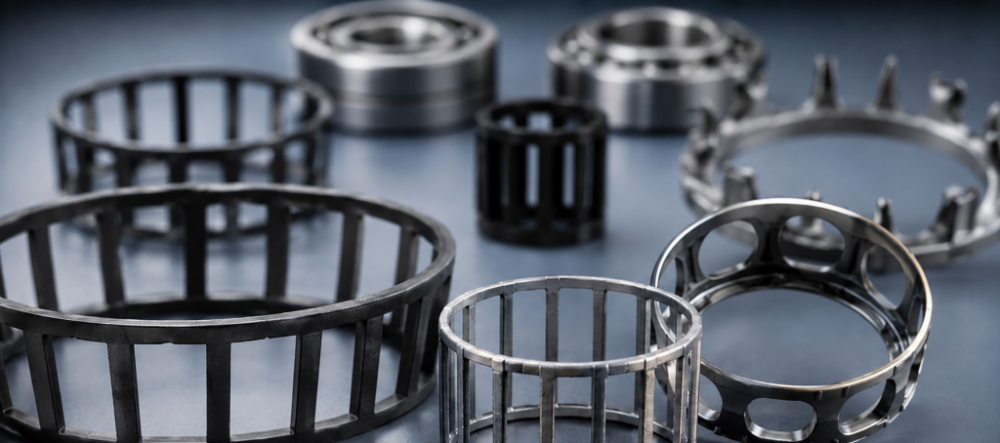
Modern machines demand increased speeds, heavier loads, energy efficiency and extended service life. Demands like these places greater emphasis on achieving highly engineered bearing solutions. Within these specifications, the Tapered Roller Bearings plays a special role as it is designed to simultaneously carry radial and axial loads with minimal rotation of the moving elements.
Precision bearing engineering is more than reducing dimensions to a finer scale; it is the controlled combination of the geometric tolerances, the quality and finish of mating surfaces, the material composition, assembly parameters and production consistency, each contributing to predictable performance.
Why Precision Engineering is Critical
Every tapered roller bearing consists of two sets of mating surfaces: the inner and outer raceway, tapered rollers, and a cage that maintains the position of the rollers relative to each other. The tapered shape of the rollers results in an intersection of their theoretical extensions at a single point on the bearing axis. This geometry enables a rolling motion with minimal sliding friction and simultaneously accommodates radial and axial loads.
However, this beneficial configuration depends on the precision with which each individual element is manufactured and assembled. If the theoretical line of contact between roller and raceway cannot be maintained due to geometric inconsistencies, the load cannot be distributed uniformly along the roller length, adversely affecting the bearing performance and potentially shortening its service life.
The same principle applies to the clearance and the resultant preload in the tapered roller bearing. Too much clearance may induce undesirable movement, while too little may cause excess friction.
Innovations in Roller and Raceway Profile Design
One of the current areas of development in tapered roller bearings relates to the modification of the roller and raceway profiles. A cylindrical roller is not always optimal since it produces maximum surface stresses when operated with shaft and housing distortions or when subjected to heavy off-center loading conditions
Engineers have adapted crowning and logarithmic profile solutions to ensure the most favorable stress patterns along the length of the roller, even under misalignment conditions.
Improved roller geometry has also helped to reduce friction, particularly in applications found in car and truck transmissions, industrial gearboxes and wheel end assemblies. Any reduction of friction has a direct effect on minimizing power losses, reducing heat build-up and conserving energy.
Advances in Manufacturing and Finishing Processes
High-speed grinding, superfinishing, automated and computer-assisted inspection methods as well as modern heat treatment techniques contribute to dimensional accuracy and surface integrity of the tapered roller bearings.
Grinding sets the dimensional tolerances, and superfinishing provides a minimum surface roughness on the rolling path of both the rollers and the raceways. An optimized surface reduces friction losses and stress raisers.
Surface quality standards are more than aesthetic; waviness, roundness and finish variations must conform to acceptable geometrical tolerances and surface roughness specifications. Modern production facilities employ coordinate measuring devices, optical inspection equipment, automated bore gauging and statistical process control to detect and correct undesirable surface irregularities.
Material Development and Heat Treatment Innovations
Material selection for tapered roller bearings must accommodate surface stresses, subsurface stresses due to rolling contact, impact loading and thermal stresses resulting from exposure to extremes of temperature.
The process of heat treatment is a key element in obtaining the desired properties in a bearing steel. If the process parameters are improperly specified or if the equipment is improperly calibrated, microstructural and mechanical property variations can occur.
Manufacturers continue to research and develop improved steel technologies with reduced inclusions and better clean room processing methods during manufacturing. Because fatigue failures often originate at microscopic weakness such as a void within the steel matrix, improvements in material strength and cleanliness help to increase the service life of the tapered roller bearing without altering its basic geometry.
Engineering Challenges and Considerations
Several key areas deserve close attention in precision tapered roller bearings engineering:
- Precise roller and raceway geometries to promote even load distribution.
- Control of material hardness, heat treatment and the resultant microstructural composition.
- Consistency of clearances, surface roughness and dimensional tolerances.
- Accuracy of inspection and testing procedures.
Each of these has an interdependent effect on the performance of the bearing. A modification in one area can have beneficial or detrimental side effects in other areas. The overall effect of precision tapered roller bearing design and production must be examined as a complete system and cannot be viewed as separate manufacturing elements that serve individual operating conditions during actual use.
Digital Simulation and Predictive Engineering
As computer hardware and predictive software reach new levels of accuracy and sophistication, their contribution to tapered roller bearing design and performance assessment will grow exponentially. Finite element modeling software and special bearing calculation packages can help to analyze contact stresses, heat dissipation, lubrication quality and load distributions under a wide range of operating conditions.
The resulting predictive capabilities allow manufacturers to analyze the performance of a tapered roller bearing within the constraints and variables of an actual machine installation. Misalignment conditions, shaft and housing flexibility, load distributions and thermal expansion differences can all be incorporated into a mathematical model that simulates the operating environment in which the tapered roller bearing will actually perform.
Similar computer modeling techniques will allow condition monitoring and predictive maintenance, based on data collection and evaluation techniques. By applying digital modeling solutions to operating conditions, data acquisition and subsequent predictive analytics, bearing performance is converted from a set of statistical probabilities to a scientifically verifiable outcome.
Lubrication and Friction Considerations
Although lubrication has limited influence over the overall geometry and precision manufacturing considerations, lubrication quality and compatibility with precision bearings affects load carrying capacity, friction torques, heat generation, boundary lubrication film thickness and wear rates
Precision tapered roller bearing design and production incorporate optimized surface roughness, roller and raceway geometries, cage configurations, internal clearances and related parameters that maximize the performance characteristics of a specified lubricant. Failure to maintain tight tolerances and specifications in any of these areas reduces the efficiency of the lubrication system and increases friction and wear in the tapered roller bearing.
Future tapered roller bearings will take on operating conditions rather than standard lubricant assumptions. Speeds, loads, temperatures and housing geometry will be incorporated into a new lubrication paradigm rather than applying an arbitrary all-purpose lubricant.
Driving Forces Behind Next-Generation Bearings
Automotive and industrial equipment will continue to be the impetuous behind the evolution of the tapered roller bearings. From wheel hubs, differentials and automotive transmissions to construction equipment, wind turbines and industrial machinery, these applications continue to demand higher performance.
Electrification of automotive drivelines introduces opportunities and challenges: electrical motors drive at higher speeds and generate different vibration patterns than their combustion counterparts require modified friction characteristics from tapered roller bearings. Improved performance in terms of reduced friction and wear now extends to industrial machinery and electric motor driven applications as well.
Smart machines are placing new requirements on predictive maintenance practices. Sensors and monitoring devices offer the opportunity to shift from routine maintenance to need-based maintenance for some applications. Bearings can be included in a predictive maintenance network based on monitored vibrations and temperatures to identify developing issues.
The Challenge of Consistency
No amount of theoretical engineering can substitute for manufacturing accuracy. It is critical that production processes repeat the desired outcome, bearing after bearing, to produce an item that lives up to the theoretical performance projections.
This is why companies like DEC Bearings represent an industry segment in which dimensional tolerances, material specification, inspection and process control directly affect the performance characteristics of the finished tapered roller bearing.
Outlook for the Future of Precision Bearings
Future engineering challenges in the bearing industry will address simultaneous improvements in material science, surface engineering, geometry, inspection and computer-simulated stress modelling.
Artificial intelligence and machine learning may aid the identification and correction of manufacturing errors and process variations.
The principles of sustainability, increased machine service life, reduced energy consumption and reduced material usage will also factor into the overall precision tapered roller bearing equation as the industry seeks to balance economic and technical imperatives.
Conclusion
The future of tapered roller bearings will not be defined by a single, historic innovation but rather the simultaneous contribution of numerous small improvements. Dimensional accuracy, surface optimization, material consistency, friction and wear reduction, predictive computer modeling and enhanced process control will all combine to provide better solutions in more applications. Precision engineering ties each of these together into a cohesive whole that helps the tapered roller bearing technology to meet increasing demands.
As machines and mechanical systems continue to evolve at a breathtaking pace, demand will also grow for enhanced performance from rolling bearing technology. The ability to simultaneously carry radial and axial loads at the higher speeds and increased demands of modern equipment will place increasing demands on tapered roller bearings. Meeting these demands now and in the future requires a controlled and consistent approach to every element of bearing technology.