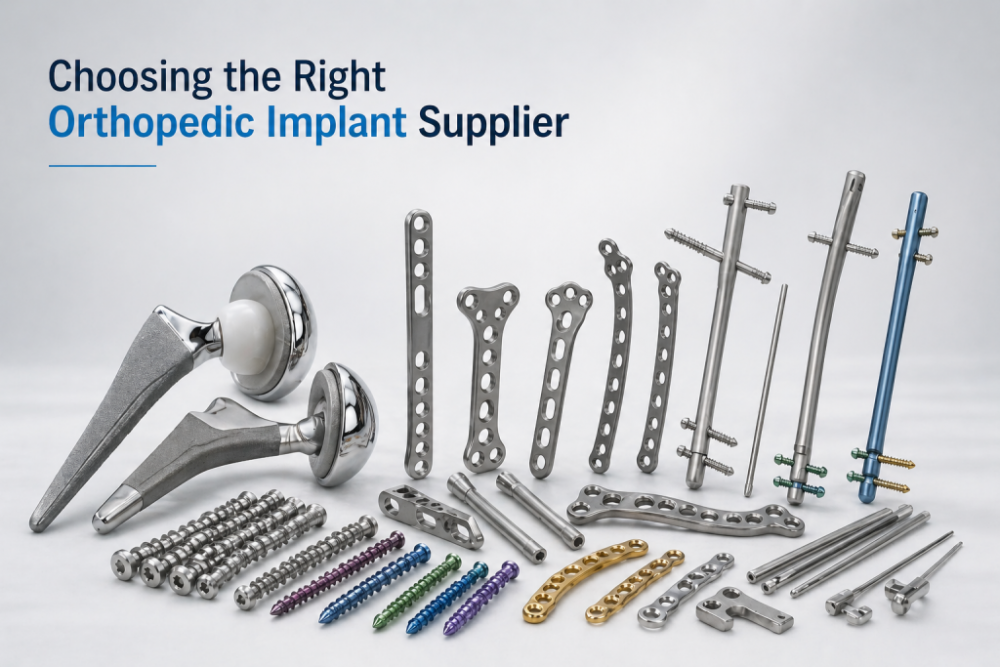
If you run a hospital, orthopedic clinic, or procurement department anywhere in Nigeria from Lagos Island to Enugu to Abuja you already know the pressure that comes with sourcing implants. The patient is on your schedule. The surgeon is ready. And the last thing you need is to discover that the plates, screws, or joint prostheses you ordered are delayed at the port, failed quality checks, or worse showed up without proper sterilization documentation.
Choosing the right orthopedic implant supplier in Nigeria is not just a procurement decision. It is a clinical decision, a financial decision, and ultimately a patient safety decision. This guide breaks it all down in plain language so that you can make an informed choice and avoid the costly mistakes that too many Nigerian hospitals have learned the hard way.
Why the Nigerian Orthopedic Implant Market Demands Careful Supplier Selection
Nigeria’s orthopedic device market is growing fast. Industry data projects it will expand from around $55 million in 2024 to nearly $90 million by 2029 a growth rate of over 10% annually. That growth is driven by real demand: road traffic accidents, sports injuries, osteoarthritis in an aging population, and the rising number of Nigerians who can now afford surgical intervention rather than traditional bone setting.
But fast market growth also attracts unreliable suppliers. As demand increases, so does the number of vendors offering implants at suspiciously low prices, often without traceable manufacturing credentials. A study published in a Nigerian tertiary hospital found that infected implants were the single most common reason for implant removal accounting for over 22% of all removal cases. Poor-quality devices and compromised sterility were significant contributing factors.
The stakes are high. Let’s talk about how to get this right.
1. Verify Regulatory Compliance Before Anything Else — Orthopedic Implant Supplier Standards in Nigeria
The first question to ask any supplier is simple: are your products registered with NAFDAC?
The National Agency for Food and Drug Administration and Control (NAFDAC) is Nigeria’s regulatory authority for medical devices. Any orthopedic implant legally sold or used in Nigeria must be NAFDAC-registered. If a supplier cannot provide a valid NAFDAC registration number for their products, walk away regardless of price.
Beyond NAFDAC, look for internationally recognized quality certifications. These include:
CE Marking (European Conformity):
This indicates the product meets the safety and performance standards of the European Union. CE-marked implants have been through documented design testing, biocompatibility studies, and manufacturing quality audits.
ISO 13485 Certification:
This is the international quality management standard specifically for medical device manufacturers. A supplier with ISO 13485 certification has demonstrated that their production systems, documentation processes, and quality controls meet global benchmarks.
FDA 510(k) Clearance:
Some suppliers particularly those exporting from the United States or marketing to US-based partners will have FDA clearance. While this is not required for the Nigerian market, it is a strong additional signal of credibility.
When a supplier sends you documents, do not just file them. Verify them. Cross-check NAFDAC registration numbers on the official NAFDAC portal. Ask for the ISO certificate’s issuing body and expiry date. A legitimate supplier will have no problem providing these and will not hesitate when you request verification.
2. Assess Product Quality and Material Standards — Choosing the Best Orthopedic Implants for Nigerian Hospitals
Once you are satisfied with regulatory compliance, the next layer is material and product quality.
Orthopedic implants are not generic products. A bone plate used in a tibial fracture repair must withstand significant mechanical stress for months or years. A hip prosthesis must integrate reliably with living bone tissue. Material quality is everything.
The most widely used materials in orthopedic implants are:
Medical-grade titanium (Grade 4 or Grade 5 Ti-6Al-4V):
Preferred for its strength-to-weight ratio, excellent biocompatibility, and resistance to corrosion. Used widely in spinal implants, trauma plates, and joint replacements.
316L Stainless Steel:
More affordable than titanium and still widely used for trauma fixation devices such as intramedullary nails, plates, and screws. It is a strong choice when budget is a concern, provided it meets ASTM or ISO material standards.
Cobalt-Chrome Alloys:
Used primarily in load-bearing joint replacements like hip and knee prostheses.
Ask your supplier which material standards their products comply with. Look for references to ASTM F136 (for titanium alloys) or ASTM F138 (for surgical stainless steel). If a supplier cannot tell you what material grade their implants are made from, that is a serious red flag.
Also request product technical sheets and batch certificates. Reliable orthopedic implant manufacturers provide documentation for each batch that shows material composition, sterility testing results, and expiry information.
3. Evaluate the Supplier’s Track Record and Clinical References
A supplier can show you beautiful certificates and polished brochures. What truly matters is their performance in real hospitals over real time.
Ask for references specifically from Nigerian hospitals or other African healthcare institutions they have supplied. If a supplier has been working with teaching hospitals in Lagos, Ibadan, or Kano, ask to speak with the procurement officer or orthopedic surgeon at those facilities. A five-minute phone call can tell you more than a hundred pages of marketing material.
Look for:
Length of time in business.
Suppliers who have been operating for at least five to ten years have navigated the kinds of supply chain challenges that new entrants have not yet faced.
Complaint history.
Ask directly have there been any product recalls or documented implant failures? A credible supplier will acknowledge and explain past issues rather than pretend they do not exist.
African market experience.
Suppliers who have already navigated NAFDAC registration, Nigerian customs procedures, and local distribution logistics will cause you far fewer headaches than those entering the African market for the first time.
There is also a practical dimension to consider: implant sizing. Research has increasingly highlighted that implant designs developed primarily for Western patient populations do not always match the anatomical dimensions of African patients. A forward-thinking supplier will either offer sizing ranges validated for African bone morphology or be transparent about the limitations of their products in this regard.
4. Examine Supply Chain Reliability and Delivery Capacity — Orthopedic Implant Delivery to Nigeria
Even the best implant is useless if it does not arrive on time. Nigerian hospitals face real and recurring challenges around importation: port delays at Apapa or Tin Can Island in Lagos, customs documentation errors, cold chain failures, and inconsistent courier performance.
A dependable orthopedic implant supplier should be able to answer the following questions clearly:
- What is your standard lead time for orders shipped to Nigeria?
- Do you have a local distributor or agent in Nigeria? If so, where are they located and what stock do they hold?
- How do you handle urgent or emergency orders?
- What is your policy if items are held at customs or arrive damaged?
Suppliers with established Nigerian distribution partners are generally far more reliable than those shipping direct from overseas for every order. Local stock buffers mean your hospital can access commonly needed trauma implants, plates, screws, nails without waiting weeks for international freight.
Also clarify packaging and sterility. Implants should arrive in individually sealed, sterile packaging with clear expiry dates, batch numbers, and product codes. Any packaging that is damaged, unlabeled, or without a clear sterilization indicator should be rejected immediately.
5. Compare Pricing Transparently — Cost vs. Quality in Orthopedic Implant Procurement
Budget is real. Nigerian hospitals operate under significant financial pressure, and procurement officers are often asked to reduce costs. But in medical device procurement, the cheapest option is almost never the best value.
Consider the total cost of an implant failure: revision surgery, extended hospital stays, potential litigation, reputational damage, and most importantly patient harm. A low-quality implant that requires removal within months costs many times more than a properly certified one purchased at a slightly higher price.
That said, quality does not have to mean premium global brands only. Several manufacturers from India, China, and Europe supply ISO-certified, NAFDAC-compliant implants at price points that are workable for Nigerian hospital budgets. The key is to compare suppliers at the same quality tier not to sacrifice certification and material standards for a lower unit price.
When requesting quotations, ask for itemized pricing that separates:
- Unit cost per implant
- Instrumentation and surgical tool sets (often provided as a loan set by the supplier)
- Shipping and customs charges
- After-sales support and training costs
Some suppliers bundle instrumentation and training into their supply agreements, which can represent genuine value for hospitals building out their orthopedic program.
6. Insist on After-Sales Support and Surgeon Training
The relationship with your orthopedic implant supplier should not end when the box arrives. Reliable suppliers offer ongoing technical support, and the best ones actively invest in surgeon and theater staff education.
Specifically, look for suppliers who provide:
Implant-specific surgical training: This may take the form of hands-on workshops, cadaveric labs, or on-site support during initial cases. This is particularly valuable when introducing a new system or technique that your surgical team has not used before.
Technical representatives: Having a knowledgeable rep available whether local or reachable by phone for queries during surgery preparation or post-operative review is a marker of a serious supplier.
Product documentation in English: All surgical technique guides, sizing guides, and instrument manuals should be readily available in clear, usable English.
Research published in African Health Sciences noted that unavailability of implants and lack of training support were among the top barriers to advancing orthopedic surgical practice in Nigeria. A supplier who actively addresses both of these gaps is not just selling you a product they are investing in the long-term growth of orthopedic care at your facility.
7. Build a Long-Term Supplier Relationship, Not Just a Transaction
Nigeria’s orthopedic implant market is still maturing. The hospitals and clinics that will benefit most from this growth are those building structured, relationship-based procurement models not those buying ad hoc from whoever offers the lowest price this month.
A preferred supplier relationship gives you:
- Priority access to stock during supply shortages
- Better pricing as volume grows
- Faster response times for urgent needs
- A partner who understands your facility’s surgical mix and stocking needs
Formalize this with a supply agreement that outlines minimum service levels, complaint resolution timelines, and product quality guarantees. Reputable orthopedic implant manufacturers and suppliers will welcome this kind of structured partnership.
Final Thoughts
Choosing the right orthopedic implant supplier for your Nigerian hospital is a process that requires diligence, not just speed. Verify credentials. Check references. Test delivery reliability. Demand proper documentation. And never let price alone drive the decision.
Nigeria’s orthopedic sector is at an exciting inflection point. Hospitals that build strong supplier partnerships today grounded in quality, compliance, and clinical trust will be far better positioned to serve the growing number of patients who need effective, safe orthopedic care tomorrow.
If you are evaluating orthopedic implant suppliers for your facility, use the checklist in this guide as your starting point. Your patients deserve nothing less.