Businesses are working hard to provide their clients with excellent service. They are changing how they deliver service rapidly, and they are moving toward fast, personal response times to client inquiries. Many clients have been requesting faster response times and more personalized services from their providers.
Traditional CSM solutions have had difficulty meeting client demand as they receive so many requests, with some organizations receiving over 1,000 or more than 10,000 requests daily. Multi-agent AI systems have provided organizations with a solution to their high volume of requests from clients.
By using multiple customer service agents that work collaboratively through AI technology rather than just one chatbot for all customers, service organizations can deliver faster response rates to their customers while automating repetitive service calls. Utilizing multi-agent AI systems will assist organizations in improving the speed of service, the quality of service, and decreasing operational costs in industries such as e-commerce, financial sectors, healthcare, and telecommunication, etc.
What Are Multi-Agent AI Systems?
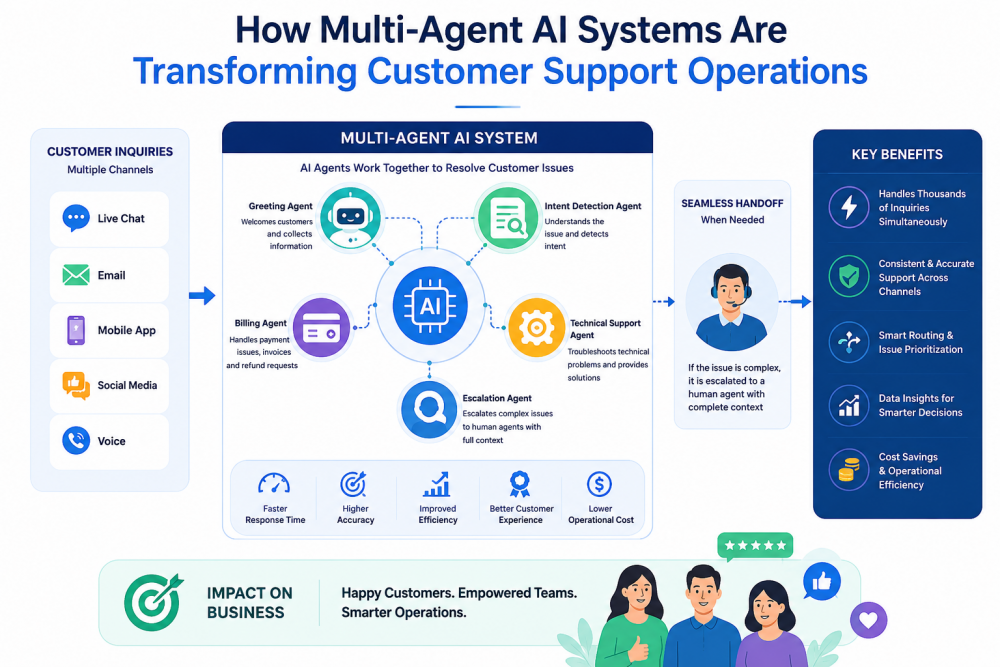
A multi-agent AI system is a collection of intelligent AI-based agents who collaborate to complete different tasks and accomplish shared objectives. Multi-agent systems have many more agents than traditional chatbots that are responsible for handling all customer interactions; therefore, each of the individual agents in multi-agent systems is responsible for performing different tasks or functions. The ability of each agent to focus on a specific task enables the entire system to perform more efficiently, accurately, and effectively. The agents of a multi-agent system can communicate with each other in real-time by sending and receiving messages and sharing information to help resolve customer concerns and streamline workflow management.
As an illustration, one AI agent may perform the functions of greeting the customer and collecting their basic contact information; another AI agent may evaluate the customer’s problem and make a recommendation for a solution, while another AI agent may process all requests related to billing, and another AI agent may address problems relating to technical troubleshooting. If the customer’s issue is not resolved by an AI agent, the multi-agent system can transfer the customer’s message to a human agent along with all necessary information about the customer and their issue. This cooperation between agents allows businesses to deliver faster and more organized support experiences.
Why Businesses Are Adopting Multi-Agent AI Systems
Many customers now expect quick solutions and more personalized communication from service providers. Traditional customer service management (CSM) solutions often struggle to meet these growing demands, especially when organizations receive thousands of support requests daily. This is where multi-agent AI systems are making a major difference.
Instead of relying on a single chatbot for every customer request, businesses are now using multiple AI agents that work collaboratively to handle different tasks. These systems help companies automate repetitive support activities, improve service quality, and reduce operational costs across industries such as e-commerce, finance, healthcare, and telecommunications. As businesses continue adopting advanced automation tools, Agentic AI is transforming business operations by improving workflows, increasing efficiency, and helping organizations deliver faster and smarter customer support experiences
How Multi-Agent AI Systems Work
Multi-agent AI systems break up customer support functions among different types of agents; each of those agents specializes in a different aspect or part of the problem being solved. The agents talk to one another via connected workflows and common systems, and they perform this function as soon as a customer initiates contact with a company using one of the four channels of communication (i.e., live chat, e-mail, mobile app, or social media).
The first contact with a customer is typically done by an AI Agent called the Movie Agent. The movie agent gathers information about the customer’s problem, and based on this information, it determines what type of inquiry the customer wants to make; this information can also be used to perform the process of intent detection. Intent detection helps the system to determine if the inquiry is related to billing, technical support (troubleshooting), account issues, or the product.
When the movie agent has identified what the customer is inquiring about (the type of inquiry category), the request is sent via an automatically routed path to the appropriate AI agent to resolve the issue for the customer. For example, a billing question would be sent to a billing agent; on the other hand, if there are technical problems with an account, the best-fit agent would be connected for troubleshooting. In many cases, more than one AI agent will be used to resolve an issue for a customer in the shortest time, with the greatest degree of accuracy, through the use of the correct process of resolution.
If the AI agent is unable to resolve the customer’s issue completely but has already gathered sufficient background information to support the customer service representative (CSR) assigned to the customer, the customer would then be transferred seamlessly to the CSR without having to repeat any of the background information.
Major Benefits of Multi-Agent AI in Customer Support
An important advantage of multi-agent AI systems is their improved operational efficiency, as they are able to interact with thousands of customers at once, thus allowing businesses to scale up their support operations while still maintaining a high quality of service during peak hours.
Another major benefit is the ability to consistently deliver the same experience to all customers, since multi-agent AI systems follow defined processes, allowing businesses to provide accurate and consistent support across all channels.
Additionally, multi-agent AI systems automatically route support requests to the appropriate department or specialist, thus reducing delays and increasing customer satisfaction by ensuring that customer requests are routed to the correct resource.
Another major benefit of multi-agent AI systems is the ability to analyze customer interaction data, which helps businesses identify recurring problems and develop better support strategies.
Finally, by automating repetitive tasks, multi-agent AI systems can help businesses reduce their labor costs and increase efficiency by better managing and distributing their workloads.
Industries Using Multi-Agent AI Systems
AI technologies are already being used across many businesses in a variety of industries using multi-agents. On the e-commerce side of things, companies will use AI agents to track orders, recommend products, process refunds & offer help with payments. The result is that these systems have improved both the overall shopping experience & reduced customer wait times.
Banks & financial institutions use AI systems to help their customers with account inquiries, to alert customers of fraudulent activity, to provide support with transactions, and to help customers with their loans. AI also improves security by enabling the rapid detection of suspicious activity.
Healthcare providers use multi-agent AI systems to help with the scheduling of appointments for patients, to answer patient inquiries, to assist with insurance, and to alleviate some of the administrative tasks performed by healthcare providers while also improving communication between healthcare providers & patients.
Telecommunication companies also benefit from the use of AI-powered support systems. Multi-agent AI enables these companies to automate troubleshooting for their customers and manage large volumes of technical complaints in a more efficient manner.
Challenges and Future Opportunities
Businesses are facing many difficulties implementing multi-agent artificial intelligence despite the advantages of using a multi-agent artificial intelligence system. Integration of AI technologies with current systems and databases can be expensive and complicated for a business. In addition, businesses need to protect and ensure that customer information is not at risk of privacy violations.
Another challenge is finding the correct balance between the use of AI for automated tasks and the use of humans to assist customers with their issues. Automated processes are sufficient for simple requests but often require human assistance for more complicated or sensitive issues. Businesses must also consider a good synergy between AI and human representatives.
While multi-agent AI still poses some challenges, the future looks bright for these types of systems as companies continue making improvements to their AI technology. Systems powered by multi-agent AI will improve the way they fulfill their customer needs, anticipate problems before they become an issue, and provide more proactive support across chat, email, phone, and social media.
Conclusion
Despite all the positive aspects of multi-agent artificial intelligence (AI) technology, there are still barriers for businesses to overcome during the implementation of these systems. Integration of AI into existing software and databases can be both challenging and costly, and businesses must take steps to protect customer data and to prevent any potential privacy risks associated with having information accessible to multiple people at one time through a multi-agent system.
Another challenge for businesses to address is to find a balance between allowing automation through AI as opposed to allowing human interaction with an automated system for tasks that are not repetitive or mundane. While AI systems may be capable of handling simple tasks on a continuous basis, there are instances where human assistance is required due to the sensitivity or complexity of an issue. Businesses should develop a system that combines automation and human intervention effectively.
With all of the above issues being addressed, the future of multi-agent AI technologies used in customer support is very bright. As AI technology continues to become more and more sophisticated, the ability to recognize how to identify customer needs, detect problems, and create a more proactive response to customer interactions across multiple platforms (such as chat, email, and social media) will grow exponentially in the years to come.