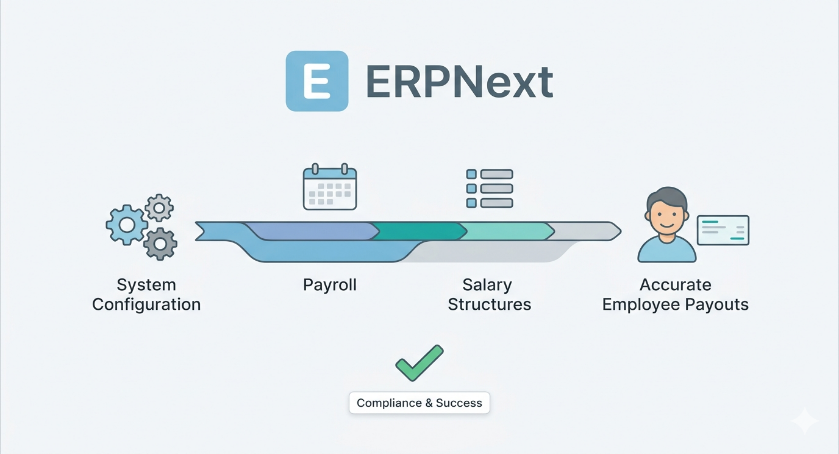
Most US businesses do not struggle with payroll because the concept is hard. They struggle because payroll demands precision at every step: the correct withholding method per employee, the right state tax component for each location, Social Security contributions capped at exactly the right threshold, and every figure tying back cleanly to the general ledger. ERPNext is built to handle all of it, but the system only performs as well as the configuration behind it. For any business going through an ERPNext implementation, getting payroll right from the start is not optional.
Salary Structures: The Foundation of Accurate Payroll
ERPNext builds payroll around two core objects: Salary Components and Salary Structures. Components are the individual line items that make up a paycheck, regular wages, overtime, health insurance deductions, 401(k) contributions, and similar items. Salary Structures group these components into a reusable template that gets assigned to employees based on their role or employment classification.
For US businesses, the earnings side of a salary structure typically includes Regular Pay, Overtime Pay at the 1.5x rate required under the Fair Labor Standards Act for non-exempt employees, bonuses, and commissions where applicable. On the deduction side, the mandatory federal components are Federal Income Tax, Social Security at 6.2% of gross wages up to the 2024 annual wage base of 168,600 USD, and Medicare at 1.45%. Employees earning above 200,000 USD in a calendar year also trigger the Additional Medicare Tax of 0.9% on the excess amount.
What makes ERPNext particularly useful here is its support for formula-based components. Each component can carry a Python-style expression that the system evaluates automatically on every payroll run. The Social Security wage cap, for example, can be fully automated so contributions stop at the correct annual threshold without any manual adjustment at year-end.
Federal and State Tax Withholding: Building the Logic Correctly
ERPNext does not arrive with pre-loaded IRS tax tables. Your configuration team will need to build withholding logic directly inside the system, using IRS Publication 15-T as the primary reference. Businesses that work with experienced ERPNext consultants at this stage tend to avoid the reconciliation problems that come from guessing at formula structure.
The percentage method from Publication 15-T is the most practical approach for ERPNext. The formula references each employee’s pay frequency, W-4 filing status, and whether they have checked Step 2 on a 2020 or later W-4. Employees with Step 2 checked are subject to a different withholding table than those without, so the formula must branch to handle both. Employees still on a pre-2020 W-4 require a separate calculation path tied to their declared withholding allowances.
State withholding follows the same structure but requires a separate tax component for every state where you have active employees. For businesses with distributed or remote teams, reciprocal tax agreements between states add another layer of complexity. An employee who lives in New Jersey but works in New York, for instance, is subject to specific rules about which state collects the withholding. These distinctions need to be reflected accurately in your component configuration from day one.
Processing Payroll: From Entry Creation to Bank Disbursement
With structures in place, ERPNext payroll processing follows a clear and auditable sequence. You create a Payroll Entry scoped to a company, department, cost center, and pay period. ERPNext pulls in all employees assigned to matching salary structures, calculates gross pay against attendance or leave records, applies each deduction component in sequence, and produces individual salary slips for review before anything is finalized.
The review stage is where mid-period corrections happen: a promotion taking effect partway through the cycle, a change from part-time to full-time status, or a one-time supplemental payment that needs separate handling. Once the Payroll Entry is submitted, ERPNext generates the corresponding accounting journal entry automatically, debiting wages expense and crediting tax liability and net payable accounts without any manual ledger entries.
Payment can be processed through ERPNext’s Payment Entry module or exported as an ACH file for direct upload to your banking portal. Businesses that are still deciding on infrastructure should review ERPNext deployment models: cloud vs on-premise, since cloud-hosted environments generally offer simpler ACH integration and lower maintenance overhead than self-managed server setups.
Year-End Reporting: W-2s, 941s, and FUTA Without the Scramble
A well-configured ERPNext payroll system makes year-end far less painful because every tax deduction, employer contribution, and benefit amount has been posting to the general ledger in real time throughout the year. There is no reconstruction work, only reporting.
ERPNext does not generate W-2 PDFs natively, but the Salary Register and Tax Withholding Summary reports contain all the data needed to populate them accurately. Box 1 taxable wages, Box 3 and Box 5 Social Security and Medicare wages, and Box 12 amounts for qualified benefits like employer-sponsored health insurance or HSA contributions are all accessible through these reports. The data can be exported into your W-2 filing software or passed directly to your CPA.
Quarterly Form 941 filings and the annual Form 940 for Federal Unemployment Tax work the same way. The figures are already in ERPNext, segmented by period, and they reconcile cleanly with the general ledger when the initial chart of accounts was set up properly. This is one reason businesses that invest in professional setup early tend to have significantly smoother year-end closes.
Payroll Configuration Is Worth Getting Right
ERPNext gives US businesses a capable and flexible payroll platform. That same flexibility means configuration shortcuts carry real consequences: an incorrect withholding formula affects every employee on every payroll run until someone catches and corrects it. Businesses that build salary structures carefully, validate tax logic against IRS publications, and run test payrolls before going live end up with a system that operates reliably and scales without friction as headcount grows.
For businesses still in the evaluation stage, the complete ERPNext guide for businesses covers the full platform in depth and is a practical starting point before committing to an implementation roadmap.