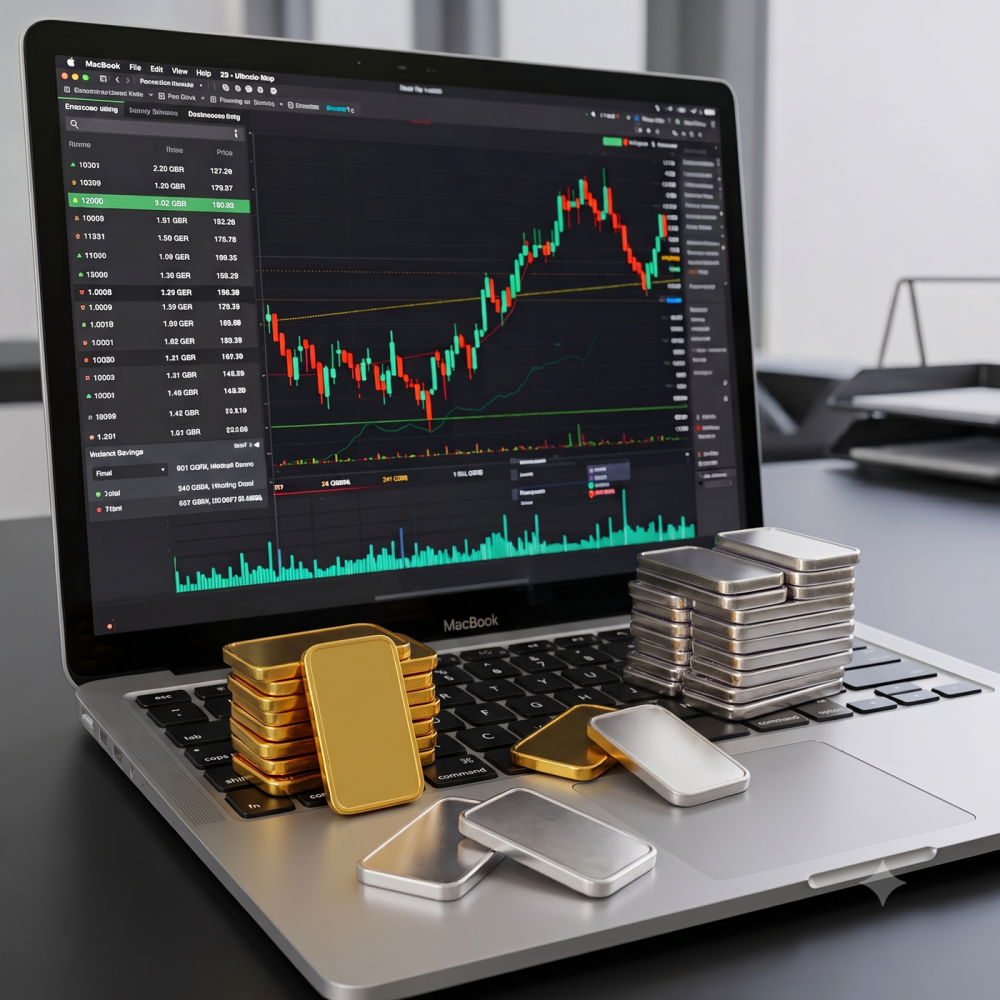
A forex demo account gives traders a practical environment to explore metals trading without placing real capital at risk. It allows you to study price movements, test order types, and practise managing positions under simulated market conditions.
However, demo trading is most useful when treated as structured preparation rather than a risk-free game. The objective is not to generate an impressive virtual balance. It is to develop a repeatable process that can support more disciplined decisions later.
Table of Contents
- Why practice matters in metals markets
- How to use a demo account effectively
- A structured practice plan
- Benefits and limitations of demo trading
- Common mistakes to avoid
- When to consider live trading
- Frequently asked questions
Why Practice Matters in Metals Markets
Gold and silver can move sharply in response to changes in interest-rate expectations, currency strength, inflation concerns, economic data, and wider market uncertainty.
These movements can create opportunities, but they can also expose weak risk management. A trader who has not practised position sizing, stop placement, or order execution may make rushed decisions when volatility increases.
A forex demo account provides time to understand how metals behave across different market sessions. For example, you can observe whether spreads change during quieter periods or how price reacts around major economic releases.
This preparation does not remove risk, but it can reduce avoidable platform and planning errors.
How to Use a Forex Demo Account for Metals Trading
Simply opening trades is not enough. Effective practice requires a clear purpose.
Learn the Trading Conditions
Before testing a strategy, review the specifications of the instrument you plan to trade. Check:
- Contract size
- Minimum trade volume
- Margin requirements
- Trading hours
- Typical spreads
- Swap or financing conditions
- Stop-distance requirements
Gold and silver contracts may differ between brokers. Understanding these details helps prevent mistakes when calculating exposure or potential trading costs.
Focus on One Market First
Beginners often switch between gold, silver, currencies, indices, and cryptocurrencies. This makes it difficult to understand why a strategy works or fails.
Start your metals trading practice with one instrument. Studying a single market allows you to recognise its typical volatility, active trading periods, and reactions around important price levels.
Once your process becomes consistent, you can evaluate whether it also suits another metal.
Test Rules, Not Predictions
A useful demo strategy should define:
- The market condition required
- The entry signal
- The invalidation point
- The profit-taking method
- The amount of simulated capital at risk
For example, a trader might only consider buying gold when the higher-timeframe trend is upward and price returns to a recognised support area. The entry may require a bullish rejection candle, while the stop is placed beyond the level that invalidates the idea.
The purpose is to test whether the rules produce consistent decisions—not to predict every market move correctly.
A Structured Practice Plan
Use the following process to make your forex demo account more realistic and useful.
- Set a fixed virtual balance
Choose an amount close to the capital you may realistically use later. An oversized demo balance can encourage careless position sizing. - Define your maximum risk
Decide how much of the account you may risk in one position. Apply the same rule to every trade. - Trade during specific hours
Select a session that fits your daily routine. This helps determine whether the strategy is practical for you. - Record every position
Note the setup, entry, stop, target, trade size, market condition, and result. - Review the process weekly
Look for repeated errors, weak setups, and situations where you ignored your own rules.
A trading journal is especially valuable in metals trading because gold and silver can behave differently during trends, ranges, and high-volatility events.
Benefits and Limitations of Demo Trading
Benefits
A forex demo account allows traders to:
- Learn platform functions without financial pressure
- Practise placing market and pending orders
- Test technical strategies
- Compare different timeframes
- Develop a position-sizing process
- Review trading results over a larger sample
Traders exploring HonorPro can use the available demo environment to become familiar with the platform and metals instruments before reviewing the conditions of a live account.
Limitations
Demo results should not be treated as proof of future profitability.
Virtual trading cannot fully reproduce:
- Fear after a real financial loss
- Greed after several winning trades
- Hesitation when entering with real capital
- The temptation to move a stop-loss
- Every aspect of live liquidity and execution
A strong demo record shows that a process may be worth further evaluation. It does not guarantee the same outcome in a live market.
Common Demo Trading Mistakes
One common mistake is using position sizes that would be unrealistic with real funds. Large virtual trades may create impressive gains, but they provide little preparation for disciplined live trading.
Other mistakes include:
- Taking random positions without written rules
- Resetting the account after every loss
- Changing strategies too frequently
- Ignoring spreads and financing costs
- Testing only favourable market conditions
- Treating every trade as an opportunity to recover losses
- Moving to live trading after a few successful positions
Your forex demo account should reflect the limits and behaviour you intend to maintain later.
When Should You Consider Live Trading?
There is no fixed number of days or trades that guarantees readiness. Instead, assess the quality of your process.
You may consider a cautious transition when you can:
- Follow the same entry rules consistently
- Calculate position size before every trade
- Accept losses without changing the plan
- Explain why each position was opened
- Avoid overtrading after wins or losses
- Maintain a detailed trading journal
- Produce stable results across different conditions
Even then, begin with smaller exposure than your maximum planned size. Live metals trading introduces emotional and execution pressures that may not appear in a simulated environment.
Key Takeaways
- Use demo trading to build a process, not chase virtual profits.
- Learn each metal’s contract details before placing positions.
- Test one clear strategy over a meaningful sample of trades.
- Match the virtual balance and trade size to realistic conditions.
- Record entries, exits, mistakes, and market context.
- Move to live trading gradually and maintain strict risk limits.
Frequently Asked Questions
Is a forex demo account suitable for beginners?
Yes. It helps beginners understand charts, order types, position management, and platform functions without risking real funds.
Can I practise gold and silver trading on a demo account?
Yes, provided the broker offers those instruments in its simulated environment. Contract conditions may differ between providers.
How long should I use a demo account?
Use it until you can follow a defined strategy consistently. The quality of your decisions matters more than a fixed period.
Are demo prices the same as live prices?
Demo accounts often reflect live market pricing, but execution and liquidity conditions may not always match a real account exactly.
Can a profitable demo strategy fail in live trading?
Yes. Market conditions, costs, execution, and emotional pressure can affect live results.
Should I test several strategies at once?
It is better to test one method at a time. This makes it easier to identify which rules are producing useful or weak results.
Conclusion
A forex demo account can provide a valuable foundation for metals trading when it is used with realistic capital, clear rules, and consistent risk management. It allows traders to learn the platform, study market behaviour, and identify weaknesses before financial pressure becomes part of the process.
Treat every simulated position as though real capital were involved. Build evidence through careful testing, review your journal regularly, and move to live markets only when your process—not just your account balance—shows greater consistency.
Open a demo environment, choose one metals market, and begin testing a clearly defined trading plan before committing real funds.
Risk warning: Trading forex, metals, and leveraged products involves significant risk. Market prices can move rapidly, and traders may lose some or all of their capital.