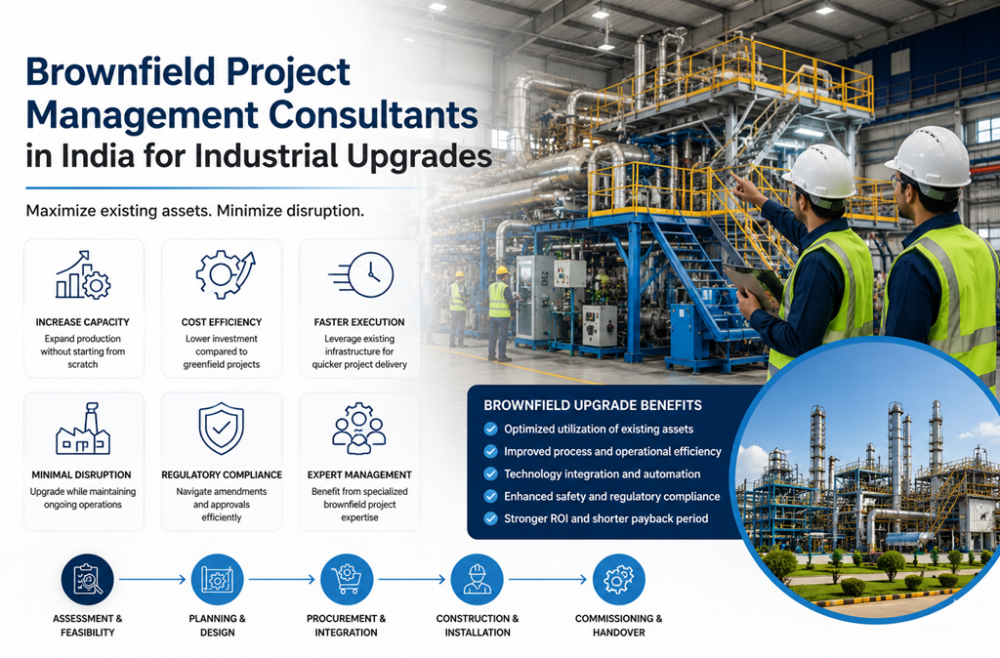
India’s existing manufacturing plants are running hotter than they have in years. Capacity utilisation in the manufacturing sector rose to 75.6% in Q3 FY 2025-26, up from 74.3% in the previous quarter, per the Reserve Bank of India’s 72nd round of the Order Books, Inventories and Capacity Utilisation Survey (OBICUS). The Index of Industrial Production (IIP) grew 4.9% year-on-year in April 2026, with manufacturing expanding 6.2%, per the Ministry of Statistics and Programme Implementation’s (MOSPI) revised IIP series and Capital Goods output rose 16%, signalling sustained business investment in capacity expansion.
When an operating plant crosses the 75-80% utilisation threshold, brownfield expansion adding capacity, automation, or new product lines within an existing, licensed facility becomes the capital-efficient default over building a new plant from the ground up. Manufacturers increasingly rely on brownfield project management consultants in India to plan and execute these expansions while maintaining operational continuity and regulatory compliance.
Brownfield expansion carries a structural advantage in capital and timeline terms. But it carries a structural complication that greenfield projects do not: the expansion must be delivered inside a facility that is already licensed, already staffed, and already generating the production revenue that funds the project itself. Civil work, equipment installation, and regulatory amendments all have to proceed without disrupting the output the plant is currently shipping.
This is precisely the execution challenge that brownfield project management consultants are engaged to solve. This article sets out the specific benefits Indian manufacturers gain by bringing in specialist brownfield project management expertise, rather than running an industrial upgrade through internal teams or fragmented vendor coordination.
Why Brownfield Expansion Is Accelerating Across Indian Industry
- Manufacturing capacity utilisation reached 75.6% in Q3 FY26, per RBI’s OBICUS survey the threshold at which brownfield capacity addition becomes the more capital-efficient option for operating plants
- Capital Goods production rose 16% in April 2026 year-on-year, per MOSPI’s revised IIP a leading indicator of sustained capital expenditure in plant and machinery across Indian industry
- The Union Budget 2026-27 deepened Production Linked Incentive (PLI) disbursements and increased the Department of Pharmaceuticals’ PLI allocation to ₹5,931.22 crore, directly supporting brownfield capacity additions among existing PLI-eligible manufacturers
- Dedicated Rare Earth Corridors announced across Odisha, Kerala, Andhra Pradesh, and Tamil Nadu are expected to accelerate brownfield capacity expansion in electronics, EV, and defence manufacturing supply chains dependent on these materials
- Nestlé India’s April 2026 brownfield expansion of its Sanand facility adding 20,500 MTPA of Maggi Noodles capacity at a cost of ₹90 crore, funded entirely from internal accruals illustrates the capital discipline brownfield expansion allows, compared to greenfield capex
The Execution Risk That Makes Brownfield Projects Different
Brownfield projects are frequently assumed to be simpler than greenfield builds because the land, licences, and core infrastructure already exist. In practice, the opposite is often true at the execution level.
- Construction and installation activity must be sequenced around an active production schedule, since shutting down existing lines to accommodate expansion work directly erodes the revenue funding the project
- Utility systems power, water, compressed air, effluent treatment are typically sized for the existing facility and must be reassessed and, in many cases, augmented to support the additional capacity without disrupting current operations
- Regulatory amendments to an existing factory licence, Consent to Operate, and Fire NOC are governed by a different procedural track than fresh applications, and incorrect sequencing can trigger renewed inspection cycles for the entire facility, not just the new addition
- Integration between new equipment and existing process lines introduces interface risk that does not exist on a greenfield site, where the entire layout is designed from a blank slate
- Workforce safety risk rises measurably when construction activity and live production operations run concurrently on the same shop floor a condition that does not arise on an undeveloped greenfield site
Top Benefits of Hiring Brownfield Project Management Consultants
1. Production Continuity Throughout the Upgrade
- Specialist brownfield consultants sequence construction, installation, and utility tie-in work around live production schedules, protecting the output and revenue the existing plant generates during the upgrade
- Shutdown windows, where unavoidable, are planned to coincide with scheduled maintenance periods rather than disrupting the production calendar independently
2. Faster, Lower-Risk Regulatory Amendments
- Consultants experienced in brownfield projects understand the distinct procedural track for amending an existing factory licence, Consent to Operate, and Fire NOC, rather than treating the expansion as a fresh regulatory application
- This sequencing discipline prevents the kind of inspection resets that can affect not just the new capacity, but compliance status across the entire existing facility
3. Integrated Utility and Infrastructure Assessment
- A structured brownfield assessment evaluates whether existing power load, water supply, compressed air, and effluent treatment capacity can absorb the expansion, or whether augmentation is required before equipment installation begins
- This prevents the common and costly scenario where new equipment is installed and qualified, only to discover insufficient utility capacity to run it at full output
4. Capital Efficiency Compared to Greenfield Alternatives
- Brownfield expansion leverages existing land, approved environmental clearances, established utility connections, and an existing workforce each of which would require fresh capital and lead time under a greenfield approach
- Nestlé India’s Sanand expansion, funded entirely from internal accruals at ₹90 crore for 20,500 MTPA of additional capacity, reflects the capital efficiency this model enables when execution is properly managed
5. Workforce Safety Management During Concurrent Operations
- Experienced brownfield consultants implement segregated work-zone protocols, controlled access, and safety briefings specific to running construction activity alongside live production a risk profile greenfield projects do not carry
- EHS (Environment, Health and Safety) planning is integrated into the project schedule from the outset, rather than addressed reactively once construction begins
6. Faster Time-to-Commission for PLI-Linked Capacity
- For manufacturers expanding capacity to meet PLI production milestones, brownfield consultants structure the project timeline to align commissioning with incentive-linked deadlines, given the smaller scope and shorter cycle of brownfield work compared to greenfield construction
- With Budget 2026-27 deepening PLI disbursements, including the increased Department of Pharmaceuticals allocation of ₹5,931.22 crore, manufacturers with PLI exposure have a direct financial incentive to commission brownfield capacity additions without delay
7. Single-Point Coordination Across a Complex Stakeholder Set
- Brownfield upgrades typically involve plant operations teams, existing equipment OEMs, civil contractors, statutory authorities, and new equipment suppliers simultaneously a coordination load that specialist consultants centralise under one accountable project structure
- This reduces the handoff gaps that arise when internal plant teams attempt to manage an expansion alongside their existing operational responsibilities
What to Evaluate Before Engaging a Brownfield Project Management Consultant
- Track record specifically in brownfield expansion within an operating facility, not only greenfield project delivery the risk profiles and required expertise differ materially
- Demonstrated experience securing regulatory amendments to existing factory licences, Consent to Operate, and Fire NOC within the manufacturer’s specific state
- Capability to conduct an integrated utility capacity assessment covering power, water, compressed air, and effluent treatment before finalising the expansion scope
- A documented approach to sequencing construction activity around live production schedules, including shutdown-window planning where unavoidable
- EHS planning specific to concurrent construction and production operations, not generic safety protocols adapted from greenfield projects
How IMARC Engineering Supports Brownfield Industrial Upgrades in India
IMARC Engineering provides brownfield project management and EPCM advisory services for manufacturers expanding capacity, adding production lines, or upgrading process technology within existing, operating facilities across India.
- Brownfield feasibility and utility capacity assessment, evaluating existing power, water, compressed air, and effluent treatment infrastructure against expansion requirements
- Production-continuity scheduling that sequences construction, installation, and commissioning activity around live operations, minimising disruption to existing output
- Regulatory amendment management for existing factory licences, Consent to Operate, and Fire NOC, structured to the specific procedural track each state authority applies to brownfield modifications
- Integrated EHS planning for concurrent construction and production environments, including segregated work-zone protocols and access control
- Single-point coordination across plant operations teams, existing equipment OEMs, civil contractors, and new equipment suppliers
- Sector experience across pharmaceuticals and APIs, FMCG and food processing, specialty chemicals, electronics assembly, and automotive components, with active engagement across Gujarat, Maharashtra, Tamil Nadu, Telangana, Karnataka, Andhra Pradesh, andUttar Pradesh
As industrial capacity utilisation rises, partnering with specialist brownfield project management consultants in India can help manufacturers execute upgrades with greater speed and control.
Brownfield Expansion Is the Capital-Efficient Path If Execution Is Managed Correctly
The data points in one direction: India’s existing manufacturing base is running closer to full capacity, and the capital-efficient response is to expand within that base rather than build new.
- 75.6% manufacturing capacity utilisation in Q3 FY26, per RBI’s OBICUS survey the threshold at which brownfield economics become unambiguous
- 6.2% manufacturing growth and a 16% rise in Capital Goods output in April 2026, per MOSPI both pointing toward sustained capacity-expansion investment
- ₹5,931.22 crore in deepened Department of Pharmaceuticals PLI allocation under Budget 2026-27 directly incentivising brownfield capacity additions among existing manufacturers
- Nestlé India’s ₹90 crore, internally-funded Sanand expansion a documented illustration of the capital discipline brownfield expansion enables when execution risk is properly managed
The manufacturers who convert this opportunity into commissioned, compliant, fully operational additional capacity will be those who recognise that brownfield projects carry a distinct execution risk profile one that demands production-continuity planning, regulatory amendment expertise, and integrated utility assessment from a specialist brownfield project management partner, not a generic construction or EPC approach borrowed from greenfield projects.
Conclusion
Brownfield expansion has become the preferred path for many manufacturers seeking to increase capacity without the cost and timeline associated with a new facility. However, success depends on careful planning, regulatory coordination, and uninterrupted plant operations. By bringing in experienced brownfield project management consultants, manufacturers can reduce execution risks, maintain production continuity, and deliver industrial upgrades more efficiently.