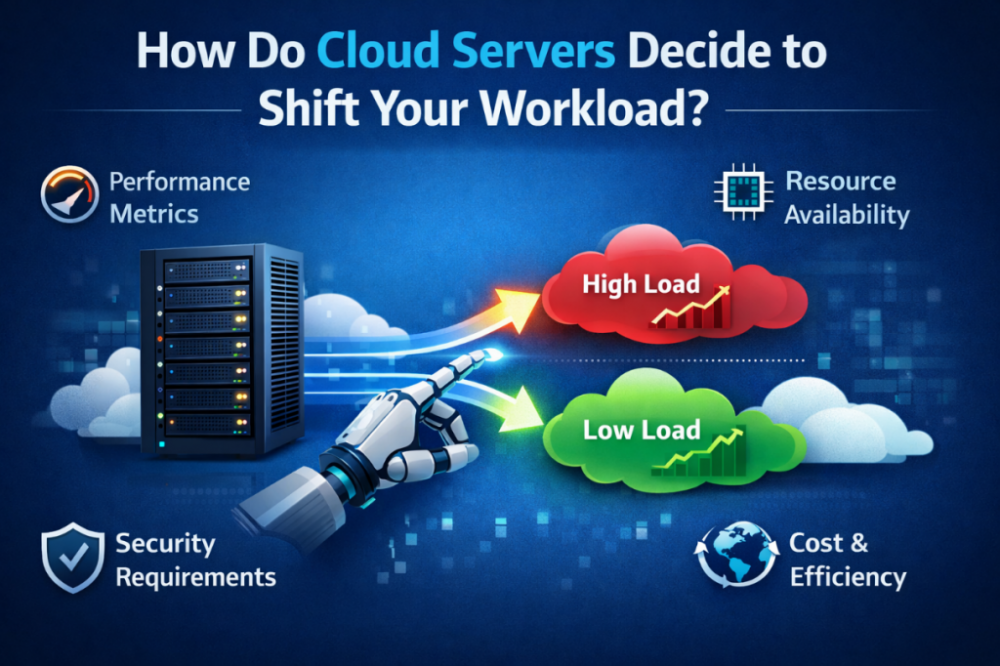
Cloud servers continuously judge workload health. They do not wait for failure. They observe patterns, pressure, and internal stress signals. Decisions are made quietly and early. This decision system runs below dashboards, alerts, and scaling rules. It is a core part of cloud operations and a key concept studied during the Associate Cloud Engineer Certification because it defines how cloud platforms maintain stability at scale.
Cloud workloads are treated as living processes. They grow, shrink, slow down, and recover. Cloud servers track this behavior and decide when keeping a workload in the same place becomes risky.
Internal signals that guide cloud movement decisions
Cloud platforms do not depend on surface metrics alone. CPU percentage and memory usage are only small pieces of the picture. Real decisions come from deeper system signals.
Some critical signals cloud servers monitor includes:
- CPU scheduling delay inside the kernel
- Time spent waiting for memory pages
- Frequency of memory page faults
- Disk IO wait time spread
- Network packet queue buildup
- Context switch pressure
- Cache miss growth
- Virtual clock drift
Each signal tells a story. A single spike may not matter. A pattern always matters.
Cloud systems observe how fast these signals rise. They also observe how often they repeat. A workload that slowly builds pressure is treated differently from one that spikes suddenly.
Key things cloud systems evaluate from these signals:
- Is the workload becoming unstable?
- Is performance likely to drop soon
- Is the host under shared pressure?
- Is the workload causing pressure for others?
Modern Cloud Computing Training focuses on understanding these signals because most production issues start here, not at visible limits.
Cloud servers prefer prevention over repair.
Timing logic behind workload shifting
Moving a workload is not a quick reaction. It is a timed decision.
Cloud systems calculate whether moving a workload will help more than it hurts. Migration consumes resources. If the cost is higher than the gain, the workload stays.
Factors used in timing decisions include:
- Speed of stress growth
- Stability history of the workload
- Size of memory footprint
- Rate of memory changes
- Sensitivity to delay or pause
- Dependency strength with other services
Cloud platforms also simulate future behavior. They predict how the workload will behave in the next few minutes. If the prediction crosses a risk threshold, preparation begins early.
Preparation steps may include:
- Pre-validating target hosts
- Starting background memory copying
- Preparing network routing paths
- Reserving compatible resources
These steps reduce risk when actual movement happens.
Advanced Cloud Computing Training explains that good cloud systems allow early movement rather than forced movement. Early movement is smoother and safer.
This timing logic is why some workloads feel stable even during heavy usage.
Technical process of shifting a running workload
Workload shifting is controlled and layered. Nothing is rushed.
The system follows a structured flow:
- A target environment is selected
- Compatibility checks are completed
- Memory is copied in rounds
- Changed memory blocks are tracked
- CPU execution state is synchronized
- Network traffic is redirected
- Storage links remain intact
The workload continues running during most of this process.
Containers move faster because their runtime state is smaller. Virtual machines require more care because kernel state must remain consistent.
Workload type also affects movement:
- Stateless services move easily
- Stateful services require stricter control
- Databases need stable storage paths
- Messaging systems need message safety
Engineers trained through Cloud Computing Coaching in Bangalore often focus on movement-friendly architecture because high-growth systems demand frequent balancing. Systems designed for movement recover faster.
In Cloud Computing Coaching in Hyderabad, attention is often given to precision. Long-running workloads with strict consistency rules need controlled migration windows. In both cases, the same backend logic applies. Only the risk tolerance changes.
Scheduler and placement engine decisions
Schedulers decide where workloads run now. Placement engines decide where they should run next. These systems work together. They assess many conditions at once.
Key placement checks include:
- CPU type and instruction support
- Cache availability
- Memory layout balance
- Network distance to dependencies
- Storage attachment limits
- Security isolation rules
- Hardware reliability score
Schedulers do not search for empty machines. They search for safe machines.
Below is a simplified table showing how different workloads influence placement logic:
| Workload Category | Main Stress Signal | Placement Priority | Movement Tendency |
| API services | Network delay | Low latency nodes | High |
| Databases | Disk wait time | Storage locality | Low |
| Stream processing | Memory churn | Balanced memory | Medium |
| Batch jobs | Cost pressure | Spare capacity | High |
Schedulers also protect failure domains. They avoid placing related workloads on the same risk zone. This reduces large-scale outages.
Engineers from Cloud Computing Coaching in Bangalore and Cloud Computing Coaching in Hyderabad often learn that placement quality affects performance more than instance size.
Understanding scheduler behavior leads to better workload design.
When cloud systems avoid moving workloads
Not every workload should move. Cloud systems avoid movement when:
- Memory changes too fast
- Local state cannot be copied safely
- Storage detachment is risky
- Licensing rules restrict movement
- Migration risk is higher than benefit
These decisions are logged internally. Users rarely see them. Workloads designed for portability perform better over time.
Key takeaways
- Cloud decisions rely on deep internal signals
- Movement is planned, not reactive
- Timing is based on future risk prediction
- Schedulers prioritize safety over space
- Placement logic shapes performance
- Movement-friendly workloads stay healthier
Conclusion
Cloud workload shifting is a constant and careful process. It happens quietly, guided by signals hidden deep inside systems. Cloud servers watch behavior patterns, predict stress, and decide early. Migration is not a response to failure. It is a prevention step. Schedulers and placement engines work together to protect performance and stability. Engineers who understand this backend logic design better systems. They allow movement instead of blocking it. This understanding turns cloud usage into cloud engineering and helps systems stay reliable as demand grows.