Consider how most online enquiries still happen.
A visitor lands on the website, browses, and fills out a form. After that,the process becomes inconsistent. Someone from the team eventually calls or replies to an email.
Sometimes quickly. Sometimes hours later.
That small gap between submitting a form and starting an actual conversation is where many enquiries quietly lose momentum.
This is one of the reasons businesses have started shifting to WhatsApp forms.
Instead of ending the interaction after submitting a form, users are led directly into a WhatsApp chat where the form appears and the conversation actually starts.
Many businesses are now building these workflows using platforms based on the WhatsApp Business API
What Are WhatsApp Forms?
At a basic level, a WhatsApp form collects structured information — name, requirements, preferences, or contact details.
What changes is where the form appears.
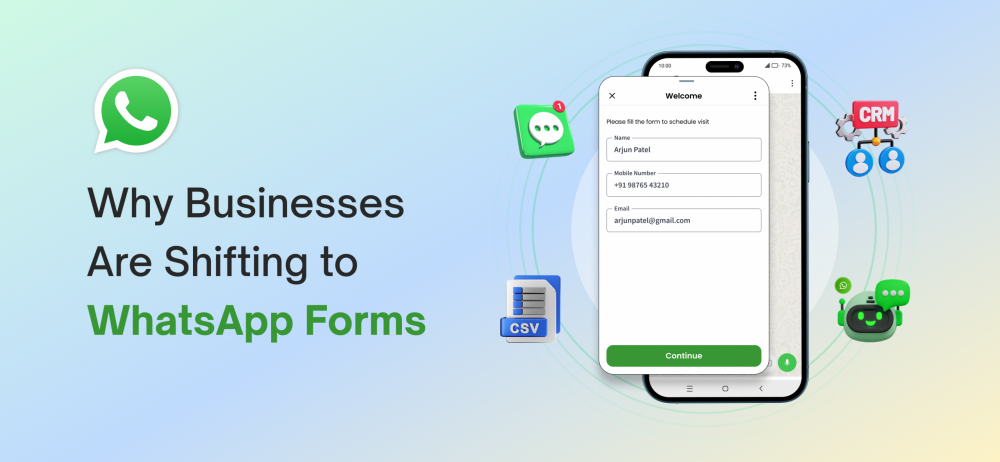
The user first opens a WhatsApp chat with the business. Then, the form opens within the WhatsApp itself. It looks and behaves like a regular form, similar to what you might see with tools like Google Forms.
The user fills it out, submits it, and returns straight to the same chat window.
So the process feels familiar, but the user never leaves the app.
On the business side, the responses are captured on the backend. Teams can view the information, export it as a CSV file, or sync it directly with their CRM if it is connected.
Once the form is submitted, the conversation starts in the same chat, either through automated response from a chatbot or with a team member responding manually.
Tools built on the WhatsApp Business API often support this kind of workflow by combining automation, forms, integrations, and team chat in one place.
Why Businesses Prefer This Approach
Traditional forms were designed for websites.
But customer behaviour has drastically shifted post-pandemic. Messaging apps have become the place where most conversations now happen.
That’s why moving the enquiry process into WhatsApp often feels natural to users. They’re already active there, messaging friends, colleagues, and sometimes even businesses.
For companies, this creates a meaningful advantage. When someone submits a form, the conversation is already happening on a platform where the customer is present and responsive.
Questions can be answered immediately. Sometimes it’s something simple — a price range, product availability, or service details. Other times, they can have live chat with agents about their specific needs.
And because the interaction stays inside WhatsApp, businesses can continue engaging and nurturing that enquiry instead of letting it go cold.
Where WhatsApp Forms Are Being Used
Once businesses start using WhatsApp forms, they often find several ways to apply them.
Forms play an important role in business communication because they help collect information in a structured way, instead of receiving open-ended messages like “I’m interested,” teams can ask for specific details such as location, budget, service type, or timeline right from the start.
One of the most common uses is lead qualification. Instead of receiving vague enquiries, the form asks a few key questions upfront, things like location, budget range, or service requirements.
By the time the chat begins, the team already has context.
Some businesses use forms simply to understand their audience better. Asking about preferences or interests helps segment customers and send more relevant updates later.
Support teams use them for service requests, collecting the information needed to resolve issues faster.
They’re also becoming popular for event registrations. A webinar sign-up, for example, can lead directly into a WhatsApp conversation where reminders and updates are shared.
Marketing teams have found other creative uses too — giveaways, early access lists, product interest forms, even newsletter sign-ups.
The common theme is simple: the interaction continues after the form.
When Forms Connect with the WhatsApp Business API
As the convenience of WhatsApp has become a norm for most customers, managing those conversations can become difficult without the right structure.
Platforms built on the WhatsApp Business API allow businesses to organise chats, automate certain replies, and connect WhatsApp with internal systems like CRMs.
Why This Shift Matters
Forms themselves haven’t changed much over the years.
But the way people communicate online has.
WhatsApp forms sit somewhere between traditional forms and live conversations. They still collect structured information, but they also allow businesses to continue the interaction immediately.
For many teams, that small shift not only makes enquiries easier to handle, but also more productive.
If you’d like to explore how these forms are created and implemented in more detail, you can read this guide on WhatsApp Forms
And if this topic interests you, you can also join the WhatsApp community, where we regularly discuss practical ways businesses are using WhatsApp to communicate with customers.