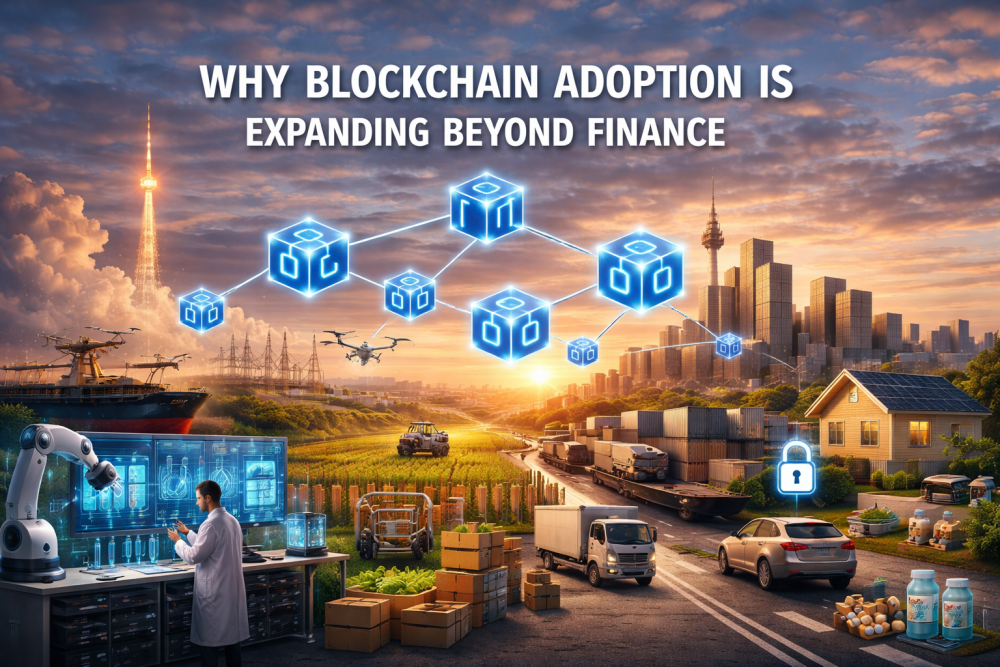
Originally became popular due to bitcoin, blockchain plays a prominent role in the finance sector where there are large transactions and digital currencies. However, due to rapid development in blockchain technology, various industries has started to integrate blockchain in their day-to-day task to ensure transparency, maintain accountability and increase efficiency.
The integration of blockchain systems is majorly seen in healthcare industry, education sector, e-governance and supply chain managements for various tasks such as record keeping, product tracking and maintaining safety and privacy of users.
Moreover, the shift towards digital transformation in various industries has increased the risk of cybertheft and data security, further enhancing the involvement of blockchain due to its advance safety measures. Businesses are integrating it to build resilient systems that safeguard sensitive information while maintain operation efficiency.
As innovation grows, blockchain is developing from just a finance niche to an essential component in various industries aiming towards rapid growth and security. The following article talks about few such industries that have rapidly integrated the use of blockchain technology in their operations.
Blockchain In Healthcare
Enterprise blockchain solutions are transforming healthcare data management. It is changing how medical data is stored, shared and secured. Blockchain uses data decentralization to store highly sensitive medical data which protects it from theft and cyberattacks.
Another major advantage is data privacy and security. Since medical data is highly sensitive, it need to be stored accordingly. Blockchain ensures that once the data is uploaded and secured, it cannot be accessed until the whole system agrees, making it the safest way to store highly sensitive and personal medical information.
Blockhain is also revolutionizing supply chain management in healthcare, especially in tracking pharmaceuticals. It allows every part if the drug journey, from manufacturer to patient, be recorded in order to minimize the supply of counterfeit and illegal drugs. This promotes reliability, openness and efficiency.
By creating tamper proof records, it preserves the accuracy of data result and prevents manipulation. Simultaneously, it allows doctors to share data and information while maintain proper transparency and authenticity.
Blockchain Use in Supply Chain Tracking
The integration of block chain in supply chain management is transforming how goods are tracked from their place of production till they reach the final customers. Blockchain creates a shared and tamper proof record of every transaction and movement made in the whole life of the product.
Each stage is logged on a distributed ledger, with access only to verified participants. This real time visibility helps businesses and consumers track products accurately and builds trust across the entire network.
By giving products their own digital identities, authorities gain the ability to monitor and access them at any point, effectively combatting fraud and counterfeiting. When products are damaged or defective, companies can swiftly address the problem by pinpointing its origin.
Blockchain In Voting Systems
This is the emerging sector in which blockchain is being used. Traditional voting systems faced challenges such as fraud and vote manipulation ultimately questioning the reliability of result. This has encouraged the adopting of blockchain in voting system to ensure the accuracy and reliability of collected data.
This setup safeguards voter privacy and renders the votes tamper-proof, guaranteeing the integrity of the final tally. Blockchain technology has also broadened accessibility.
Remote and online voting are now possible, a significant advantage for citizens living overseas who might otherwise be unable to participate in elections. Governments and organisations are exploring this technology to convert traditional voting into a modern system which is safe, secure and accessible to all.
Conclusion
Hence, the blockchain adoption is growing beyond finance because as industries have started to evolve, they need a secure, decentralised system to store their personal data and track products. Since blockchain provides all these benefits along with many more, its use has been rapidly increasing beyond the finance sector and is entering into multiple different sectors such as healthcare, education and even in voting mechanisms and supply chain.
Even with its rapid advancements, blockchain still encounters challenges such as unclear regulations, scalability limitations and difficulty in integration. In 2026, the move from early-stage pilot projects to full scale enterprise implementation is accelerating driven by the growing need of regulatory compliance, greater transparency and improved operational efficiency.