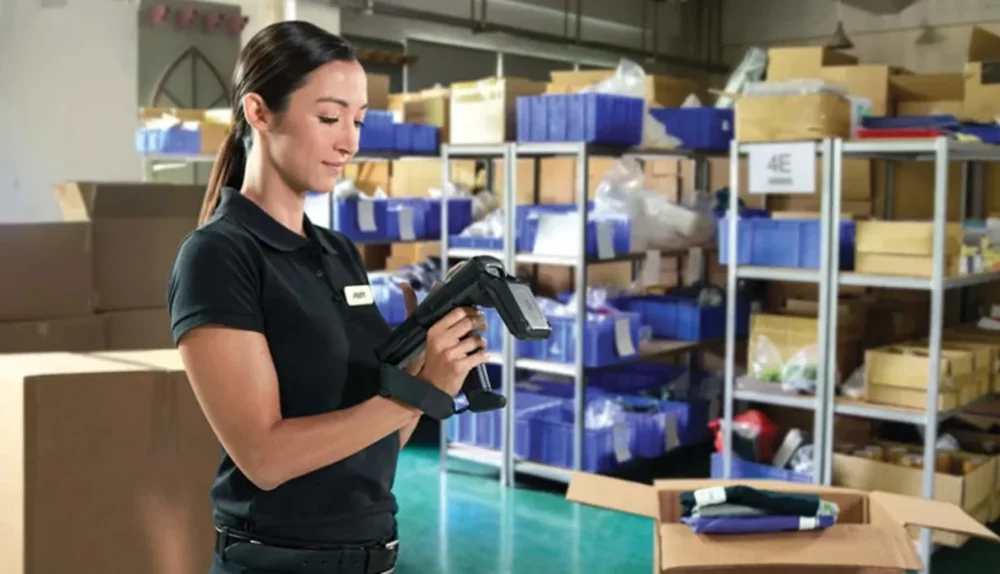
| Summary: RFID scanning is faster than barcodes because it can read tags at the same time without needing to see them. It works even when things are moving it captures a lot of data instantly and it allows for real-time tracking. By reducing the need for people to do things manually and making mistakes RFID changes the way work is done. It makes counting inventory, checking shipments and tracking assets faster and more efficient while growing with the company. |
The speed of doing things creates a change in everything. The difference between scanning one item at a time and scanning items at once changes all aspects of picking items in a warehouse, tracking equipment, counting inventory and checking shipments.
The same question keeps coming up when people are looking at tracking technology because companies first ask about how fast RFID scanning‘s which is faster than traditional barcode systems. To really understand this we need to look at more than the hardware because it includes three important parts.
These three parts are how technology thinks, how technology communicates and how technology performs in situations that require movement and different systems and depend on accurate data. We need to work to make this happen.
First think about how each technology “sees”.
The barcode system works like a flashlight that needs to see the item because it needs a direct line of sight to work. The person using it needs to point the device at the item and make sure it is aligned before it can finish the process and move on to the item.
The RFID system works like a radar system that can detect items in its range. It sends out radio waves that can detect all the tagged items at once of reading one label at a time.
The RFID system can keep collecting data all the time without needing people to aim or take breaks. The people in charge of companies need to understand this difference, which is about needing to see the item and using radio frequency to detect it because it sets the basic rules for speed.
One-to-One vs. One-to-Many Reading
Imagine scanning 500 boxes with barcodes. You would need to lift each box or angle the scanner carefully. Beep. Next. Beep. Next. Even if it only takes two seconds per scan that is than 15 minutes of repeating the same motion.
Now imagine walking past the pallet with an RFID reader. In a few seconds the system can detect every tagged item automatically.
That is not an improvement. That is a change in the way work is done.
RFID does not wait for instructions between scans. It can read tags at the same time, which is called bulk reading. This allows teams to capture shipments, shelves or storage areas in one pass.
The speed here is not just a little better. It is much better.
Motion Does Not Slow Down RFID
Barcodes work best when things are not moving. If items move fast the scans do not work. Conveyor belts often need to be spaced out so the scanners can read each label correctly.
RFID works well even when things are moving. Tags can be read while items are moving through doors on conveyor systems or inside vehicles. Fixed readers create checkpoints that automatically log when items move.
No pauses. No rescans. No bottlenecks.
That means companies do not need to slow down their processes to collect data. The tracking adapts to the way work is done not the way around.
Human Effort vs. Automated Capture
Lets be honest. Scanning things manually takes concentration. Workers need to find the labels point the scanners confirm the reads and repeat. Over time people get tired. Mistakes happen. Some scans are missed.
RFID reduces this burden a lot.
Because readers collect data automatically staff do not need to interact with every item. They can focus on important tasks instead of repeating the same scanning motion. Less strain. Fewer mistakes. Faster work.
It is not about replacing people. It is about removing obstacles.
Data Depth Without Extra Time
Here’s something people may not realize: RFID does not just read faster. It can also collect information at the same time.
A barcode typically has an identifier. To get details systems need to look up the information in a database after each scan.
RFID tags can store and send more detailed data, like serial numbers, timestamps and status flags. So while a barcode scan may need steps to get the full context an RFID read can give it all at once.
More insight. Same scan. No delay.
Range Changes the Game
barcode scanners only work within a few inches or feet. Operators need to be close to each label.
RFID expands this range a lot. Depending on the system tags can be read from feet away or even from across a room. Long-range readers can track assets as they move through facilities without needing people to intervene.
What does this mean in practice?
Forklifts do not need to stop to scan pallets.
Staff do not need to climb racks to reach labels.
Inventory checks do not require touching every item.
Distance becomes an advantage of a limitation.
Real-Time Visibility of Batch Updates
Barcode workflows often update systems in batches. Items get scanned during receiving, picking or audits and records are updated when someone does that action.
RFID enables visibility. Readers positioned throughout a facility can monitor asset movement in time. The system always knows where items are because it is always listening.
This shift, from updates to live tracking eliminates blind spots. Teams can find equipment instantly verify shipments automatically and detect anomalies as they happen.
Speed is not about RFID scanning. It is about making decisions.
Environmental Flexibility
Barcodes have trouble when labels get scratched, dirty or covered. Warehouses, yards and production floors are not environments. Dust, moisture and handling can damage printed codes quickly.
RFID tags the kind made for industry can withstand harsher conditions. Many are sealed, ruggedized or embedded directly into equipment or packaging. Because they do not rely on readability they keep working even when surfaces are not perfect.
Fewer failed reads mean delays.
Scaling Without Slowing Down
Imagine a company scanning 50 items a day. Barcodes work well.. What happens when the volume jumps to 5,000 daily transactions?
Manual scanning grows linearly. More items require time or more staff.
RFID grows differently. Since readers collect tags at the same time higher volume does not necessarily increase scanning time. Whether 10 items or 1,000 items pass through a read zone the system processes them in near time.
Growth does not demand labor. That is an operational advantage.
Accuracy Drives Speed Too
It might sound strange. Accuracy plays a direct role in speed. Every missed scan duplicate entry or mislabeled item forces teams to stop and fix errors. Investigations take time. Corrections slow down workflows.
RFID reduces these interruptions. Automated capture minimizes error, while built-in validation rules ensure data consistency. When systems trust the data processes move faster because they do not need verification.
Reliable information accelerates everything
Integration Multiplies the Impact
Speed is valuable. Speed combined with system integration is transformative.
When RFID connects to company platforms. Inventory systems, asset management tools, maintenance software. It does not just collect data. It triggers actions. Automatic updates. Alerts. Reports. Workflows.
That is where companies like Lowry Solutions make a difference. By integrating hardware, software and tracking technologies into platforms companies gain a single view of assets, inventory and movement. Of using separate systems teams see everything in one place and act immediately.
Visibility fuels speed.
Where Barcodes Still Shine
Does this mean barcodes are no longer needed? Not at all.
Barcodes remain cost-effective, simple and highly reliable for use cases. Small businesses, low-volume workflows or environments where line-of-sight scanning is not a problem often find them perfectly sufficient.
In fact many modern tracking strategies use both technologies. Barcodes handle item-level identification where needed while RFID manages tracking and automation. The smartest systems do not choose one over the other. They use each where it works best.
The Real Reason RFID Feels Faster
Yes RFID reads tags quickly.. The deeper reason it feels faster is because of how it works, not just the technology.
There is no waiting. No aiming. No confirmation beeps. Data just appears.
Processes flow. Workers move naturally. Systems update silently in the background.
When technology becomes part of the workflow of interrupting it operations gain momentum. That momentum is what teams notice first.. What leaders measure later, in productivity metrics.
Final Thoughts
The speed of tracking systems is really important to us. It is about how fast they can scan things. We want to get rid of all the things that slow us down when we get goods store them move them and make reports. The Lowry Solutions system uses RFID technology to track items without needing to see them. This RFID technology can track a lot of items at the time and gives us instant information and it works well with the technology we already have.
Companies that want to know how fast RFID technology’s compared to barcodes will get an answer that tells them the difference.
The process is now faster than it was before.
The way we do things is changing what we think speed is with the help of RFID technology.
The teams that have seen the changes do not want to go to the old way of using barcodes.
FAQs
1. Why is RFID technology faster than scanning barcodes with RFID technology and barcodes?
RFID technology can read a lot of tags at the time using radio waves but barcodes have to be scanned one by one and you have to be able to see them to use barcodes.
2. Do we have to aim at RFID tags like we do with barcodes and RFID technology?
No. RFID technology can find tags automatically without us having to aim at them when we use RFID technology.
3. Can RFID technology work when items are moving with the help of RFID technology?
Yes. RFID technology can read tags when items are moving on things like conveyor belts at dock doors or in vehicles. It does not slow things down when we use RFID technology.
4. Can RFID technology store information than barcodes with the help of RFID technology?
Yes. RFID tags can hold a lot of information like numbers and status information so we do not have to look things up in a database when we use RFID technology.
5. Are barcodes useful when we compare them to RFID technology?
Yes. Barcodes are still a choice when we do not need to track a lot of items and they are cheap and reliable but RFID technology is better when we need to track a lot of items, with RFID technology.