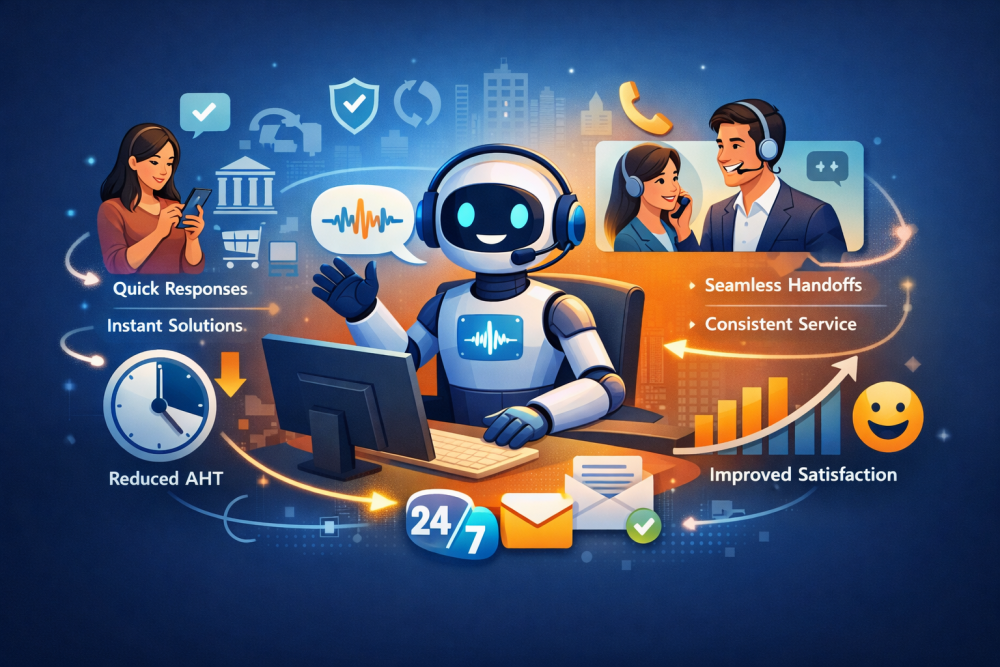
There’s a familiar moment in every customer’s journey: being placed on hold, listening to a looping tune, and waiting for someone to finally pick up.
This is where the shift is happening. Not loudly, not disruptively, but steadily. The rise of the voice bot is changing how customer conversations begin, flow, and resolve. And in many cases, how quickly they end.
The Real Problem with Handling Time
Average Handling Time (AHT) has long been a critical metric in customer support. Lower it, and you improve efficiency. Push it too far, and you risk rushed, unsatisfactory interactions.
Traditionally, reducing AHT meant training agents better, building scripts, or optimizing call routing. But these improvements often plateau. Human-led systems, no matter how refined, still face limits, fatigue, variability, and scale.
A conversational AI bot, especially one that works with speech, changes the game. It doesn’t just help; it takes in the initial layer of client interaction.
1. Instant Response, Zero Queue Time
The first and most visible advantage is simple: no waiting.
A voice bot answers immediately. There’s no queue, no hold music, no escalation delay. For high-volume industries, banking, telecom, insurance, this alone can shave off a significant portion of AHT.
But more importantly, it changes perception. Customers feel heard instantly.
Deloitte says that how quickly a company responds is one of the most important factors in customer satisfaction. If the first touchpoint is quick and helpful, the rest of the encounter usually goes well.
2. Smart Triage That Gets to the Point
Not every query needs a human. In fact, most don’t.
A well-designed voice bot can quickly understand intent, whether it’s checking an account balance, tracking a request, or updating details, and either resolve it or route it intelligently.
This “frontline filtering” reduces unnecessary transfers and cuts down on back-and-forth explanations.
Think of it as removing the small talk in customer service, not the human warmth, but the operational friction.
The result? Shorter calls, clearer conversations, and agents who spend time where it truly matters.
3. Consistency at Scale
People interact with each other in different ways. Some agents work faster, some give more information, and some are better at calming things down.
A conversational AI bot makes things consistent.
Every time, it takes the best route. It doesn’t forget steps, skip checks, or mess up simple requests. This regularity makes it easy for companies that get thousands of calls every day to figure out how long it will take to deal with them.
According to studies from the Harvard Business Review, making service procedures less random can make consumers a lot happier, and things operate more efficiently.
Voice bots do just that: they discreetly standardize the first layer of communication.
4. Faster Resolution for Simple Grievances
A large percentage of customer grievances are repetitive: status checks, basic troubleshooting, and document requests.
These don’t require human judgement. They require speed and accuracy.
A voice bot handles these instantly. No delays, no dependency on agent availability. For the customer, the issue gets resolved in minutes. For the business, it reduces the load on support teams.
And here’s the subtle shift, customers begin to trust the system not because it sounds human, but because it works efficiently.
5. Smarter Handoffs When Humans Are Needed
The real strength of a voice bot isn’t just automation, it’s knowing when to step aside.
When a query becomes complex or emotionally sensitive, the bot can transfer the call to a human agent, along with context. No repetition. No restarting the conversation.
This reduces one of the biggest contributors to high AHT: customers explaining the same issue multiple times.
By the time the agent joins, they already know the situation. The conversation moves faster, and more importantly, it feels seamless.
A Subtle but Powerful Shift
The conversation around voice automation often focuses on replacement. But in reality, it’s about redistribution.
Voice bots don’t replace agents; they remove inefficiencies.
They handle the predictable so humans can focus on the unpredictable. They cut down on the routine so that time may be focused on finding a solution instead of doing the same thing over and over.
This is in line with what the World Economic Forum says: AI in customer service works best when it enhances human talent instead of replacing it.
What This Means for All Businesses
The basics are still the same, although speech bots have varied effects in different industries:
- Banking and Financial Services: Faster answers to questions about balance checks, KYC updates, and transaction problems
- Telecom: Less call congestion during outages or billing cycles
- E-commerce: Get instant information on your orders, returns, and refunds.
- Healthcare: Easier to make appointments and get basic information
In each situation, the result is the same: a shorter AHT, fewer escalations, and a smoother customer journey.
How to Make It Work in Real Life?
It’s not only about using technology when you have a speech bot. It’s about making conversations that seem natural and have a point.
A bot can be helpful or bothersome, depending on how well it knows what you want and how quickly it changes.
Not Just the Numbers, But the Business Impact
Lowering AHT is a measurable result. But the real value goes deeper.
Shorter handling times mean lower operating costs. Customers are delighted when issues are resolved more quickly. People trust a brand more when they interact with it in the same way every time.
In the end, this leads to something more important: trust.
People don’t remember every time they talk to a firm. But they remember how easy it was.
The Takeaway
Voice bots are not a futuristic upgrade. They’re a practical response to a very present problem: too many conversations, too little time.
By streamlining the initial interaction, they trim down the average handling time while maintaining high standards. This method fosters improved service, more effective conversations, and, in the end, superior outcomes.
In customer support, the best interactions often mean a quick, seamless fix that just works, without any problem.