Key takeaways:
- Cross platform mobile app development services includes building a single page application that runs on multiple operating systems, using a shared codebase.
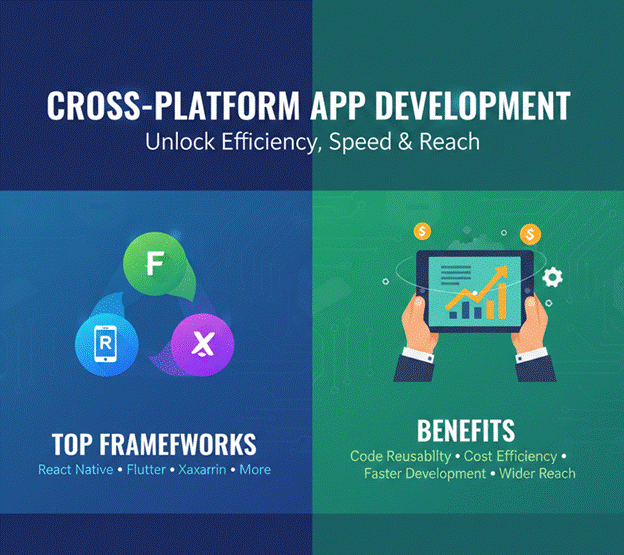
- Flutter, React Native, and Kotlin are the top most cross-platform frameworks, which are used by developers.
- India, Vietnam, Indonesia and few other Asia regions are the most cost-effective destinations to hire cross platform developers, as you can hire experienced developers for $15/hr in India.
- US, UK, Canada, Australia are some of the most expensive regions to hire developers. Even a junior Cross-platform developer may cost you a minimum $100-$250+.
With cross-platform mobile app development becoming more popular, there are a bunch of new tools popping up. It can be tricky to pick the one that’s right for you since there are so many choices.
Here’s a guide to the best cross-platform app development options and makes them stand out. Let’s get started!
What is Cross-Platform App Development Framework?
Developers use cross-platform mobile development frameworks to build native looking applications for multiple platforms such as, Android,iOS, using a single codebase.
Instead of creating different versions of apps for every platform, mobile engineers can seamlessly create apps that operate on a single platform with a single codebase.
Basically, it follows a philosophy “write once, run everywhere”, this accelerates the overall development process and helps your app develop in minimal time to market.
So, if you’re looking to build a high performance mobile app that works seamlessly across iOS, Android, web, and desktop. Hire cross platform developers to develop native applications, who have an expertise knowledge of flutter, React Native and Ionic developer to deliver a consistent user experience across iOS, Android, and web platforms.
Advantages of Cross Platform App Development
So now you’re well known about what actually a cross-platform app development, let’s move further and know some significant benefits of cross-platform app development:
1. Reduced Development Cost
Cross platform development is best known for “code once and run everywhere”. This strategy builds more productivity among tech-savvy, where developers only have to code once and they can be run on different devices. This tactic of reusable codes helps minimize development costs.
2. Best Exposure To the Target Audience
To reach out to more audiences, cross platform works better. It allows organisations to create and deploy an app over multiple platforms and the web.
3.Rapid Development Process
Cross-platform frameworks increase developers productivity by 80%, as they have to do single base code which works for every operating system.
4. Easy Maintenance and Deployment
Instead of maintaining separate codebases for different platforms, cross platform development allows for a single codebase. This means that when an update is required or a bug needs to be fixed. The changes need to be applied once to the shared codebase.
5. Integration with Cloud
Having one codebase makes it easy to link up with cloud services, so the app can use the cloud’s strong and scalable setup. Plus, adding plugins and extensions from others becomes much simpler.
Best Cross-Platform App Development Frameworks
An ideal framework makes developing cross-platform applications like a honey to flower. The best framework include:
1. Flutter
- Flutter is an open source UI software development kit created by Google.
- It is used as a single codebase for developing top notch Android, iOS, Linux, macOS and Windows.
- It’s known for its best features like Hot reload, Graphical widget, Access to native features, Internationalization.
2. React Native
- React native is an open source UI software framework developed by Meta Platform.
- It is used to develop applications for Android, Android TV, iOS, macOS, tvOS, web, Windows and UWP.
- They include features like Hot reloading, Native performance, fast refresh, and UI focused.
3. Ionic
- Ionic is an open-source UI toolkit that lets you build apps for mobile, web, and desktop. It uses web stuff you already know, like HTML, CSS, and JavaScript/Typescript.
- Basically, it gives you ready-made UI parts and tools, so you can make great-looking, interactive apps.
- It’s got some cool stuff too, like helpful native and Cordova plugins. Plus, it’s cheap and testing is a breeze.
4. Native Script
- Native script is an open source cross-platform framework that enables developers to write programs in any language, such as C#, AngularJS, Typescript, Javascript etc.
- It provides features like Live reload, Synchronization, Angular 8 Support, Access to Native APIs, and Plugins.
5. Xamarian
- It’s got the tools, languages like C#, and libraries you need to make apps.
- You can build stuff for iOS, Android, and Windows all from one place.
- And it’s not just for phones Xamarin works for smartwatches (like on watchOS and Wear OS) and even Apple TVs too.
Challenges to Cross-Platform Application Development
Successful applications come with lots of obstacles and challenges. So if you are planning to leverage this approach, consider the following points:
1. Updates Takes Time
Cross-platform applications usually take time to upgrade and they mostly rely on new and advanced features. So, it might cost you to exit from a competitive market.
2. Poor User Experience
You can use a single codebase for both platforms, so app developers cannot experience any advantage of platform specific functionalities such as 3D effects, animations, or enhanced graphics.
3. Low-Quality Images
Cross-platform applications development provides graphics whose quality is not as good as those used in natively built programs. You’ll be unable to access the core libraries of OS graphics.
4. Security
Cross-platforms apps struggle with security because of occasional updates. The applications built by cross-platform framework are always surrounded with cyberattacks.
5. Lack of Performance
Ensuring optimal performance across platforms is a major difficulty in cross-platform development. It is futile to compare the performance of cross platform apps with native ones.
Conclusion
Cross-platform development makes it easier for businesses to build apps that work everywhere without spending any extra time and cost. Top frameworks like flutter, react native, and Ionic help teams create beautiful, fast and reliable applications. With the theory of “write once and run everywhere”, cross-platform development is a smart and efficient approach for the future of app building.