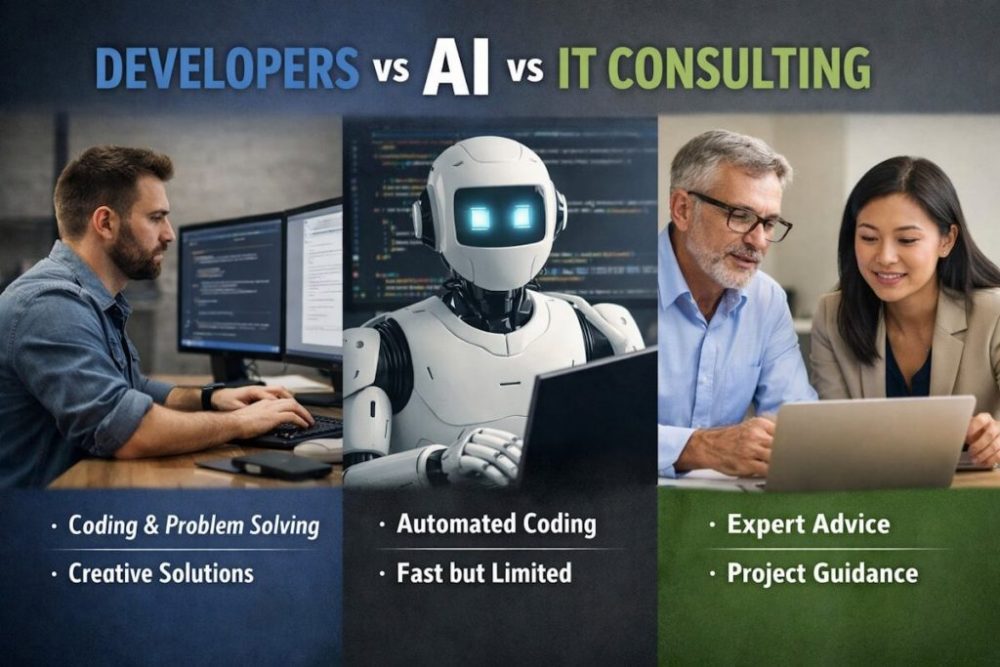
If you’re trying to make sense of where software development is heading, you’re not alone. Between the rise of AI tools, the constant shift in tech stacks, and the growing demand for external expertise, it’s easy to feel overwhelmed. Everyone’s got an opinion, but few offer a no-nonsense take that cuts through the noise.
This is your straightforward software development guide. No fluff. Just what you need to know about how software developers stack up against AI tools and why IT consulting still matters more than ever.
Let’s break it down.
What Is Software Development, Really?
Before we get into battles between humans and AI or whether to bring in consultants, let’s get the basics right.
Software development is the process of creating programs and applications that run on computers, phones, tablets, or any other device with a processor. This includes designing, coding, testing, debugging, and maintaining software.
You’ll see words like front-end, back-end, full-stack, DevOps, and more tossed around. All it really means is people building things that work—apps, websites, systems—and keeping them up and running smoothly.
The Traditional Role of Developers
Software developers are problem solvers. They look at a business need or a user issue and build something that makes it better. Whether it’s a web app for a small business or a custom CRM system for a large company, they write the code that brings it to life.
But it’s not just about coding. Developers also:
- Work with teams to understand goals
- Fix bugs and issues
- Handle deployments and updates
- Make sure everything works across devices and platforms
Good developers don’t just know how to code—they know why they’re coding something in the first place.
AI Is Here. But Can It Replace Developers?
AI tools are getting more attention than ever. Platforms like GitHub Copilot, ChatGPT, and others can now write code, suggest fixes, or even generate simple apps.
This raises the big question: what’s the deal with software developers vs ai?
Here’s the short answer: AI can help, but it can’t replace real developers.
Why? Because AI can only work with what it already knows. It doesn’t understand the why behind a business problem. It can’t talk to a client, brainstorm with a team, or make judgment calls. It can write pieces of code, sure—but knowing how those pieces fit together, and when to break the rules, still needs a human.
Think of AI like a smart assistant. It’s fast, and it’s helpful. But if you need to build something original, fix a messy legacy system, or come up with a workaround no one’s thought of yet, you’ll want an actual developer on your team.
Where AI Makes a Real Impact
That doesn’t mean AI is useless. Far from it.
AI can be a huge time-saver for developers. Some of the ways it’s already helping:
- Auto-completing code
- Finding common bugs
- Writing unit tests
- Converting documentation into code
- Speeding up prototyping
The trick is knowing where AI fits into the workflow. It’s a tool—not a replacement.
Developers who use AI effectively will likely have an edge. But you still need developers to steer the ship.
So Where Do IT Consultants Come In?
Say you’ve got a project idea but no internal team. Or maybe your in-house devs are buried in other work. This is where consulting comes into play.
When you Hire IT Consultants, you’re not just buying time—you’re buying knowledge. These are people who’ve seen different kinds of projects, worked across industries, and know the traps to avoid.
Consultants can help with:
- Defining the project scope
- Choosing the right tech stack
- Estimating costs and timelines
- Managing the development process
- Filling skill gaps in your current team
And here’s the key thing: a good consultant won’t just say yes to everything. They’ll push back when needed. They’ll point out when something’s unrealistic or risky. That kind of experience is hard to beat.
In-House vs Consulting: Which One’s Right for You?
It depends on what you’re trying to do.
Go in-house if:
- You have ongoing software needs
- You want full control over your product
- You’re building your core business around the tech
Go with consultants if:
- You’re testing a new idea
- You’ve got a one-off project
- You’re scaling faster than you can hire
Sometimes the smartest move is to combine both. Have a small internal team and bring in consultants to support when things get busy or specialized.
The Real Cost of Poor Software Decisions
People often look at development costs and think, “Can’t we just get this done cheaper?” That’s a risky mindset.
Cutting corners—especially early on—can mean spending more later. Whether it’s spaghetti code that can’t be updated or a platform that doesn’t scale, the wrong decisions can cost way more in time, stress, and money.
This is why having a reliable software development guide is useful. You want to understand not just what needs to be built, but how to build it right the first time.
Some practical tips:
- Don’t rush into coding without a plan
- Talk to users before locking features
- Choose tech that fits your team, not what’s trending
- Document everything (future-you will be grateful)
What’s Changing in the Software World?
Everything moves fast. But some trends are sticking around:
- Remote teams are the norm now, not the exception
- AI-powered tools are becoming everyday helpers
- Security is no longer optional
- APIs and integrations are key to scaling
Companies that stay flexible and open to change tend to handle these shifts better.
But even with all this movement, the core of software development hasn’t changed: figure out a problem, then solve it with code.
How to Work Smarter, Not Harder
No one wants to waste time and money. So here’s a few ways to get more out of your software development process:
- Start small. Build an MVP and test it. Don’t try to do everything at once.
- Get user feedback early. What you think users want and what they actually want are often different.
- Use the right tools. Don’t get caught up in hype. Choose what works for your team.
- Automate where it makes sense. From testing to deployments, automation saves time.
- Keep learning. Whether you’re a developer or a decision-maker, staying sharp is key.
So… Developers or AI?
If you’re still stuck on the whole software developers vs ai question, here’s a simple way to look at it:
- Use AI to speed things up.
- Use developers to solve real problems.
- Use consultants when you need clarity or extra hands.
Each has its place. No need to pick sides.
Final Thoughts: Don’t Go It Alone
Building software is tough. Whether it’s a fresh startup idea, internal tool, or a major enterprise system, there are always unknowns.
But you don’t have to figure it out solo.
Start with a clear plan. Use this software development guide to map your path. Bring in the right people when needed. And when you’re ready to take action, don’t hesitate to Hire IT Consultants who’ve done it before and can help you avoid common pitfalls.
Getting it right is less about being perfect and more about making smart moves at the right time.