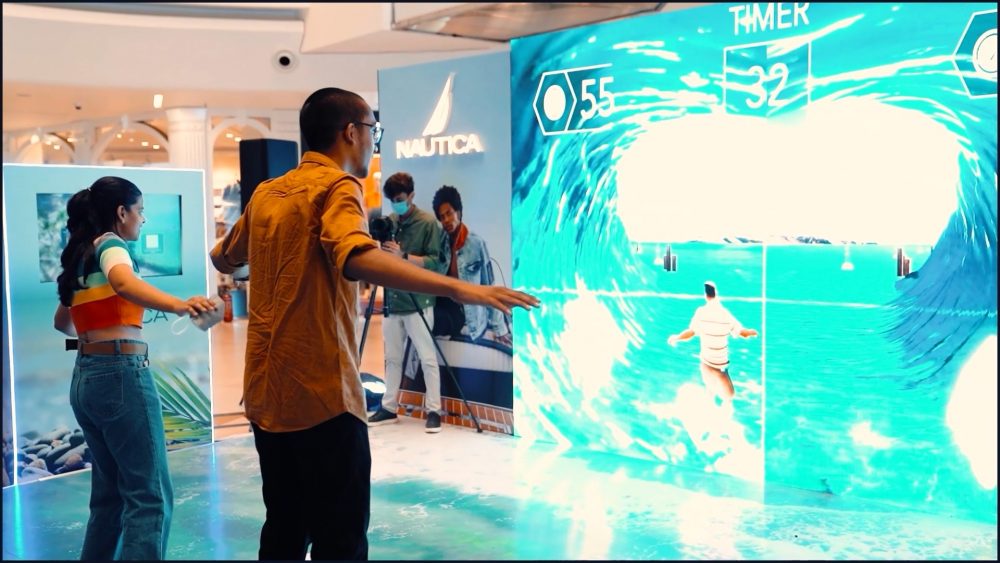
When Nautica needed to launch its Goa store and build national visibility, the brand moved beyond traditional retail openings. The result was a gesture-controlled surfing experience that logged over 500,000 interactions and increased store foot-fall by 250%. This wasn’t hype—it was deliberate design.
Here’s how real-time gesture recognition became a measurable retail driver.
The Technology Stack: Motion Sensors Meet Brand Intent
The activation centered on a physical surfing board equipped with motion sensors. Guests stepped onto the board, shifted their weight, and watched their movements translate into on-screen avatar actions. The interface captured physical gestures in real time and mapped them to surfing motions across a wave environment.
Visual output was calibrated for immersion. The display showed breaking waves, motion blur during turns, and spatial depth that responded to user input. Frame rate and latency were tuned to eliminate lag—critical for maintaining the illusion of control.
Audio layering reinforced the environment. Wave sounds, wind cues, and ambient noise matched the visual motion. The audio wasn’t decorative. It anchored the physical sensation to the digital output, creating sensory cohesion.
Multiplayer functionality introduced competition. Two guests could surf simultaneously, triggering head-to-head scoring. This extended average dwell time and created natural spectator moments around the installation.
Social capture was built into the flow. Real-time video feeds generated shareable GIFs. A QR code let participants download and distribute their content immediately. No login friction. No app download. The sharing mechanism was designed for instant gratification.
The lesson for brand teams: layered inputs—gesture capture, visual response, sound design, social output—deliver higher engagement than single-channel installations.
Process: From Concept to Multi-City Rollout
The activation aligned with Nautica’s “Joy of Water” positioning. The surfing metaphor was direct, thematic, and globally understood. The interface needed no lengthy explanation—guests saw the board and understood the task.
Development involved sensor calibration and feedback loops. Motion sensors tracked balance shifts and directional leans. Avatar responsiveness was tested repeatedly to ensure movements felt natural, not mechanical. The board’s physical resistance was adjusted to mimic surfing dynamics without requiring athletic skill.
The initial launch happened in Goa. After proving the concept, the setup was replicated in eight additional cities across India. Consistent hardware, standardized sensor configurations, and pre-programmed software allowed rapid deployment without quality loss.
Incentive design drove repeat participation. Winners received Nautica store vouchers. This linked the experience directly to retail conversion. Vouchers weren’t abstract prizes—they pulled guests into physical stores and created trackable purchase behavior.
On-ground teams facilitated participation. Staff managed queues, explained the mechanics briefly, and encouraged social sharing. The human layer mattered. Frictionless tech still requires operational execution.
For innovation teams managing activations across geographies, the replication model offers a blueprint: standardize the core, localize the deployment.
Results: Quantifiable Engagement and Retail Lift
The campaign delivered numbers worth noting.
Over 500,000 interactions were recorded. Occupancy rates exceeded 90%, meaning the installation ran near-constant use during operating hours. This wasn’t passive viewing—it was active participation at scale.
More than 10,000 coupons were distributed. Store foot-fall increased by approximately 250%. That conversion rate—from experiential touch to retail visit—demonstrates how physical-digital interfaces can drive commercial outcomes.
The activation spanned ten cities. From coastal markets to inland metros, the setup maintained consistency while adapting to local venue constraints. Geographic reach amplified brand awareness without fragmenting the message.
Fifty-plus influencers engaged with the installation. Their documentation extended reach into follower networks, creating earned media beyond the event footprint. Influencer participation wasn’t paid promotion—it was organic curiosity about a novel experience.
For decision-makers evaluating experiential ROI, these metrics offer benchmarks: interaction volume, redemption rates, geographic scalability, and organic amplification.
Strategic Takeaways for Brand Managers
Intuitive interfaces lower barriers. The surfing board was self-explanatory. Guests didn’t need instructions or demos. The physical metaphor communicated the action instantly. When designing interfaces, clarity outperforms complexity.
Multi-sensory design deepens memory. Visual feedback alone creates weak retention. Add sound, physical motion, and real-time response, and the experience becomes memorable. Brand recall improves when multiple senses encode the interaction.
Competition extends engagement. Multiplayer mode transformed individual tries into social events. Spectators formed, participants challenged friends, and dwell time increased. Gamification isn’t a trend—it’s a proven retention mechanism.
Social sharing replaces paid media spend. By enabling instant GIF creation and QR distribution, guests became content creators. User-generated content reached networks the brand couldn’t access through paid channels. Designing for shareability is cost-effective reach.
Scalable frameworks enable national campaigns. The activation launched in one city and expanded to nine more. Replication required logistical planning but not redesign. Mature brands can build activations with rollout potential from day one.
Metrics validate investment. Tracking interactions, coupon redemptions, and foot-fall increases allowed Nautica to quantify impact. Activations without measurement are guesswork. Build analytics into the experience from launch.
Application for Established Brands
If your team manages retail innovation, product launches, or experiential campaigns, these insights translate directly.
Choose interfaces that invite action. Static displays generate views. Interactive installations generate participation. The difference in engagement is measurable.
Align technology with brand narrative. Nautica used surfing to express “Joy of Water.” The interface reinforced the story. Don’t adopt technology for novelty—deploy it to amplify brand meaning.
Design for frictionless sharing. Participants should leave with content they want to post. QR codes, instant downloads, and pre-formatted media remove barriers to distribution.
Link experiences to conversion points. Vouchers connected the activation to store visits. Tie participation to your commercial ecosystem—whether that’s foot-fall, site visits, or product trials.
Ensure technical reliability. Motion sensors, gesture recognition, and real-time capture must function flawlessly. User delight depends on seamless execution. Budget for robust hardware and on-site technical support.
Plan for replication early. If the concept works in one market, prepare for expansion. Standardize components, document setup protocols, and train deployment teams before launching city two.
Track what matters. Measure interaction counts, dwell duration, incentive redemption, social shares, and downstream conversion. ROI clarity requires defined KPIs from project initiation.