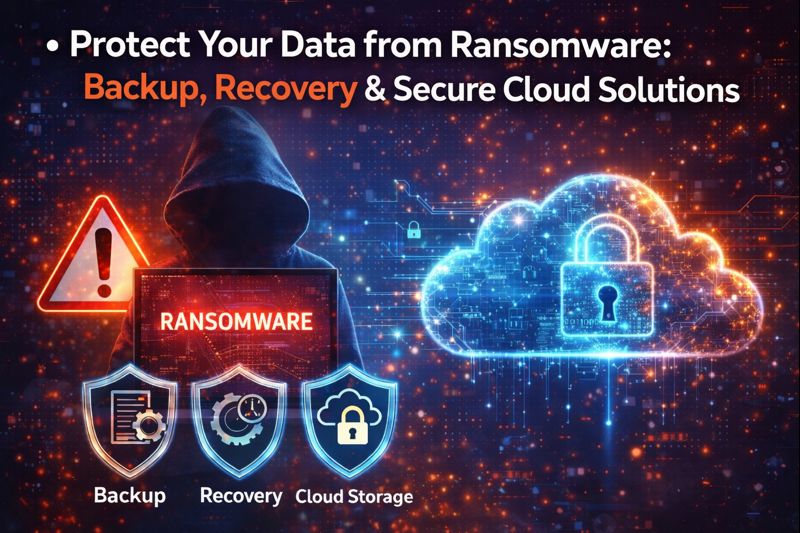
In the modern world, ransomware attacks are one of the gravest cyber threats that businesses and individuals face. Ransomware will probably dominate the cyber threat in 2026. It will intercept your precious information and will release your value at the cost of money. Other implications of ransomware attacks include disruption of operation, loss of confidence, and the fact that once the information is lost, it cannot be replaced.
Nevertheless, ransomware attacks have resolutions to overcome your hostage data through the intelligent combination of Secure Cloud Storage Solutions, data recovery methods, and security solutions on your cloud storage. This guide will mark out the fundamentals in order to keep your data safe in 2026 and beyond.
What Is a Ransomware Attack?
Ransomware is a form of cyber extortion where hackers gain access into a system, encrypt files and require payment (usually in crypto currency) to be able to access those files once again. Ransomware attacks are growing more advanced and apparently cybercriminals are attacking healthcare, finances, government, and cloud-based infrastructure.
Why You Must Protect Against Ransomware Attacks
In cybersecurity reports of the world, the average is greater than $30 billion (in damages) as of 2026 because of cybercrime all over the world. Then why is it so extraordinarily significant to prevent and protect against ransomware attacks?
• Permanent data loss
• Ransom will not be a guarantee of recovery.
• Lost revenue is covered by downtime.
• Damage in reputation may be irreparable.
• Risks of not complying with the law (GDPR, HIPAA, etc.)
Vulnerability, back up and data recovery system, especially those that are saved on a backup, virus-free silo cloud platform is essential in preventing spam, ransomware or viral attacks.
The Role of Secure Cloud Storage in Ransomware Defence
Cloud Storage secures you against ransomware, take into account four points:
1. Immutable Backups
You are supposed to store your backups in a NAS (Network Attached Storage) or S3 compatible storage that is capable of maintaining backup immutability. By doing so, you will be certain that there is no one (not even an administrator) who will tamper with the backup files.
2. Versioning / File Snapshots
Automated versioning is provided by cloud storage vendors like 10pb. Even when the Ransomware encrypted the very recent copy of your files, you can still restore a prior version of your files.
3. Geographical Redundancy
An attack of ransomware on your on-premise systems will not affect your cloud backups. They can be stored in various safe areas as long as they are stored.
4. Access Control
Cloud systems have rigid access control and access logs. These access controls can significantly minimize internal and external threats.
Creating a Ransomware-Proof Backup Strategy
The best solution against ransomware is a good data backup and recovery plan. The 3-2-1 strategy of backups, namely:
- 3 copies of your data
- 2 different types of storage
- 1 copy onsite (cloud storage would be best)
Backup Basics:
Automated Backups: Backups are to be done every hour or day.
Health Testing: You are expected to do practice restores regularly.
Cloud/Offsite Backup and Offline Storage: You are advised to back up to offline media such as a tape or BDR besides cloud backups.
Retention Policies: save historical data as original monthly back-ups.
Recovery: Your Secret Weapon After an Attack
No matter how good the defenses, there will always be a failure. This is where recovery comes in. Solutions like 10pb, provide cloud-based data recovery options, the ability to:
- Rapidly restore complete environments with little downtime
- Recover individual files or entire systems.
- Reduce overall data loss utilizing near-instant snapshots.
- Protect endpoints, servers, databases, and VMs.
- Recovery readiness is your insurance when prevention fails.
How 10pb Helps You Stay Ransomware-Proof
Whatever the excellence of the defenses, there will be an ultimate failure. That is where recovery helps. such solutions as 10pb, offer cloud-based recovery options of data, the capability to:
- Re-create entire environments in a very short time.
- Restore single files and complete systems.
- Minimise loss of data in general using snapshots in real time.
- Secure of endpoints, servers, databases, and VMs.
Your insurance in case of prevention failure is recovery readiness.
Best Practices to Prevent Ransomware Attacks
Here’s a checklist to follow:
• Virtual antivirus and endpoint protection.
• Update software on a regular basis.
• Train workers on phishing.
• Multi-factor authentication (MFA) should be used.
• Restrict admin privileges
• Compose Secure Cloud Solutions.
With these approaches and a solid cloud storage policy they can protect your digital properties.
Industries That Must Prioritize Ransomware Protection
Health care: Hackers have a strong target against patient records.
Finance: Ransomware is highly disruptive to the business and can make them vulnerable to regulatory failures.
Education: strapped budget, yet there they have some huge amounts of data.
SaaS & Start-ups: They are likely to have their mission critical applications on.
In those issues, the cloud storage of 10pb has always-on recovery and ransomware protective features that give one peace of mind.
FAQs
1. How do you protect yourself the most against ransomware?
Naturally, there is not a single solution: an integrated system of cloud storage with permanent backups, access control, employee education, and renewed security software.
2. What is the frequency of cloud-based back-ups?
You would like to have more backups every day (or even better, every hour) based on the frequency of use and kind/size of data you should have to maintain your business that is very important.
3. Is my cloud backup vulnerable to ransomware?
Yes, however, except when they are not versioning enabled or immutable and this is why you would always prefer to use immutable S3 compatible storage.
4. Can we be secure storing confidential business information in the cloud?
Yes, so long as it is encrypted, controlled access, and it is in compliance with your requirements such as ISO, HIPAA and SOC2 such as 10pb.
5. How does 10pb assist me in regaining after being a victim of Ransomware?
10pb assists you to swiftly restore to heal your business in a cost effective and secure manner through immutably backing up the data, conflagration of versions, point in time restores and automating notifications.