Buying components for the industry in India is quite a challenging task. It doesn’t matter if you are in a technology hub like Bengaluru or an automobile industry center like Pune, you will be faced with an overwhelming multitude of choices. On one side, you have world-class manufacturers and, on the other side, you have workshops that you’ve never heard of, both claiming to be able to deliver the task. But when it comes to Pillow Block Bearings, “doing the job” is not enough. It has to do the job for ten thousand hours without you even thinking about it.
What Are We Actually Talking About? (The Basics)
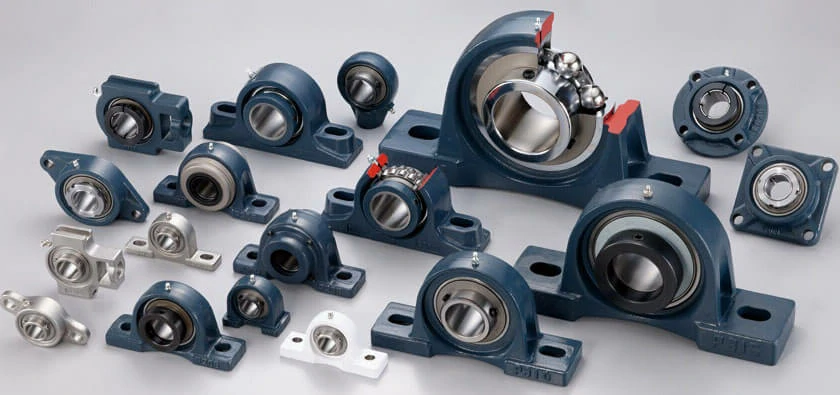
A pillow block bearing might sound fancy, but it’s just a housing with a built-in support for turning shafts. Depending on where you are, someone may call it a plummer block instead. What matters is that it holds a bearing securely while letting the shaft spin smoothly inside. These bearings, being mounted on surfaces which are parallel to the shaft axis, are usually visible and, unlike other bearings, could therefore be considered to be exposed to a harsh environment.
Such a simple product, wholly made up of a pedestal, a housing, and a bearing insert, can easily mislead one. As a matter of fact, this is often the case. Because pillow block bearings may be constantly exposed to dust, moisture, and heat, the kind of decision you make during the sourcing of components phase is what is going to determine whether your machine with these parts will run smoothly for a long time or it will give you maintenance problems.
The Anatomy of the Assembly
- The Housing: Usually made from cast iron or pressed steel. That’s the “pillow” part.
- The Insert Bearing: Generally, a deep-groove ball bearing with a spherical outer diameter.
- The Sealing: The unsung hero that keeps the grease in and the “Indian monsoon” out.
- The Locking Mechanism: The part that actually grips the shaft.
Step 1: Choose your materials wisely
Housing material is the first decision you will make while choosing a pillow block bearing. However, instead of guessing what people usually do, I would say that they often resort to cast iron mainly because “it’s the way things have always been done,” but the truth is that the environment is a real boss in this case.
Cast Iron (The Standard)
In India, grey cast iron in Grades 20 and 25 is mostly used in industrial applications. There are lots of benefits, such as it is stiff, vibration is muffled reasonably well, and it is cheap. If you have a standard conveyor in a dry warehouse, then he is your guy.
Thermoplastic and Stainless Steel
On the other hand, if you run a food processing plant or a chemical manufacturing facility near the coast, where salt air is like breakfast to metals, then using cast iron is totally wrong. I remember seeing cast iron blocks getting rusted and shutting in no time in the case of Chennai’s dampness. In such cases, a combination of thermoplastic housings and stainless steel inserts is the right way to go. They are the “washdown” type of equipment. They don’t peel off, rust, and they make the auditors happy.
Step 2: The Load and Speed Equation
This is actually the part where the “Expert” in me comes out. You just cannot select a bearing based on the shaft size. Of course, you can, but then you will be gambling.
Static vs. Dynamic Loads
Firstly, radial load is the weight pressing down, so you need to know that, and secondly, the axial load is the force pushing along the shaft. While Pillow Block Bearings are mostly alright with radial loads, they don’t excel with axial ones. So, in case your belt is angled and pulling, the bearing will certainly notice that.
The Speed Limit
Speed limits matter for every bearing. Running a fan too fast can push a standard grease-packed housing beyond its limit. Heat builds up when resistance rises. That heat makes the lubricant runny. Once it thins out, trouble follows. Matching the RPM spec to what the motor delivers keeps things safe. Seems obvious, yet plenty overlook this small point.
Step 3: Secure with locking mechanisms to prevent slipping
The bearing’s fixation to the shaft is a major source of problems. To be frank, I have received more calls about shaft slipping than probably any other issue.
- A set screw locking is where typically two screws bite into the shaft. The installation is easy, but the screws might damage the shaft a little bit. It’s fine for moderate speeds and loads.
- An eccentric locking collar: You rotate the collar in the direction of rotation to fix it. It’s very tightly locked; if the shaft reversal happens, the collar might loosen. Fortunately, I had a chance to learn it on a reversible conveyor.
- A tapered adapter sleeve: It is the standard of excellence in utilizing such close grips that one can hardly feel the vibration in the production line. Though there is the inconvenience of being pricey and somewhat difficult to fit, the high-load industrial applications make it a good investment.
The “Speed to Market” Factor in India
The market today is very competitive, and everyone is racing to go ahead. Based on the research given, those who act first will be the ones who find opportunities before those who follow. When your machine breaks down in the factory, you cannot stay idle for weeks until you get a spare part from overseas.
Therefore, my advice to my clients is always to search for manufacturers that have a solid local basis. Brands like SKF, FAG, or high-quality Indian players like NBC or Tata Bearings have distribution networks that are capable of delivering you a replacement within 24 hours. Quicker response to your production team’s needs internally, compared to your competitors, will give a considerable advantage to your business. What you are doing is simply working smarter instead of harder.
Step 4: Sealing and Lubrication (The Life Insurance)
Lubrication is the biggest single bearing failure cause – moral 80% of the time. Any one of the three problems: too much, too little, or the wrong type, can result in failure. Especially in India’s industrial dusty areas – think of a cement plant or a quarry – dust is like very fine liquid sandpaper.
The LSH in bearings
Think about it like this: while low-smoke halogen matters in cables for safety, triple-lip seals play the same role in bearings – only they guard against wear. A basic metal shield won’t cut it when dirt sneaks in. What works is a tight seal blocking grime before it enters. That kind of barrier makes parts last far longer.
Relubrication vs. Sealed-for-Life
- Relubricatable: Such bearings have a grease fitting (zerk). Great if you have a disciplined maintenance team.
- Sealed-for-Life: The best choice when the bearing is in a position that is “difficult to access.” Nevertheless, consider that once the grease runs out, it is the end of the bearing.
The AI and Tech Angle: Predicting Failure
It is common that the industry goes with the idea of not waiting for equipment to break down. Therefore, forefront companies employ performance tracking based on AI so they can immediately change their plans.
Nowadays, there are smart Pillow Block Bearings that are equipped with vibration and temperature sensors. The data from these sensors is sent to a central system. For example, instead of a technician climbing the ladder each week to check the heat the system sends an alert directly to the technician’s phone, “bearing 42 is 5 degrees hot, check the alignment.” Technologies like that are great because they get rid of manual work and make companies operate faster. It also changes the concept of “maintenance” from “repair” to “planning”.
Step 5: Vetting Your Supplier in the Indian Market
Let me be very honest. India is full of sellers who sell “used” bearings as if they were “new”. What they basically do is take an old, worn-out bearing, polish it up, package it in a new box, and sell it at a 40% discount.
How to Spot a Fake
- Have a look at the price: When a price quote is far below the price of genuine dealers, you should be very careful. You are essentially using the same raw materials. The only way to save such a large amount is to buy steel of extremely poor quality.
- The Box and Laser Marking: Take a look for sharp printing and exact laser etching on the bearing race. Fake product labels are commonly blurred.
- Certifications: Always request a Certificate of Conformity. If you wouldn’t purchase a cable that doesn’t have an ISI mark, you should also refuse an industrial bearing that doesn’t have the correct documentation.
The Strategic Balance: Cost vs. ROI
A fresh look at bearings might surprise you. When cutting costs becomes the only goal, like that AI case revealed, room for real progress often shrinks.
A solid pillow block bearing means fewer worries down the road, backed by a warranty built to last. Buying one of these isn’t just about metal parts arriving on time – it’s about keeping machines running when everything else slows. Think midnight shifts humming along because the right part held firm. Peace of mind shows up quietly, often around three in the morning.
Finding balance matters, just as Pernod Ricard did – moving fast now while also shaping what comes next. Paying extra today for a leading brand? Often, it means less time lost later, which keeps things agile when change hits.
Common mistakes to avoid
I have also made mistakes as well as witnessed others making bigger ones. Listed below is a quick reference of what not to do:
- Ignore Shaft Tolerance: If the shaft you have is even 0.05mm smaller, the bearing will not properly grip it. Vibrations, heating, and, eventually, breakdown will be the result. Always use a micrometer for measuring your shaft before ordering the bearing
- Applying excessive grease: – This is the “Indian Uncle” attitude towards maintenance, if a little is good, then a lot must be better. Wrong! The presence of too much grease will cause the internal friction, which in turn leads to seals being blown out.
- Incorrect Housing: Use a heavy-duty insert for a light-duty housing. It is the housing that will break upon the first shock load.
Actionable Advice: Your 5-Step Sourcing Checklist
You sit there, staring at the screen, wondering about pillow block bearings for that upcoming job. Now it is only the two of us, nothing else around. Picking one might feel tricky, but here’s how to move forward: a clear path through the confusion
- Picture rain, grit, heat – what happens then? Not just sunny skies and clean floors. Housing made of cast iron handles rough days better. Thermoplastic might bend when things get ugly. Think past calm mornings. Imagine midweek chaos instead. Tough materials win when conditions shift hard.
- Be sure to define the load: Radial and axial Newton-meters should be clarified with your engineering team. No guessing, please.
- Start here: set screws work well when tasks stay basic. When machines shake hard or run nonstop, go sleeve instead. Choice shifts with the stress level onthe equipment.
- A solid quality check starts with asking suppliers for proof. One key piece is the ISO 9001:2015 certificate – it shows their process meets standards. Then there’s the lab report; it has to come from a NABL-approved facility. That document confirms the actual batch was tested properly. Without these two, verification falls short.
- Picture this: how much does each hour without that budget bearing really set you back? Add in what you paid for it. Now slide in the price of a top-tier version instead. See where the numbers land. Turns out, spending more up front saves money later. Funny how math works.
Conclusion
Ultimately, your industrial business is just the Components you choose today. As I mentioned earlier, a slow response to a missed market signal or a delayed product release may even seem harmless; however, the situation gap between competitors will become huge over time. In fact, a bearing failure is a “missed signal” from your machine.
Do not allow a small price difference to lure you into making a compromise on your mechanical system. Choose a partner rather than a supplier. Even if you are upgrading a factory in Maharashtra or building a new plant in Gujarat, quality is still king.
Truth be told, the whole thing is about respect: respect for machines, respect for people’s time, respect for the bottom line. I hope you make the right tool choices and power your projects with the confidence of a truly well-equipped tradesman.