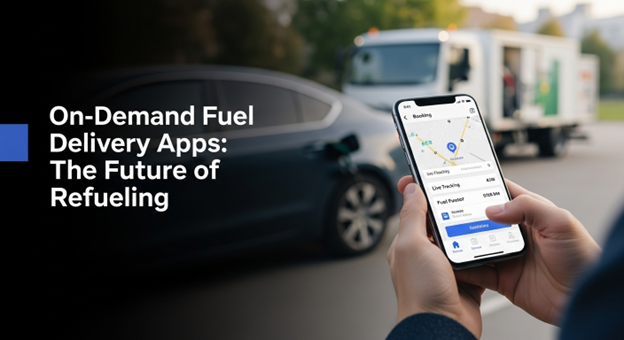
Think back to a time when you found yourself stuck on a highway with your fuel warning light flashing. Or how about the experience of being late to work one morning because you stopped at the gas station to fill-up, only to remember that you have to drop off your kids before heading into the office? These are common daily frustrations for millions of people and until recently, no one ever really considered the possibility of solving them.
Now you know the answer, it’s right here on your phone (or tablet) – with on demand fuel delivery applications changing how we look at refueling. Instead of driving to a gas station, you simply request to have fuel delivered straight to your vehicle, wherever it may be parked at – whether in front of your house, in the parking garage at your office building or just somewhere else that is convenient for your lifestyle. It may sound too good to be true; however, this is where the fuel industry is going.
What Is a Fuel Delivery App?
Petrol, Diesel, and even Electric Vehicle (EV) charging is available to fuel delivery app users, by way of a simple app that connects them to mobile fuel providers, including truck and tank drivers, by way of a quick and easy “on-demand” application process. Users simply input the location of their vehicle, choose which type of fuel they want, either petrol, diesel or, in some cases, electric charging, and fuel delivery services are completed within less than 1 hour using payment methods that are completely online.
The idea also has a lot of similarities with what many other delivery services have done, such as food delivery or ride-hailing, as well as a working example of being able to deliver products or services to customers in a manner that is much more efficient than if customers travelled to them. The key principle behind all these delivery services is that you are providing customers with a value for your time, and there is the inconvenience of having to drive out of your way to get gasoline. Therefore, the development of fuel delivery services is a way that technology can help solve this problem.
Why Are People Actually Using These Apps?
Many people consider fuel delivery apps to be an unnecessary convenience, but there’s more to it than simply saving you a trip. Consider the following factors driving adoption:
- Time savings for your everyday traveler are huge: From a fleet manager to sales reps, to someone who travels daily for work, you could be losing 15-20 minutes every time you fill up with gas, once you consider travel time, wait time, and payment time. Over the course of a month, that’s a lot of lost productivity!
- Fleet management is so simple now: Companies that operate large fleets of vehicles, such as logistic companies, taxi services, and delivery services, benefit tremendously from fuel being sent directly to their fleet. Centralized fuel delivery saves a lot of downtime and administrative headaches for companies operating a large fleet.
- Safety and convenience with late-night fueling: Imagine being at a gas station at 2 AM on a dark highway. Fuel is now available at your home or in a well-lit parking lot. No more worries about safety!
- Emergencies: Running out of gas on a highway is extremely dangerous. Emergency fuel delivery is one of the most practical benefits of using fuel delivery apps.
The Technology Powering These Platforms
Behind each efficient fuel delivery experience are significant logistical technology applications that enable the efficient delivery of fuel to customers. In particular, GPS tracking allows drivers to find their customers’ vehicles accurately and most efficiently. The flow of real-time information provides customers with updated information on deliveries throughout the delivery process. Additionally, dynamic pricing algorithms allow for the adjustment of fuel prices to ensure that supply meets demand within each of the respective delivery zones, and digital payments facilitate the acceptance of both one-time transactions and monthly payments from fleet customers.
The best platforms for delivery drivers also utilize route optimization technology to decrease the number of trips required to service multiple customers that are located in proximity to one another. This not only enhances the operational efficiency of the delivery driver but also decreases the amount of fuel that he/she uses to complete the delivery, thereby eliminating one of the many criticisms that are often levied against this model of fuel delivery.
If you’re thinking about building or investing in this space, understanding the technology blueprint is essential. A well-executed fuel delivery app development process covers everything from dispatch algorithms and real-time driver tracking to payment integration and white-label solutions. Getting the tech architecture right from day one can be the difference between a platform that scales and one that stalls out before it gains any real traction.
Is the Market Ready for Fuel Delivery?
The global on-demand fuel delivery market is continuing to expand at a steady pace, with no sign of slowing down. Many factors are contributing to this demand, including urbanization, increased vehicle ownership, and increased customer expectations for convenience. Countries such as the US, India, UAE, and Australia have all recently launched fuel delivery services by active players in the market.
In addition, the regulatory environments are also starting to catch up. Many areas have updated their licensing regulations to allow for mobile fuel dispensing and treat the delivery tankers through the same safety regulations as they do a stationary gas station. This regulatory certainty has provided greater confidence to investors and entrepreneurs entering the space.
For startups entering this market space, there has never been a better time, as barriers to entry have decreased significantly. White-label app solutions are available so that you do not need to build everything from the ground up; rather, you can purchase or license an existing platform and direct your focus on operations, partnerships, and customer acquisition.
Challenges That Still Need Solving
In naming the real-life barriers facing the industry, they must be addressed to give an honest picture.
- The Regulatory requirements vary greatly in terms of compliance related to the handling and transportation of flammable liquids; compliance encompasses a wide range of Permit required, Training for the Operator and his Drivers/Employees; a Vehicle that complies with the appropriate regulations. The cost of moving fuel safely would create a significant financial hardship for a startup company.
- There is a very limited Coverage area for providing mobile Fuel Delivery Services. Therefore, Mobile Fuel Delivery Services require a density of Customers within their Coverage area in order to create enough volume to make Route Operations Economically Feasible. Mobile Fuel Delivery Services are viewed as Very Challenging to provide Service in Rural Areas – the density of customers is simply not there.
- Consumers need to feel Comfortable and have a certain level of Trust when allowing somebody that they do not know access to their unattended Vehicle. Building that Trust involves Transparency and thorough processes, such as Background Checks, and the use of tamper-evident seals.
- The price offered to a Customer for delivered fuel will include: Fixed Operating Costs associated with each Vehicle Used, Driver wages, and operating fees (i.e., an App, etc.) Associated with providing the Order, all will be included in the price to the Customer. While providing a Reasonable Margin to provide for the Business Operation, along with being profitable, is always a Delicate Balance.
What the Future Looks Like
There’s no doubt about it — the delivery of energy to consumers will evolve as electric vehicles become more common. Fuel delivery apps are already making the transition by adding mobile electric vehicle (EV) charging to their offerings, in addition to regular gasoline and diesel service. Some services are investigating delivering hydrogen fuel to commercial fleets. The technology that will power energy delivery to consumers and the behaviors of consumers that they will develop through today’s services will set the stage for what energy delivery looks like in the decade to come.
For entrepreneurs and investors, there is still an opportunity to enter this market, but that opportunity will not last indefinitely. The first movers’ advantages in local markets are significant, brand loyalty is extremely sticky, and the network effect of having an established delivery fleet is nearly impossible to duplicate. The question is not whether fuel delivery will be a standard consumer service, but rather who will control that service in your local market.
If you’re curious about what goes into building one of these platforms from the ground up, this is a great place to start: The Best Tech Stack For Fuel Delivery App Development
Final Thoughts
On-demand Fuel Delivery isn’t a gimmick but rather an effective service designed to provide real-life solutions for businesses and consumers alike. Just like how food delivery faced early doubts but eventually gained widespread acceptance, so too will on-demand fuel delivery. The companies that can establish themselves at the forefront of the industry by executing well on key attributes (operational excellence, safety, and exceptional customer care) will ultimately set the standard for the industry going forward.
Whether you are a consumer who is interested in trying out Fuel Delivery Apps, a fleet manager focused on improving operational efficiency, or an entrepreneur looking for your next big business opportunity, you should check out what Fuel Delivery Apps have to offer.