Think about the last time you waited more than a few minutes for a service without checking your phone or feeling mildly frustrated. It probably did not take long to recall. This is the world businesses are operating in today, one where patience is short, expectations are high, and the window to impress a customer before they switch to a competitor is razor-thin.
On-demand app solutions have stepped into this gap and changed the rules entirely. From healthcare to home services, from logistics to fuel delivery, businesses that have adopted this model are not just keeping up. They are pulling ahead. And businesses that have not are quietly losing ground, often without realizing why.
This article breaks down why on-demand apps have gone from a trend to a business necessity, what makes them effective, and how industries, including fuel delivery, are using them to unlock real, sustainable growth.
The Expectations Have Already Shifted — For Good
Consumer behavior is not going back. The widespread adoption of smartphones, coupled with years of using apps like Uber, Swiggy, and Dunzo, has recalibrated what people consider “normal” when they interact with any service business. Instant confirmation. Real-time tracking. No phone calls. No waiting in the dark.
According to industry estimates, the global on-demand services market was valued at close to USD 200 billion in 2024 and is projected to cross USD 320 billion by 2033. This is not niche growth. This is a structural shift in how services are requested, delivered, and paid for, cross virtually every sector.
For business owners, the implication is straightforward: if your service can be delivered digitally, booked, tracked, and fulfilled through an app, your customers already expect it to be. The question is whether you are the one offering it, or your competitor is.
What On-Demand Apps Actually Do for Business Growth
Even though many people expect an on-demand application to be a tool for ordering or booking, there is much more to it than that. When designed with care, by experienced mobile application developers who consider the right architecture, user flows, and other components, the on-demand application can serve as the operational backbone of your business. Below is how an on-demand delivery application can provide value to your business:
- Automated service delivery: With automated service delivery, all of your operational processes will happen automatically from booking to confirmation to dispatch. Your focus will be on executing services without coordinating them.
- Real-time visibility of orders for customers: When customers can track their orders, they will have real-time information about where their orders are, when to expect them, and who is going to deliver them. By providing this level of transparency to customers, you will help to eliminate cancellations and reduce customer support frequency.
- Smarter decisions through data: Every time someone books a service, there is a delay, receives a rating, and re-books, you collect data. All of this information is collected passively through the on-demand application and made available in dashboards that your operational team can utilize in making decisions.
- Customer loyalty through convenience: If your customers find it takes less effort to use your product than it would take them to call a competitor for their service, they will tend to return to your business. Making using your product easy will build a habit and create the strongest form of loyalty.
- Scalability without proportional costs: If you double your order volume, you do not have to double your labor force to accommodate this growth. Using efficient dispatch, automated workflows, and allocating resources in real-time allows you to grow your company’s operational capacity.
Why Most Competing Articles Miss the Point
Search for this topic, and you will find dozens of articles listing generic benefits: “reach more customers,” “reduce costs,” “improve user experience.” These are true, but they do not explain anything. They are conclusions without context.
The reason on-demand apps drive business growth is not that they look modern or tick a technology checkbox. It is because they fundamentally reduce the distance, both literal and operational, between a customer’s need and its fulfillment. Every friction point removed is a reason for the customer to stay. Every automation added is overhead your business no longer carries.
The businesses winning with on-demand apps are not the ones that built the flashiest interface. They are the ones who mapped their real operational pain points, identified where customers were dropping off or getting frustrated, and solved those problems specifically.
Real-World Impact: On-Demand Fuel Delivery
Fuel delivery services are often perceived to be old-fashioned, yet they are ripe for an overhaul by a transition to an on-demand model. Examples of companies in the industry include fleet management companies, logistics firms, construction companies, and agricultural operations. All of these types of businesses have one common operational challenge – making sure that they receive the right amount of fuel at the right time and without disrupting their work processes.
The traditional method of delivering fuel can be costly, prone to numerous errors, unpredictable lead times, and difficult to grow. Route efficiency suffers due to delivery missed due to information provided for deliveries being inconsistent in nature; fleet managers are spending a large portion of their time chasing after confirmation documents from suppliers instead of managing their fleet.
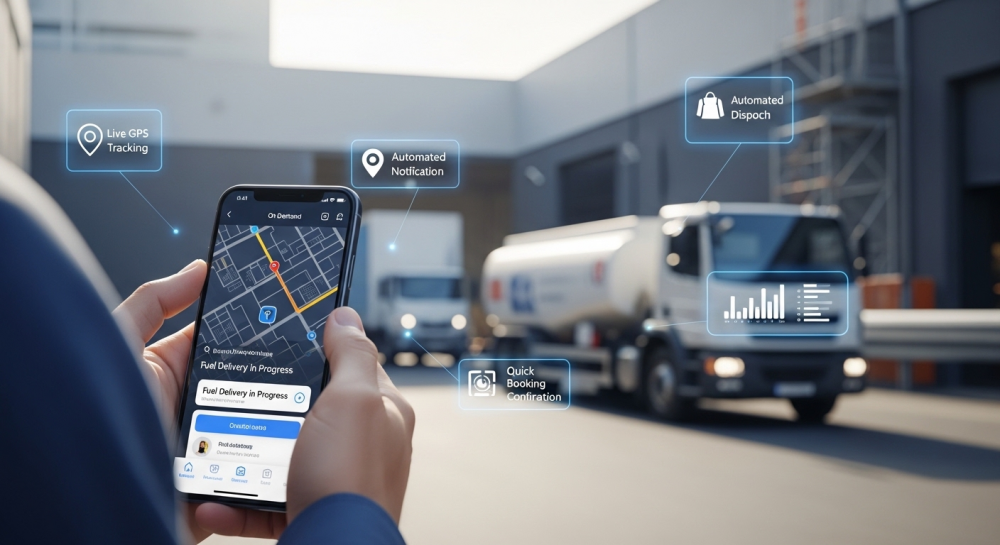
A purpose-built app that provides an on-demand fuel delivery app service will eliminate all of these sources of frustration. Through the use of the on-demand mobile ordering app, customers can enjoy placing their own fuel orders, identifying the type of fuel required and the quantity, determining where they want the fuel delivered to, and receiving an estimated time for delivery in less than two minutes.
On the business side of the equation, the on-demand delivery service assigns drivers based on geographical proximity and availability; provides optimization of delivery routes for both fuel consumption and delivery time; generates automatic invoices and email delivery confirmations; and maintains compliance with record management that would otherwise require manual record-keeping methods.
The benefits are now clear – they have been realised already, from fewer failed deliveries to reduced operational costs, higher levels of customer retention, and a business capable of processing twice its typical order volume with an equivalent number of employees working, to provide an idea of how the on-demand way of thinking translates into practice within a very important, functional and unexciting industry.
Industries Being Reshaped Right Now
Fuel delivery is just one of several industries experiencing substantial operational efficiencies as a result of on-demand applications. There are many other examples of this transformation, such as the following:
- Healthcare – Patients are now able to access teleconsultation, request prescriptions, and have home health visits scheduled with no need to call the clinic. This has enabled healthcare providers to eliminate no-shows and reduce their administrative burden.
- Home Services – Plumbers, electricians, and other repair personnel receive automatic dispatch notifications, as well as live estimated arrival times (ETA), service history, and payment functionality within the app. Home service providers are able to manage their entire calendars from a single screen.
- Logistics and Last Mile Delivery – Businesses can offer same-day or scheduled deliveries without maintaining their own transportation fleets by utilizing on-demand driver networks that scale with their volume of orders.
- Fuel and Energy – As noted above, fuel, compressed natural gas (CNG), and other forms of energy delivery are moving toward web-based models for both customers and large business-to-business (BtoB) fleet accounts.
- Beauty & Wellness – Salons, personal trainers, and other health and wellness service providers are beginning to perform their services directly in the homes of their clients, while also providing booking, payment, cancellation, and review functions through the use of applications.
What Separates On-Demand Apps That Grow Businesses From Ones That Don’t
Not every on-demand app succeeds. Many are built to impress in a demo, not to solve real problems at scale. The ones that actually move the needle for businesses share a few consistent traits.
First, they are built around the customer’s journey, not the developer’s assumptions. Before a single screen is designed, the best teams map out exactly how a customer currently interacts with the service, and where they drop off, hesitate, or get frustrated. The app is then built to remove those specific obstacles.
Second, they start with a focused MVP. A common mistake is trying to build everything at once: a multi-city launch, ten service categories, advanced analytics, subscription tiers. None of it gets done properly, and the launch is delayed by months. The best on-demand apps launch with one core service, one city, and one tight user flow, then expand based on real feedback and real demand.
Third, they are built on an architecture that can scale. An app that works fine at 100 daily orders and breaks at 1,000 is not a growth tool; it is a liability. Choosing the right tech stack, cloud infrastructure, and database design from the beginning is what allows a business to grow without rebuilding.
The Future Belongs to Businesses That Move First
The on-demand economy is not slowing down. It is becoming the default expectation for every service, in every industry, at every price point. Customers are not going to start tolerating slow, manual, phone-based service again; that ship has sailed.
Businesses that invest in on-demand app solutions today are not just improving their operations. They are building a competitive gap that becomes harder to close with every passing month. While you are still coordinating deliveries over phone calls, your competitor’s app is quietly learning your customers’ preferences, earning their loyalty, and making the switching cost feel too high to bother.
The good news? The window is still open. On-demand apps are no longer reserved for Silicon Valley startups with unlimited budgets. Whether you are running a fuel delivery business, a home services company, a logistics operation, or a healthcare practice, the technology, the talent, and the market demand are all accessible right now.
The only real question is not whether your industry needs this. It already does. The question is whether you will be the business in your market that customers open their app to find, or the one they have already stopped thinking about.