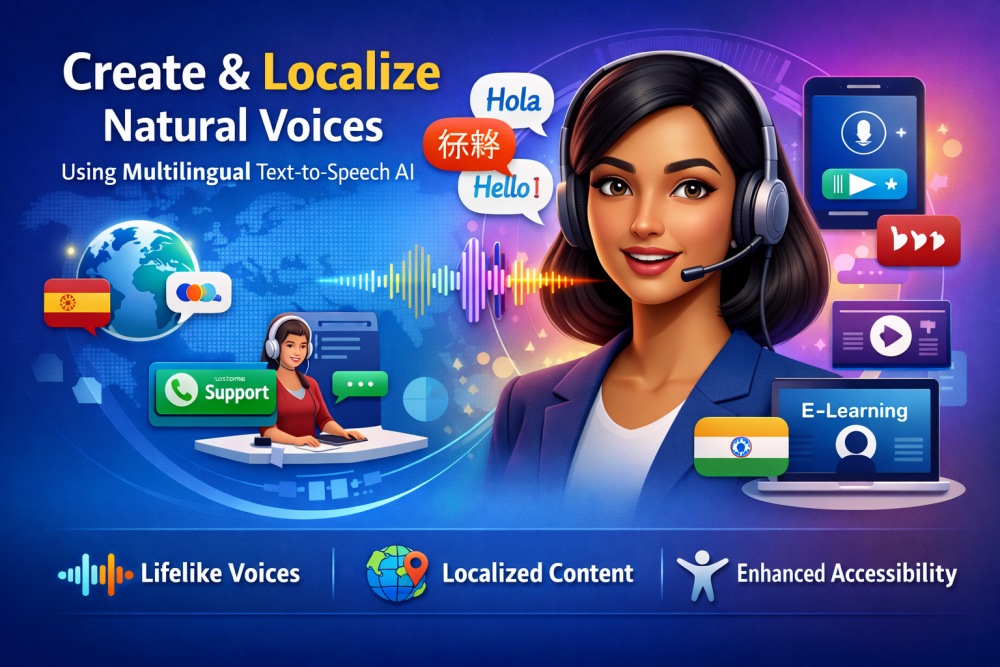
There’s a moment most businesses miss. It happens when a customer finally understands you, not just the words, but the tone, the familiarity, and the feeling that this was made for them. Not translated. Not adapted. But truly spoken in their language.
That moment is where multilingual Text to Speech (TTS) AI is quietly changing the rules.
For years, voice has been the most human interface in technology and also the most neglected. Now, with advances in AI voice generators, businesses can create natural, localized voices at scale, without losing nuance or identity. And that’s opening up a very different kind of opportunity.
Why Voice Localization Is No Longer Optional?
Text has long been the backbone of digital communication. But my voice is catching up fast.
From IVR systems and mobile apps to videos and digital assistants, voice is becoming the default layer of interaction. According to the World Economic Forum, digital inclusion is one of the defining challenges of this decade, and language sits right at its core.
Here’s the reality: most of the world doesn’t think, read, or respond in English.
If your product speaks only one language, or worse, speaks multiple languages poorly, you’re not just limiting reach. You’re creating friction.
Multilingual Text to Speech changes that equation. It allows businesses to generate lifelike, culturally aligned voice experiences in dozens of languages, quickly, consistently, and at scale.
What Makes Modern Multilingual Text to Speech AI Different?
Old-school TTS systems sounded exactly like what they were: robotic, flat, and easy to ignore.
That’s no longer the case.
Today’s AI voice generators use deep learning models trained on vast speech datasets. They don’t just read text, they interpret it. Pauses, emphasis, emotion, even conversational rhythm are built into the output.
The difference is subtle, but powerful:
- A banking alert doesn’t sound like a machine, it sounds reassuring
- A learning module feels guided, not dictated
- A customer support voice feels patient, not scripted
And when you layer in multilingual capabilities, the impact multiplies.
Because now, it’s not just a natural voice, it’s a natural voice in the listener’s own language.
4 Practical Ways Businesses Are Using Multilingual TTS
This isn’t futuristic. It’s already happening across industries.
1. Customer Support That Actually Feels Local
IVR systems are often the first point of contact and also the first point of frustration.
With multilingual text-to-speech, companies can create dynamic, localized IVR flows without recording separate voiceovers for every language. Updates become instant. The tone remains consistent.
More importantly, customers feel understood from the first interaction.
2. Scaling Content Without Re-recording Everything
Consider making videos that show people how to use a product, tutorials for new users, or training courses.
In the past, localizing them meant paying for expensive studio recordings, employing a lot of voice actors, and waiting a long time. AI voice generators change that.
You can now pretty much instantly translate exactly the same stuff into loads of different languages and make the voices actually sound like they belong . Thats a real boon for any business that is taking off across different regions or even just countrywide where people speak different languages on the ground, like in India
3. Making it easier to get digital goods
Voice is much more than just a nice bonus; it makes life a whole lot easier for users
People who aren’t big fans of reading long text or who simply prefer to get information through an audio feed – well, text-to-speech is a big deal for them. According to Deloitte total accessibility isn’t just about ticking boxes these days; it’s a true way to stand out from the crowd in a crowded marketplace
voice support in multiple languages really opens the doors for tonnes more people to get the most out of apps and services without needing to overhaul the design from scratch
4. Making communication more personal on a large scale
Think about sending voice messages in a user’s preferred language, with a tone that sounds familiar, for account updates, alerts, reminders, and notifications.
AI voice generators really shine here.
Businesses may now automatically give voice experiences that are specific to the situation and language, instead of generic, one-size-fits-all ones.
The Localization Challenge: It’s More Than Just Language
Lots of implementations go off the rails here, though. When you localize , it’s not just a matter of swapping out terms. It’s all about grasping how the real people in that location talk
Tone, language dialect , the natural rhythm and even cultural background are all super important to get right. For instance, someone from Delhi in the Hindi-speaking world might react to a particular tone in a very different way to someone from rural Uttar Pradesh
Whether you’re trying to sound all official and staid or just super casual , how it lands on the other end can be very different. An awful lot of languages even have their own unique pause and stress patterns
That’s why the really top-notch multilingual TTS systems don’t just spit out modified text – they actually rewrite the thing from scratch. Devnagri – they are experts in this area – are working to merge language intelligence with voice synthesis, aiming to craft communication that actually sounds real-life.
A Good AI Voice Generator Should Have These Features
If you want to use Text to Speech, there are a few things that can make a big difference:
- Does the voice sound real or plainly fake?
- Language coverage: Do you support dialects and regional languages?
- Customization: Are you able to change the tone, tempo, and style?
- Scalability: Can it manage a lot of work without losing quality?
APIs and SDKs are more important than you might believe when it comes to integration.
The best solutions don’t only make sound; they also mesh well with the way you already do things.
A Shift in How We Think About Voice
There’s a broader shift happening here.
Voice is no longer just an output format. It’s becoming a strategic interface.
Harvard Business Review has pointed out that companies that adapt communication to user context, language included, see stronger engagement and trust. And voice is one of the most direct ways to do that.
Because unlike text, voice carries emotion. It signals intent. It builds familiarity.
And when done right, it reduces effort, for both the business and the user.
Actionable Takeaways
If you want to learn how to use multilingual text-to-speech, you should start with the basics:
- Find important touchpoints like IVR, onboarding, and notifications.
- Don’t try to learn everything at once. Test with real people, especially for tone and how well they can understand.
- Instead of replacing everything, add to the systems that are already in place.
- The goal isn’t to “add voice.” It’s to improve how you talk to others.
Conclusion
In a world full of information, being clear wins. And nothing makes things clearer than a voice you know.
It’s not just about the technology behind multilingual text to speech; it’s also about making communication easy, open, and human again.
When your product speaks the user’s language, everything else falls into place.