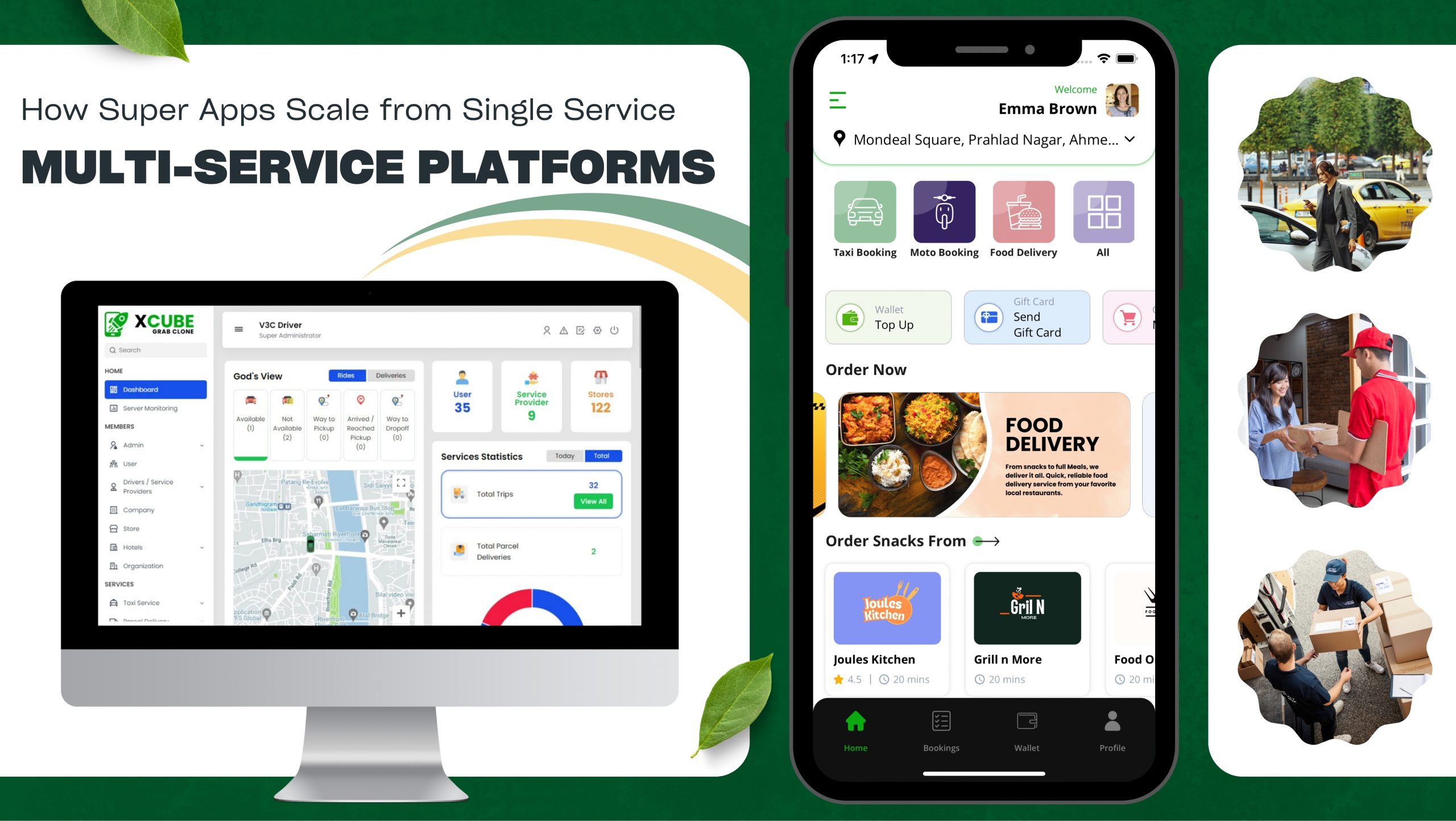
Businesses are no longer winning by offering just one great service. They win by providing many services in one seamless experience. It is very reason why multi-service platform is the backbone of every successful Super App.
Entrepreneurs, start-ups, and companies that have wish to build a scalable on-demand platform are quickly realizing one simple truth: single-service apps solve problems, but Super Apps build ecosystems and bring more profit. And at the centre of every ecosystem is a robust, flexible, and future-ready multi-service architecture.
The Market Shift: From One-Trick Apps to All-in-One Platforms
There was a time when users needed to download separate apps for taxi services, food delivery, home services, and car rentals. But this appears to be outdated now. Users demand convenience, speed, and options without the hassle of using multiple apps. They want one app that can do all things and do them perfectly.
This has led to the emergence of Super Apps. For organizations, this is not a trend but an opportunity to offer a range of services, engage users, and generate different revenue streams using a single digital product.
What Multi-Service Architecture Really Means?
Multi-service architecture allows multiple on-demand services to operate under one platform with the capability of being scaled individually. Instead of creating different apps for each service, businesses can rely on one platform where new services can be added without interrupting the flow of operations.
This design ensures that the system is always flexible, stable, and scalable. It is like building a road network instead of individual roads. Everything is connected, and scalability is not a problem but a natural process.
Multi-Service Architecture Is Essential for Super App Growth
Scalability Without Complexity
One of the key benefits of multi-service architecture is scalability. Companies can begin with a few core services and then expand into new verticals such as car rental services, food delivery services, home services, legal services, logistics, or professional hiring services.
Each of the services can be integrated into the same ecosystem with shared infrastructure, payment systems, and user data. This will make the system less technically complex while allowing the business to grow faster.
Higher User Lifetime Value
A user who booked a taxi today may order food tomorrow and hire a professional the next week. Multi-service platforms make this easy for the user by keeping everything in one app. This increases the lifetime value of a user and also cuts the cost of acquiring a customer because businesses will not have to advertise different apps. In short, one user means multiple on-demand services.
The Power of a Unified On-Demand Platform
A Super App like Gojek offers a variety of services, such as taxi, car, and moto rentals, food ordering, car washing, tow trucks, home painting, professional help, lawyers, real estate agents, DJs, tour guides, snow plowing, and many more.
The real strength of this business model is that it can continue to add more services without having to re-engineer the entire platform. For application owners, this translates to maximum market exposure, multiple revenue streams, and improved brand recall through a single application.
Core Building Blocks of a Robust Super App
A successful multi-service Super App is built on a complete ecosystem rather than a single interface.
User Apps
The platform includes Android and iOS apps for users, letting them book, deliver, consult from one single interface, respective of OS software. User can connect with services providers and get things done in quickly.
Service Provider Apps
The platform includes Android and iOS Apps for service providers such as delivery drivers, medical experts, cleaners, painters, etc. With this the service providers can receive job and get it done immediately or at scheduled time.
Store/ Restaurant Apps
The platform includes Android and iOS apps for store and restaurant owners. This let the owners manage orders, get orders and have an online presence.
Web Panels and Administrative Panel
A responsive primary website manages rates, commissions, payments, and content, while dedicated web panels serve service providers, users, dispatchers, and administrators. This multi-layered control system will ensure efficiency in the operation of the platform.
How Will Your Multi-Service App Work in Real Life?
Multi-service App allows for the coexistence of different on-demand services in one platform that can also work independently. This implies that instead of creating different apps for each service, businesses can make use of one platform that offers different services without interfering with each other. This design makes sure that the system is flexible, stable, and scalable. This is like building a road network, where everything is connected, and scalability is not an issue.
User Registration
The users register on the application using basic details such as name, phone number, email address, and location. The process is quick and straightforward.
Home Screen
Once registered, the user is directed to a home screen that provides a dynamic list of all the services offered.
Service Selection
The users can select any service they want, whether it is ordering a taxi, food, or a professional. The service search is very easy.
Real-Time Notifications
After a service has been chosen, nearby service providers are sent instant notifications. Service providers have the option to accept or reject requests depending on their availability.
Payment Processing
The app shows estimated pricing before final confirmation. Users can make payments in cash, debit cards, credit cards, or digital wallets.
Ratings and Reviews
After the completion of the service, the users rate their experience. This is an important part of the process of maintaining the quality and optimizing the performance of the platform.
Why Multi-Service Interface Is Essential for Super App Growth?
Scalability Without Complexity
One of the key benefits of multi-service architecture is scalability. Companies can begin with a few core services and then expand into other verticals like car rental services, food delivery, home services, legal services, logistics, or professional hiring. Every service can be integrated into the same ecosystem with shared infrastructure, payments, and user data.
This makes the system less complex from a technical standpoint, yet the business can expand at a faster rate.
Higher User Lifetime Value
A user who orders a taxi today can order food tomorrow and a professional service the next week. Multi-service platforms make this easy for users by keeping all services within one app. This significantly increases the lifetime value of a user and decreases the cost of acquisition since businesses will not have to market multiple apps separately. One user is equal to multiple opportunities.
Picking the Right White-Label Development Partner
To begin the process of creating a Super App, one needs to identify a trustworthy white-label app development company. Seasoned companies offer pre-developed solutions that can be tailored to suit particular business objectives.
Evaluating development partners on the basis of their technical expertise, flexibility in customization, quality of their previous projects, and post-launch support is a good practice for businesses. Testing demo apps is a must before proceeding further.
Know Deliverables Before Development Begins
A complete Super App solution package would comprise user apps for Android, iOS, and web, service provider apps on various devices, admin and dispatcher panels, tracking systems, corporate booking panels, and industry-specific modules like hotel or logistics dashboards.
This also enables the business to have clear visibility into what is being delivered, which in turn helps them to plan for future enhancements of the platform and ensures that it meets their current and future needs.
White-Labelling and Branding: Making the App Your Own
The white-labelling phase is where the functional platform is converted into a product. The logos, colours, fonts, business rules, and service settings are all integrated with the vision of the company. With proper planning, the white-labelling phase can be accomplished in a short timeline.
Launching and Scaling With Confidence
A successful launch requires more than just publishing the app on the stores. It involves on boarding service providers, implementing customer support, finalizing partnerships, and executing marketing campaigns that generate early traction
It is also necessary to keep track of the Super App even after its launch. This will ensure that the Super App remains competitive in the market as the demands in the market keep changing.
Conclusion
Multi-service architecture is not just an architectural decision; it is a business strategy. It defines the rate at which a platform can scale, how efficiently it can run, and how it can respond to change.
For companies that are interested in creating a Super App that will last for a long time, investing in a robust multi-service architecture is not an option. It is the very foundation upon which sustainable success is built. In the Super App economy, it is the ones who design for growth from day one that end up staying ahead of the curve.