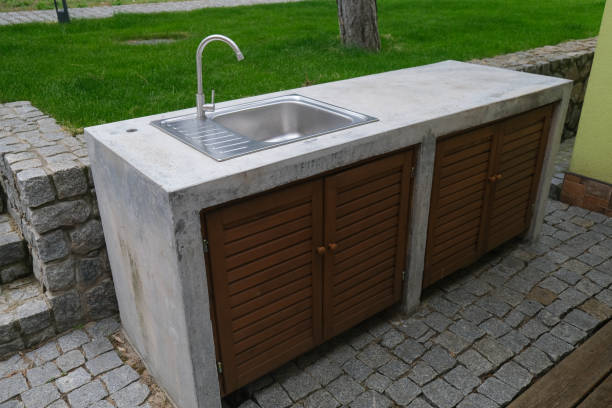
An outdoor kitchen is not only a convenient place to cook, but also to be the center of the outdoor events and a mirror image of your home. The selection of material to use in the cabinets is one of the most important decisions that one can make when designing or renovating an outdoor kitchen. The cabinets must be able to withstand the rough conditions of the outside but should also be durable and functional as well as pretty.
The most popular materials used as outdoor kitchen cabinets are MDF (Medium-Density Fiberboard) and stainless steel, although they are very different in terms of performance, durability, maintenance needs, and life cycle. Although MDF may be the preferred choice when using a cabinet in the house, stainless steel is as generally accepted as the gold standard when it comes to outdoor kitchen layouts.
This blog will closely examine MDF and stainless steel to identify which one will be most suitable in your outdoor kitchen with special attention to such vital aspects as durability, weather resistance, maintenance, aesthetics and long-term worth.
Why Material Choice Matters in Outdoor Kitchens
Outdoor kitchens are also always exposed to the elements as opposed to in-house kitchens:
- Wetness due to rain, humidity and spills.
- Change in temperatures between hot days and cool nights.
- Direct sunlight and UV rays, which result in fading, warping or cracking.
- Dust, rubbish, and even vermin that may debase the materials in the long run.
The goal of selecting a material that will overcome these difficulties will guarantee that your outdoor kitchen will not only look beautiful but also will work and will be a smart choice that you will use in the future. How MDF and stainless steel compare.
1. Durability: Long-Lasting vs. Short-Lived
An outdoor kitchen also needs durability because outdoor features can reduce the quality of materials in the long-run.
MDF: Weak and Vulnerable
MDF, which is produced by pressing wood fibers together with resins and adhesives is not as durable as a hardwood or other materials which are custom-made:
Easy to break: MDF is weak and can easily get impacted by damage (chips, scratches and breaks).
Swelling and Warping: MDF is water-absorbing and thus it swells, cracks and warps when it is exposed to moisture, regardless of the sealant applied on its surface.
Reducing Lifespan: MDF cabinets degrade with passing time and need numerous repairs or replacements, particularly in the outdoor environment.
Stainless Steel: A Rugged Performer
It is of the highest quality stainless steel at its best, which is durable in an outdoor kitchen:
Hard to Bend and Break: Stainless steel is highly strong and it does not dent, chip or crack.
- Corrosion-Resistant: The most high quality grades such as 304 or 316 marine stainless steel are able to resist rust, corrosion, and tarnishing even in the most extreme outdoor conditions.
- Lasting Durability: Stainless steel cabinets will last 20+ years of constant service with minimum service and provide an uncontested durability.
- Conclusion: Stainless steel is much stronger than MDF particularly in outdoor environments where moisture and wear are always present.
2. Weather Resistance: Can It Handle the Elements?
Outdoor kitchens should be able to withstand rain, sun, wind and fluctuation of temperatures. All it takes is weather-resistant materials in designing a long-lasting kitchen.
MDF: Weak in Harsh Conditions
Sensitive to Moisture: The wood fibres in MDF make it very vulnerable to water. Even the so-called moisture-resistant MDF cannot withstand long-term outdoor use, as it will surely swell, warp and lose its integrity.
Sensitivity to heat: MDF is prone to expand, bend or deteriorate with high temperatures particularly when subjected to direct sunlight several hours in a day.
Not Made to be Outdoors: MDF is more appropriate in an indoor setting where it is not exposed to the elements.
Stainless steel: designed as an outdoor product.
Waterproof and Rustproof: Stainless steel cannot be affected by water and humidity, so it is the solution in rainy or moist conditions.
UV Resistance: Under long exposure to sunlight, stainless steel does not fade away, crack, and weaken, but rather the material retains its polished look over the years.
Resistant to High and Low Temperatures: The stability of steel makes it not expand or shrink with temperature variation, which guarantees long-term stability in all climates.
Conclusion: Stainless steel is by far the winner in terms of resistance to weather conditions, thus it is the best material to be used in outdoor kitchens compared to MDF.
3. Maintenance: High Effort vs. Low Effort
You desire an outdoor kitchen to be a place where you can rest and have parties, not a facility that must be maintained all the time.
MDF: High Maintenance
Needs Regular Sealing and Painting: To keep MDF dry, you will have to apply sealers, laminates or paints, which break down and have to be repainted with time.
Prone to Mold/Rot: It is really difficult to clean or repair once water penetrates the MDF, which is prone to mold or rot.
Damage Repair Problems: MDF that is damaged can not be properly repaired so they are prone to frequent replacement.
Stainless Steel: Minimum of Maintenance.
- Easy Cleaning: The surface of stainless steel is smooth to clean; all one has to do is wipe it with soap and water.
- None of the Sealants Required: Stainless steel does not require any coating or treatment to remain encased, as MDF does.
- Lasting Hygiene: Mold, mildew and stains are not easy to get rid of on stainless steel thus little work is needed to ensure that it remains clean and functional.
- Decision: Stainless steel has all the points against it in terms of maintaining the appearance of your outdoor kitchen in a clean and hygienic state over the next few years.
4. Aesthetic Appeal: Style That Lasts
An outdoor kitchen is also a visual expression and hence it is important to have a material which is as pretty as practical.
MDF: First Impression Which Wanes.
Adjustable Design: MDF can be painted, laminated or finished to numerous colors and designs and was thus, relatively versatile at the beginning.
Short-Lived Appearance: MDF finishes-coatings made of paint or laminate however look worn and unappealing when they are exposed to the outside world, as they fade, chip, peel or bubble.
Stainless Steel: Classics in Style.
Modern and Smooth:
Stainless steel provides a sleek and high-end appearance that is compatible with a minimalistic as well as eclectic outdoor design.
Perennial Finish:
Stainless steel has a long life span and does not fade or peel, as does a MDF finish, it has a lustrous polished or brushed finish that lasts decades, even in high sunlight conditions.
Versatility:
The stainless steel can be used with a variety of other materials such as stone, wood and glass thus it can be used in any style.
Verdict:
Stainless steel is aesthetically pleasing in the long term, whereas MDF has short-term finishes, and would not be a good choice when it comes to outdoor kitchens.
5. Sustainability: An Eco-Friendly Perspective
Sustainability is an emerging issue in the modern world. It is of crucial importance that environmentally conscious homeowners pick some eco-friendly materials.
- MDF: Health and Environmental Issues.
- Deforestation MDF is produced of wood fibers, which are usually obtained by means of deforestation and this lowers the biodiversity and carbon emissions.
- Non-Recyclable: MDF cannot be recycled and normally finds its way to landfills.
- Has Formaldehyde: MDF is bound using urea-formaldehyde resin whose release causes production of volatile organic compounds (VOCs). These chemicals may be detrimental to the environment and human health.
- Stainless Steel: The Eco-Friendly Choice
- 100 percent Recyclable: Stainless steel is one of the most recyclable in the world and it does not lose its quality each time it is used.
- Long Lasting and Sustainable: It has a long life cycle, which means that it does not have to be replaced so often, therefore, minimizing waste.
- No Toxic Chemicals: Stainless steel is free of VOC and safe to use in food preparation in a harmless manner to the environment.
- Conclusion: The stainless steel does not harm the environment and is a sustainable material when compared to MDF which carries with it serious environmental and health implications.
Why Stainless Steel is the Ideal Outdoor Kitchen Material
When coming up with a dream outdoor kitchen, you have to select materials that are workable, attractive and durable. Although MDF can be used as a low-cost alternative, it cannot withstand the external environment, requires high maintenance and has negative environmental effects, which makes it not the best choice when it comes to outdoor use. Instead, stainless steel will provide:
- Incomparable weather protection: Waterproof, rustproof, and UV.
- Long-lasting life: Damage resistant, resist bad weather, and frequent wear-and-tear.
- Low maintenance: Cleaning and maintenance is easy.
- Classic beauty: Slick, contemporary design that can never get old.
- Environment-friendly: Recyclable, sustainable and VOC-free.
And, whether constructing or remodeling an outdoor kitchen, stainless steel cabinets will provide you with the most out of the available space: it is both beautiful and strong, as well as hygienic, all in the same material.