Indian organizations are working in an environment where quality, speed, and efficiency are not optional. These have become important for businesses. As competition is increasing across IT services, infrastructure, manufacturing, healthcare, and BFSI, companies rely on Lean Six Sigma to drive improvements. However, the delivery of these lessons evolves.
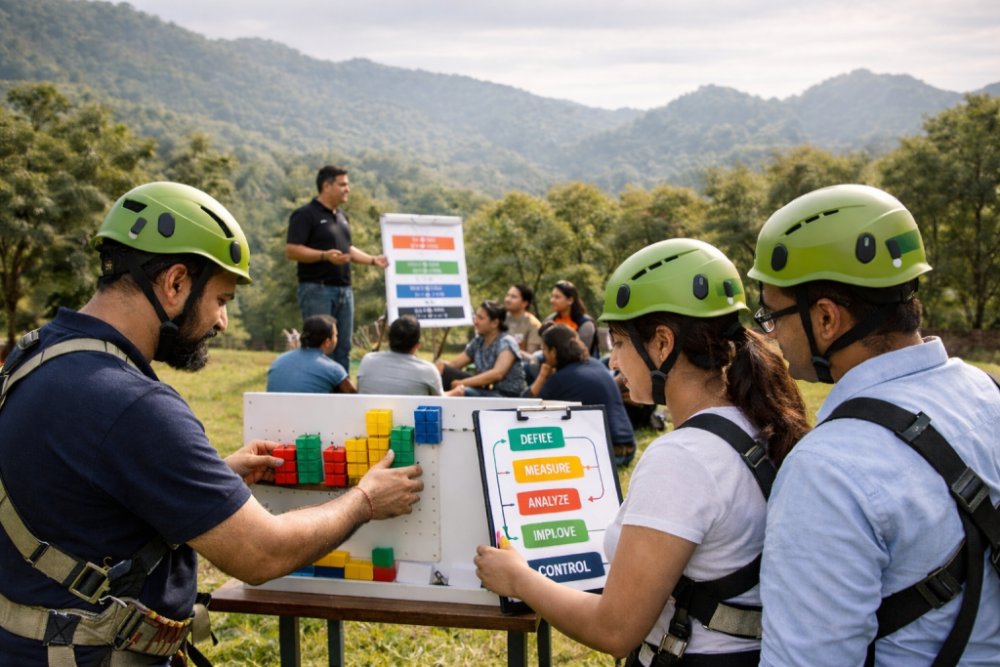
Many companies are now combining Lean Six Sigma learning with experiential sites. This approach enables professionals to transcend certification and cultivate the leadership skills necessary for implementing improvement thinking in real-world scenarios.
Lean Six Sigma Remains Valuable in the Indian Context
Lean Six Sigma is relevant in India because it provides a structured, data-driven way to help improve performance. Organizations know it for its ability to reduce variation, remove waste, and improve predictability easily.
Here are some reasons why companies continue to invest in Six Sigma certification in India:
- A standard problem-solving framework across all teams
- Focus on measurable outcomes as well as ROI
- Applicability across various industries and functions
- Alignment with operational and excellence goals
Despite all these benefits, organizations are considering that these certifications alone do not guarantee proper implementation. Research Gate assesses the benefits of Lean Six Sigma Approach in Manufacturing Industries which emphasizes its role in Indian context.
The Gap Between Certification and Execution
Several professionals finish six sigma programs with a thorough understanding of various tools like DMAIC, process mapping, and root cause analysis. But when they return to the workplace, projects stall.
This phenomenon mostly happens because a real organizational challenge has several factors that are rarely addressed in the classroom.
Some of these are:
- Stakeholder resistance and conflicting priorities
- Cross-functional dependencies
- Decision-making under uncertainty
- Leading change without formal authority
Without any exposure to such dynamics during learning, certified professionals will struggle to drive and impact.
Why Experiential Offsites Are Gaining Popularity
Off sites based on experience get rid of the normal operational distractions and make a learning space that is just as hard as the workplace. People do simulations, exercise, and other activities that make them think about how to be a good leader in both analytical and strategic ways.
Using Lean Six Sigma principles in learning experiences enhances their usefulness and simplifies their memorization. In addition to being learning resources, participants are putting those resources to use while negotiating ambiguity, time constraints, and team dynamics.
Key benefits of experiential off sites include:
- Stronger connection between theory and application
- Increased confidence in using improvement tools
- Greater collaboration across roles and functions
- Deeper reflection and behavioral insight
This combination helps transform Six Sigma from a technical skill into leadership capability.
Why Indian Organizations Prefer the Combined Approach
Scale, diversity, and change present challenges for Indian organizations, particularly those that are big and expanding quickly. The blended model of certification and experiential learning effectively addresses these realities.
Organizations adopting this approach often see:
- Better on-the-job application of Six Sigma tools
- Improved ownership of improvement initiatives
- Stronger alignment between process goals and people leadership
- Faster cultural adoption of continuous improvement
Rather than viewing Six Sigma as an individual credential, companies begin to treat it as a shared organizational mindset.
Supported by Leadership Research
Leadership research shows that learning through experience always leads to better results than just learning in a classroom. The Harvard Business Review says that leaders become better at making decisions, being flexible, and using their judgment when they learn from real-life experiences instead of just reading about them.
This realization clarifies the growing use of experiential formats in conjunction with structured approaches such as Lean Six Sigma.
A Shift Toward Integrated Capability Building
These days, organizations are creating learning journeys that combine depth of experience with analytical rigor. By adding process excellence frameworks to hands-on offsite programs, learning partners like CTRLX help make this change and ensure that improvement ideas are used, not just understood.
This unified method teaches experts how to use data-driven tools and guide people through change, which is essential for long-term success.
Conclusion
The emphasis is moving from certification completion to actual capability building as Indian organizations deal with increasing complexity. Experience-based learning gives you the background you need for successful implementation, while Lean Six Sigma gives you the framework for improvement.
Offsite leadership training is an important part of Six Sigma learning and should not be done on its own. It combines technical rigor with immersive experiences to ensure that improvement projects are led with clarity, collaboration, and confidence.