Introduction
Butterfly valve in industry is the most popular apparatus which is used for flow regulating in a pipeline by reason of simple structure, small size and weight, low cost, modulation performance. They are utilized in water treatment plants, chemical processing facilities, power plants, HVAC systems, oil and gas operations, food and beverage services as well as many other industrial applications that require precise control over the flow of liquid or gas. Learning about butterfly valves and their features, as well as the application to which they are put, organizations can increase efficiency and minimize downtime with maintenance scheduling while maintaining safe environments in all situations.
When you talk about a butterfly valve, you should know this device helps you to get access to better flow control. In the design, you will come across a metallic disc which rotates around a fixed stem axis. As it turns 90 degrees, it provides quick action control.
Prominent Benefits of Butterfly Valves
- The design of the butterfly valves is not complex. The best is that they are easy to maintain. In addition, you can operate and install the valves without a hitch. The valves can be obtained at cost effective rates.
- As the butterfly valves are light in weight, they can be applied in varied applications. To make the fluid pass at the fastest speed, you would need a metal seated valve. For most pump systems, the butterfly disc offers high strength.
- You would need minimal effort to turn on and off the valve. When you turn the valve at 90 degrees, it offers accurate flow control.
- In addition to precise flow control, butterfly valves are great for keeping pressure in check. At the time of operation, the valves drop pressure prior to the fluids get back the energy in the quickest possible time. This helps the function of the pump system operate in an efficient way. To stop or start the flow in the pipelines, using butterfly valves can be beneficial. You can get butterfly valves in various designs and sizes from the reputed butterfly valve manufacturers.
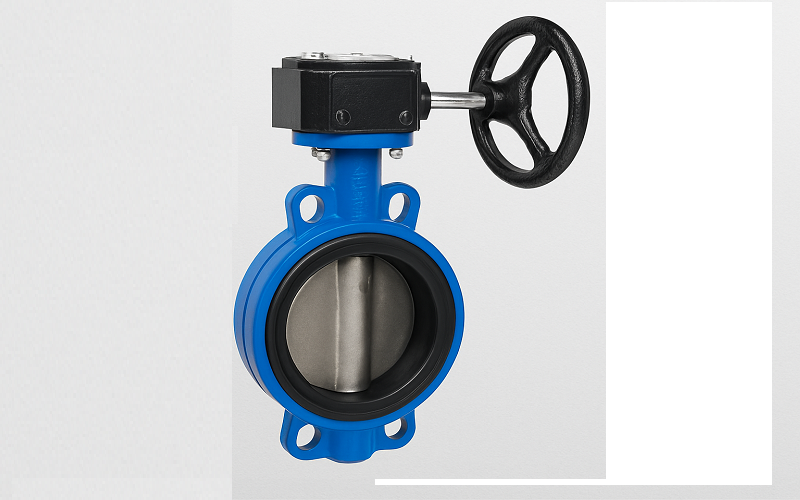
The Butterfly valves are quarter turn, Rotary type valves to be used for isolating or regulating flow. Its principal part is a plate on the end of an axis. When the valve is completely open, the disc is parallel to the flow and allows little resistance. As the valve is closed, the disc moves perpendicular to the flow and seals against a valve seat, preventing any further movement. The butterfly valve can also work in a position which is somewhere between completely open and fully closed, making it to be used not only for on off duty but also for metering or regulating service.
Design Working Principle and Components
A butterfly valve is made up of a few basic components which are the body, disc, stem, seat and actuator. The body contains the flow path and the disc is located in the middle of the conduit. The shaft interconnects the disk with a handle or actuator for controlled rotation. The seat or sealing surface provides a tight shut off and is rated for the pressure and temperature of the flow. A key advantage of butterfly valves is the relatively small pressure drop across the valve, featuring a compact design and high flow capacity; it is ideal for long-distance liquid transportation or gas/liquid/slurry transport.
Types of Industrial Butterfly Valves
Industrial Butterfly valve s have been designed and constructed in a variety of styles to suit several applications. They are commonly of the following types: concentric, double offset high performance and triple offset valves. Concentric valves are common in HVAC and water applications, especially for low pressures and temperatures. Double offset and triple offset valves add an angle to reduce the friction between the seats due to positioning, making those best for use in high temperature, pressure and corrosive services of oil and gas industries, power plants etc. Materials can range from cast iron, stainless steel to duplex alloys and more depending upon the fluid being handled as well as the operating conditions.
Actuation and Automation
The valve can be manually operated with a handle or by gear, but automated control is common to assure safety and accurate positioning. Fast and non-maintenance operation from distance is possible with pneumatic, electric and hydraulic actuators for remote control which are particularly useful in larger or difficult to reach pipelines. Actuated butterfly valves, can be connected into PLCs and SCADA systems in the digital age to provide real time monitoring and electric feedback control. This positions them as a major element in intelligent-plant automation and Industry 4.0-compatible procedures.
Conclusion
Industrial butterfly valves have come a long way from being used as simple shut off mechanisms to being developed as constantly evolving precision control devices for today’s manufacturing automation and high speed processing industry. Their blend of performance, robustness and value has given rise to a new standard for the industry and led butterfly valve manufacturers to becoming a dominant player in silicon panel manufacturing. By choosing the proper design, body material, actuation effort and pressure temperature rating industry can establish long equipment life, operational safety and system integrity on flow performing service in vital systems.