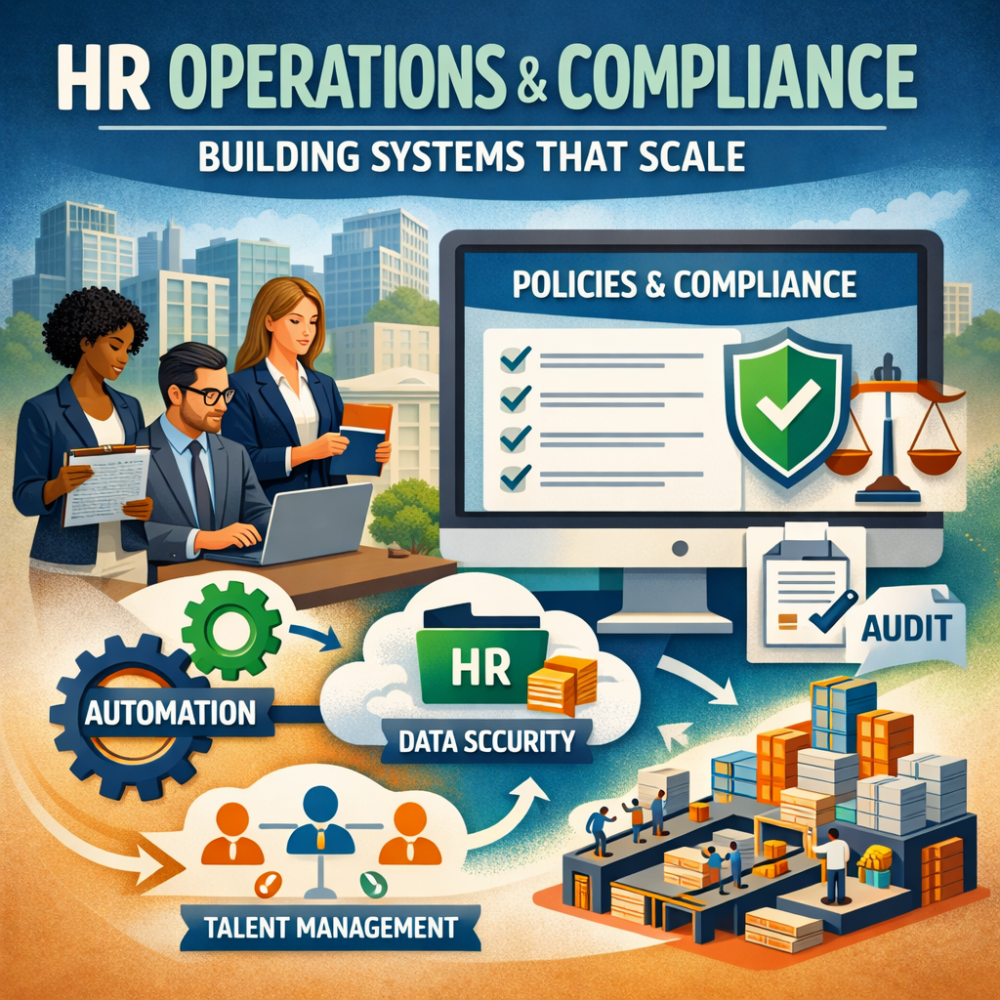
HR operations are rarely visible when they work well, where Payroll runs on time, attendance is recorded correctly, and compliance requirements are met. When these systems are weak, however, problems surface quickly in the form of salary disputes, or employee dissatisfaction.
In an HR Training and Placement, learners often begin with recruitment, and basic policy management, as organizations grow, the real challenge becomes designing HR systems. Operational stability and compliance discipline must increase alongside workforce size.
Scalable HR operations are not about adding more spreadsheets or hiring more administrators. They require structured processes, and strong internal controls.
What Scalable HR Operations Actually Mean?
Scaling HR operations involves managing:
- Growing employee headcount
- Multiple office locations
- Complex payroll structures
- Regulatory requirements
- Increased reporting needs
Each expansion adds risk if systems remain manual or inconsistent.
| Growth Factor | Operational Risk |
| Higher employee count | Data errors increase |
| Multiple locations | Policy inconsistency |
| More benefits plans | Compliance gaps |
| Complex payroll | Miscalculations |
| Cross-border hiring | Legal exposure |
Without structured systems, operational strain grows faster than the organization itself.
Core Components of HR Operations
HR operations cover daily, recurring functions that keep the workforce stable.
Key Areas
- Employee data management
- Payroll processing
- Attendance tracking
- Leave management
- Benefits administration
- Compliance documentation
| HR Function | System Requirement |
| Payroll | Accurate calculation engine |
| Leave tracking | Automated accrual logic |
| Employee records | Secure data storage |
| Compliance filings | Audit-ready documentation |
| Reporting | Reliable workforce metrics |
Structured systems reduce dependency on individual memory or manual tracking.
Compliance as a Continuous Process
Compliance is not an annual event. It is an ongoing operational responsibility.
Common compliance areas include:
- Labor law adherence
- Statutory payroll deductions
- Employee documentation
- Workplace policies
- Data privacy requirements
In an HR Management Course, learners understand that compliance failures often result from weak process controls rather than lack of knowledge.
Compliance Risks
- Missing statutory filings
- Incorrect salary calculations
- Incomplete employee records
- Unauthorized access to data
Strong internal controls reduce these risks.
Building Process Discipline
Scaling requires documented workflows rather than informal coordination.
Example: Payroll Process Flow
- Attendance data validation
- Salary structure review
- Deduction verification
- Approval workflow
- Disbursement
- Reporting and reconciliation
Each step must have:
- Defined owner
- Verification checkpoint
- System record
| Step | Control Mechanism |
| Attendance review | Data validation rule |
| Salary processing | Automated calculation |
| Approval | Dual authorization |
| Payment release | Bank reconciliation |
| Reporting | Audit trail storage |
Process clarity improves accuracy and reduces disputes.
Role of HR Analytics in Scaling
As workforce size increases, data complexity grows.
An HR Analytics Course often emphasizes using workforce data to support decisions rather than relying on intuition.
Analytics supports:
- Attrition tracking
- Hiring efficiency
- Overtime analysis
- Absenteeism patterns
- Cost per employee
| Analytics Use | Operational Benefit |
| Attrition trend | Retention planning |
| Overtime analysis | Cost control |
| Leave patterns | Workforce planning |
| Payroll variance | Error detection |
Analytics strengthens compliance by detecting anomalies early.
Technology Enablement
Manual processes do not scale effectively.
Technology improves:
- Record accuracy
- Data security
- Reporting speed
- Audit readiness
Systems typically include:
- HRMS platforms
- Payroll software
- Attendance integration
- Document management tools
Technology does not remove responsibility, but it reduces repetitive errors.
Segregation of Duties
As organizations expand, control separation becomes critical.
Example
- Data entry team updates records
- Payroll team calculates salaries
- Finance team approves payments
- Compliance team audits filings
| Risk | Preventive Control |
| Fraud | Dual authorization |
| Data manipulation | Access restriction |
| Unauthorized changes | Audit logs |
| Payroll errors | Independent review |
Segregation reduces dependency on individual trust.
Data Accuracy and Record Control
Employee data must remain consistent across systems.
Common issues:
- Duplicate records
- Inconsistent job titles
- Incorrect bank details
- Missing tax information
Data validation rules and periodic audits prevent long-term complications.
In an HR Course in Noida, learners often practice maintaining structured documentation, which becomes critical in enterprise-scale HR environments.
Handling Policy Expansion
As organizations grow, policies multiply.
Examples:
- Travel reimbursement
- Flexible work
- Performance incentives
- Remote workforce rules
Without standardized policy documentation:
- Employees receive inconsistent treatment
- Managers interpret rules differently
- Compliance risk increases
Clear documentation and centralized policy access improve fairness.
Audit Readiness
Audits examine:
- Payroll records
- Attendance logs
- Tax filings
- Employee documentation
Organizations must maintain:
- Historical records
- Version-controlled policies
- System-generated reports
- Traceable approvals
| Audit Area | Required Evidence |
| Payroll | Salary registers |
| Compliance | Statutory filings |
| Leave | Approval records |
| Data changes | Change logs |
Prepared systems reduce audit stress.
Scaling Without Losing Human Oversight
Even automated systems require review.
Important practices:
- Periodic payroll review
- Random compliance sampling
- Policy updates based on regulation changes
- Training for HR teams
Automation increases speed, but oversight ensures reliability.
Warning Signs of Weak HR Operations
Indicators include:
- Frequent payroll corrections
- Employee complaints about salary
- Compliance notices
- Inconsistent policy enforcement
- Data mismatches between departments
Early correction prevents larger systemic issues.
Building an Enterprise HR Mindset
Scaling HR operations requires:
- Structured documentation
- Defined ownership
- Continuous monitoring
- Policy clarity
- Data discipline
These habits strengthen long-term organizational stability.
Conclusion
HR operations and compliance are foundational to organizational stability. As employee numbers grow, structured systems become more important than individual effort. Clear processes, data control, defined responsibilities, and analytics support enable HR Generalist Course functions to scale responsibly.
Well-designed HR systems reduce errors, improve compliance, and support confident decision-making. Sustainable growth depends on operational discipline rather than reactive corrections.