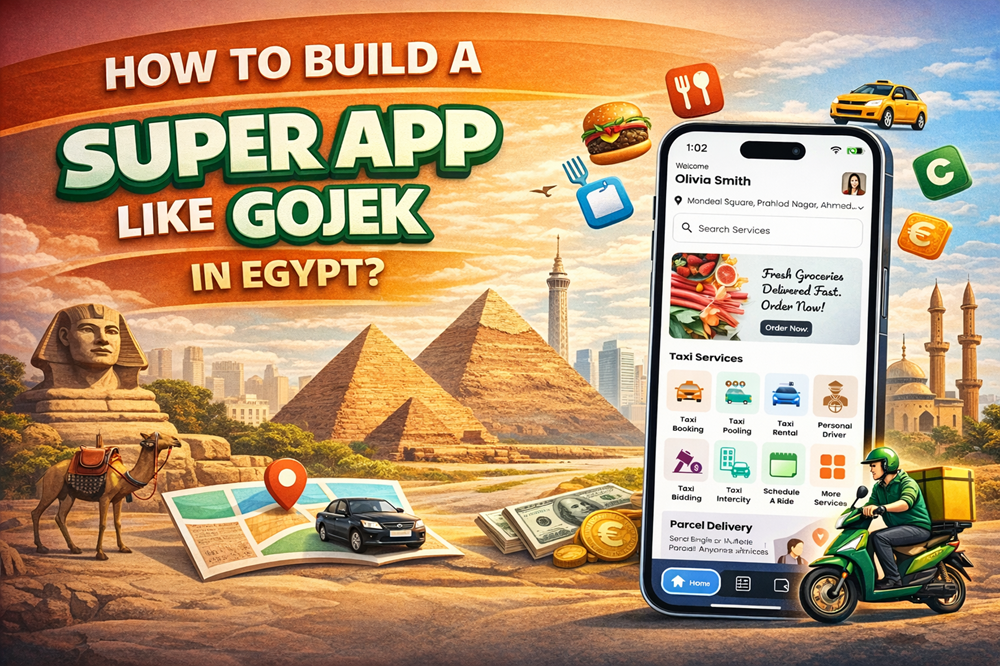
Egypt: The Goldmine for On Demand Businesses
Every on demand business knows, convenience is currency. This is also the reason, most on-demand apps have started to notice the pattern and increased their service range. This isn’t just in the US or UK, it’s global, and Egypt is no exception.
This is exactly why starting a Super App like Gojek in Egypt is a wonderful choice. The timing, the market, and the economics has just played their part for you to open a Gojek Clone of your own in Egypt.
On top of that, the smartphone penetration is increasing day by day. In 2026, the number is going to reach 99% and internet users are going to reach more than 87% fueling, a robust digital economy, and people have been accepting e-wallet payments, which will result in the EGP to reach 120 Billion.
In this modernity, super apps are not a luxury but a need, and this guide tells you exactly what you need in Egypt.
What is a Super App like Gojek?
A Super App like Gojek is an on-demand platform, where users can access more than 101 services in a single app. The app connects the marketplace, users, and professionals at a single platforms and offer an economic system where people can book their preferred services like taxi, parcel delivery, store delivery, and many more on demand services.
For each of these services, there are modes of generating revenue, while maximum of the revenue is generated through the commissions which are charged on every service booked.
What Features Will Work the Best in Egypt?
Egypt’s economy is slowing growing its potential back, however the inflation vs income ratio has always kept people into an unattended dilemma of affordability. This is exactly why you need to understand what works in Egypt and what doesn’t. Look at this table.
| Factor | Key Features | Economic Reasons |
| Affordability | Multiple Options, Low Commission services | High inflation, low incomes |
| Payments | In-App Wallet | Cash-to-digital transition |
| Safety | GPS, emergency SOS, Live trip sharing, Advanced Safety Toolkit | User complaints, women safety History |
| Multi-Service | Rides + delivery + on-Demand services | App fatigue, urban needs |
Let’s address each factor and their key features elaborately.
Multiple options
Provide tiered services and pricing options, so that customers can select based on price or speed. Choice is mandatory: it keeps churn out of cost-sensitive markets.
Lower Commission Services
Make sure that the platform’s fees are low to draw and keep freelancers and small companies. The requirement is that high commissions reduce supply, which ultimately kills the app.
In-App wallet
An integrated wallet that can be used for refunds, payments and promotions. It is accessible across all services. It is mandatory: it eliminates any friction and ensures that money circulates throughout the ecosystem.
GPS Tracking
In real-time tracking of delivery and trip locations End-to-end visibility for customers and operations. It is mandatory: without it, you’ll lose confidence, efficiency, and the basic optimization of routes.
Emergency SOS
Alert for panic on one touch which notifies contact, support, and responders in a matter of minutes. It’s a mandatory security feature that regulators and customers require.
Live Trip Sharing
Lively share trip information with selected contacts, which include ETA and the route. Mandatory: it improves trust among users and decreases the perception of risks, particularly for vulnerable users.
Advanced Safety Toolkit
Background checks driver ratings, background checks camera checks, as well as post-incident procedures. The requirement for trust is that it is the currency of a platform and this is the method you create it.
Rides
Rapid on-demand transportation with dynamic pricing and routing. Rides are a mandatory most important service in the system that drives usage daily.
Deliver
Parcel and food delivery, with live tracking in real time and management of the fleet. Delivery is a mandatory high-frequency revenue stream with a high expectation.
On-demand services
Services that can be booked such as beauticians, cleaners and errands all within the same application. Mandatory: variety of services increases daily contact points and life-time value.
Arabic and Egyptian Pound Integration
Services must be resonating to user and service providers. Mandatory: people are more comfortable to speak in their own cultural language.
How Much Does the Gojek Clone in Egypt Cost?
The Cost of any app today depends on development timeline, features, customizations, and the business model. With these factors in mind, there are two types of development routes available in the market. One is a custom development route, other is a white-label solution.
Let’s understand the difference.
| Aspect | White-label Gojek Clone | Custom Super App |
| Development Time | 1-2 weeks; pre-built modules ready | 12-18 months; built from scratch |
| Features | 20-65 services (rides, delivery, wallet, payments, & language + currency support) out-of-box | Fully tailored; add exactly what Egypt needs (EGP, Arabic) |
| Customization | Rebranding, UI tweaks, some modules; fits super app basics | 100% unique; perfect for local safety, rural features History |
| Scalability | Handles growth efficiently. | Unlimited but needs expert planning |
| Risk | Low; proven in Egypt-like markets History | High; delays, bugs common |
| Best For | Quick Egypt launch | Unique features long-term |
White-label works well for quick market entry in Egypt’s expanding ride-hailing and digital payments industries, allowing for speedy multi-service and affordability testing. Only complex, long-term customization requirements can be met by custom.
Development Process of the Egyptian Gojek Clone
A white-label firm can develop your Gojek Clone in just 2 weeks. How? Because their Gojek Clone Solution is a pre-built code, ready to customize, with a global feature set which can be plug and played. So, the process totally depends on what you choose, and launch is handled by the white-label firm, perfect for the non-technical and technical founders who either don’t have time or need a special fast deployable source code.
Let’s understand what happens in the launch process.
Purchase Phase
The process begins by exploring Live demonstrations of Gojek Clone. Gojek Clone application to understand its multi-service ecosystem and workflow capabilities, as well as operational capabilities. After the platform’s features have been examined, you will work with the consultants and sales team to define your business needs.
During this discussion the team will evaluate your offerings in terms of ride hailing and food delivery, as well as food delivery services, logistics for parcels home services on demand as well as the integration of digital payments. Based on your business objectives along with your expectations for scalability and budgeting experts suggest the best solution package. When you’ve made your purchase the Technical Manager is appointed to guide you through the development configuration, deployment, and installation steps.
Customization Phase
At this stage, the development and design specialists customize the application according to your brand identity and business model. The Android and iOS user applications, service provider apps, and the web based admin dashboard are redesigned with your company name, branding colors, UI preferences, and service flow logic.
Customization also includes service module activation, commission structures, pricing algorithms, payment rules, geographic configurations, and regional service mapping. This ensures the platform aligns with your target audience and operational strategy.
Launch Phase
After a successful test and acceptance after successful testing and approval, after approval and successful testing, Gojek Clone application is prepared for release on large platforms, including Google Play Store and Apple App Store. Technical support is provided by the team responsible for the submission process as well as compliance verification as well as optimization of the store listing and the finalization of launch.
Post launch support is also provided to ensure smooth onboarding, operational monitoring, and platform scalability as your business expands.
How does Gojek Clone Earn Money in Egypt?
Well, Egypt is an inflated economy, that’s why commissions can be a reliable method to go to billions. Instead, you need to rely on diverse revenue streams that make money. That’s why a White-Label Gojek Clone is perfect for Egypt. It gives you 8 very powerful sources of income in a single app, letting you maximize profits in either way possible. The list of revenue streams are as follows:
- Commissions per booking
- Subscription plan for drivers/service providers
- Commission from stores
- Subscriptions from tracking apps.
- Priority listing fees
- In-App advertising
- Surge Pricing
- Cancellation Fees
Conclusion
You want a super app, not a science project. Egypt already has the demand, rising digital payments, and a population that prefers convenience over downloading ten different apps. The real success depends on launching fast, keeping services affordable, and building strong wallet, safety, and localization systems from day one.
A white-label Gojek Clone helps you enter the market quickly with proven features, scalable infrastructure, and multiple revenue streams already aligned with Egypt’s economic environment. Instead of spending years building from scratch, you can focus on market capture, partnerships, and user retention.
Before finalizing your solution, evaluate live demo apps from reliable white-label providers. Testing real workflows, service modules, and admin capabilities will give you clarity on how efficiently your super app can perform once it enters the Egyptian market.