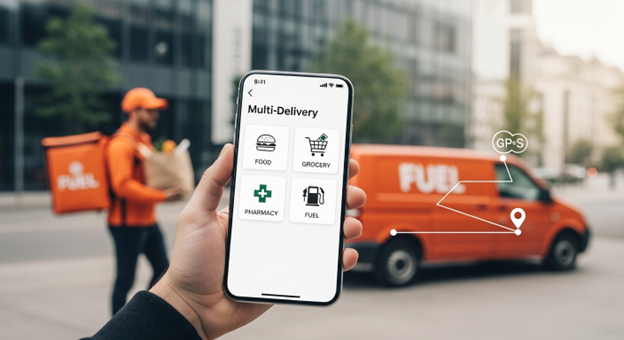
Demand for goods and services delivered to consumers has increased enormously over the last few years. Goods that used to require hours to acquire, such as groceries, meals, medicines, and gas, can now be delivered within minutes or at least on demand. With this rapid evolution in consumerism comes an opportunity for businesses to develop on-demand multi-delivery app development.
Multi-delivery applications do not operate as “food delivery clones.” They provide a single application with multiple delivery categories of products and services to consumers, including: food, beverage (i.e., liquor), grocery, pharmacy, and meat delivery. Therefore, you can think of this as the ultimate, multi-purpose delivery application.
If you are an entrepreneur, start-up, or existing business that is considering entering the multi-delivery application marketplace, this guide provides you with the following information: overview of key features; recommended technology stack; development timeline; and expected price ranges.
What is an On-Demand Multi-Delivery App?
A multi-delivery app allows you to order various types of products from many different categories in one app. Using one app, you can have access to restaurants and other businesses that provide grocery stores, pharmacies, etc., and have your orders tracked in real-time, use multiple payment types, and have them delivered to your door through a network of delivery agents.
Multi-delivery platforms are designed to serve a greater audience than single-vertical apps (e.g., only food or only grocery) and give your business a competitive advantage by allowing you to generate multiple lines of revenue from one app.
Some of the leading multi-delivery apps in the world include Rappi, Gojek, and DoorDash Marketplace, which have all been successful by bundling multiple delivery services together.
Core Features of a Multi-Delivery App
The three panels required for a multi-delivery application encompass customer, delivery, and admin.
Below is a list of features provided to users:
1. the customer-facing application:
- Multi-category browsing, Users may search for items from varying categories (food, groceries, medication, fuel, etc) within a single application.
- Smart search and filtering options, Users can easily find products/stores via filters such as category, price, and/or rating.
- Real-time order tracking, Users may track their delivery provider in real-time from the time the order was picked up until the order is delivered to them.
- Multiple methods of making payments, Users have the option of paying for their order via credit/debit card, e-wallet, UPI, cash on delivery, or buy now pay later.
- Order history and reorder capabilities. Users will be able to re-order items previously purchased via a single touch.
- Ratings and reviews for respective stores and/or delivery personnel – Users can rate/review their experience with the store or the delivery provider, as well as assign a rating for each party.
- Push notifications, Users receive real-time notifications related to their order(s), coupons, and/or promotions.
- Customer loyalty and rewards programs. Users may accrue loyalty points, earn cash back, and receive referral bonuses to encourage them to return to the application.
2. Delivery Representative App Functionality
- Intelligent Order Assignment: Automatically or Manually Accept Orders Based on Distance
- Optimized Route Navigation: GPS Navigation on the App Can Provide Directions for the Fastest Way to Complete Delivery
- Earnings Dashboard: Gives You Up-to-Date Information on Completed Orders, Tips, and Amount Paid for Each Completed Order
- Availability Toggle: Able to Go On/Off-Line with One Button Click
- Ability to Handle Multiple Orders: Able to Pick Up and Deliver Various Orders at the Same Time
- In-App Chat/Call Feature: Allows Communication with Consumers Without Revealing Your Personal Phone Number
3. Admin Panel Functionality
- Vendor/Store Management: Enroll, Verify, and Manage Multiple Store Partners
- Delivery Zone Management: Define Service Areas Where Services Will Be Provided and Identify Delivery Representatives
- Real-Time Analytics: Includes Total Revenue, Number Orders Completed, Cancellation Rate, And More
- Commission Management: Establish and By Vendor or Type and Their Commission Rate – Manage It Yourself
- Promotions/Discounts: Create and Schedule Campaigns (Advertising), Use Promo Codes, And Offer Flash Sale
- Create a Support Module to Handle All Customer Complaints, Refunds, Or Disputes in One Place.
Step-by-Step Development Process
The process behind developing a multi-purpose delivery app is very methodical. A standard app development team typically accomplishes the task in the following way:
- Discovery and Market Research: Determine who your target market will be, as well as which delivery verticals you will have and how you will position yourself competitively. Identify which geographic areas and niches you will serve first.
- User Interface/User Experience (UI/UX) Design: Create wireframes and interactive prototypes of all three user interfaces. Prioritize simplicity and speed; if an app has poor UX, it will be abandoned by the customer.
- Back-End Architecture: Develop a scalable server infrastructure; define your APIs; design your database schema to accommodate multiple types of orders efficiently.
- Front-End Development: Develop both the customer app and the delivery agent app using cross-platform frameworks, thereby minimizing development time and costs.
- Third Party Integrations: Integrate maps, payment gateways, SMS/One-time Passcode services, push notifications, and analytics.
- Quality Assurance (QA): Perform extensive testing, including functional, performance, security, and user acceptance testing, on all devices.
- Launch and Post-Launch Support: Release the apps through the app stores; monitor the performance of the apps; capture customer feedback; and release incremental updates for the future.
Recommended Tech Stack for Multi-Delivery App
The right technology choices ensure your app is fast, scalable, and easy to maintain. Here is a proven tech stack:
| Layer | Recommended Technologies |
| Mobile Apps | Flutter (cross-platform), React Native |
| Frontend Web | React.js, Next.js |
| Backend | Node.js, Laravel (PHP), Python (Django/FastAPI) |
| Database | MySQL, PostgreSQL, MongoDB |
| Real-Time Tracking | Google Maps API, Socket.io |
| Push Notifications | Firebase Cloud Messaging (FCM) |
| Payment Gateway | Stripe, Razorpay, PayPal, Braintree |
| Cloud Hosting | AWS, Google Cloud, DigitalOcean |
| Storage | Amazon S3, Firebase Storage |
| Analytics | Mixpanel, Google Analytics, Firebase |
For mobile app development specifically, Flutter is a popular choice as it allows you to build both iOS and Android apps from a single codebase, significantly reducing both cost and development time.
How Much Does It Cost to Build a Multi-Delivery App?
Development cost depends on the complexity of features, the platform (iOS/Android/both), the number of panels, and the location of your development team. Below is a general estimate:
| Module | Basic | Mid-Range | Enterprise |
| Customer App | $3,000–$6,000 | $6,000–$12,000 | $12,000–$20,000 |
| Delivery Agent App | $2,500–$5,000 | $5,000–$10,000 | $10,000–$18,000 |
| Admin Dashboard | $2,000–$4,000 | $4,000–$8,000 | $8,000–$15,000 |
| Backend & APIs | $3,000–$6,000 | $6,000–$12,000 | $12,000–$22,000 |
| UI/UX Design | $1,500–$3,000 | $3,000–$6,000 | $6,000–$10,000 |
| QA & Testing | $1,000–$2,000 | $2,000–$4,000 | $4,000–$8,000 |
| Total Estimate | $13,000–$26,000 | $26,000–$52,000 | $52,000–$93,000 |
These are ballpark figures. The actual cost depends on your specific requirements, desired features, and the development partner you choose. Working with an experienced team can help you optimize costs without compromising on quality.
For a custom quote tailored to your needs, you can explore on-demand multi-delivery app development solutions from specialized development companies.
Key Factors That Affect Development Cost
- The more delivery verticals there are (food, grocery, pharmacy), the more complicated things get for the backend.
- There is also a substantial amount of cost attached to the platform you choose; native apps tend to have a higher price point than cross-platform frameworks (for example, Flutter).
- Any feature you add that is real-time (such as order tracking, chat, push notifications) will dramatically impact your development hours.
- Adding third-party integrations (like multiple payment gateways, map APIs, and SMS services) increases the overall scope of the project.
- If you choose a custom UI/UX design (i.e., a completely branded app with a pixel-perfect design), it will take longer to develop than if you used a template.
- Compliance is a huge factor when you create an app for the US, EU, or other heavily regulated areas, as there are usually many additional compliance requirements to take into account.
Monetization Strategies for Your Multi-Delivery App
Developing an application is just one aspect of building a business; below are ways to monetize your application:
- Commission Per Order – Charge a percentage (10% – 30%) for every transaction made through your app
- Delivery Fee – Charge a flat or distance-based fee to deliver to the consumer’s location
- Subscription Options – Provide customers with premium membership options that include no delivery fees, priority service, and exclusive promotions.
- In-App Ads – Charge store owners and brand owners to advertise their products in featured placements, on banners, or as sponsored items.
- Surge Pricing – Increase prices dynamically based on high volume of orders/deliveries during high demand times, such as rush hour.
- White Label Licensing – License your application to other companies looking to enter new regions.
Challenges to Anticipate —and How to Solve Them
1 Managing Multiple Vendors:
You will need a strong backend system to onboard and manage all of the vendors for your business. A self-serve portal that allows partners to manage their menus, prices, and availability on their own will help with this process.
2 Real-Time Scaling Performance:
If you anticipate your order volume to grow exponentially in the near future, you should ensure that your app is capable of processing thousands of orders simultaneously. To do so, leverage cloud-based auto-scaling technologies, load balancers, and microservices infrastructure from the outset.
3 Delivery Agent Retention:
The high turnover of delivery agents within the gig economy can be an obstacle to effective service delivery. Create transparency around agent earnings through the use of an earnings dashboard and provide timely pay and performance bonuses to increase retention.
4 Hyperlocal Logistics:
In order to optimize deliveries in very urban environments, you must implement effective zone management strategies. AI-based route optimization combined with a dynamic approach to zone assignment can help you reduce delivery lead time and costs.
Conclusion
In the app ecosystem, the on-demand multiple delivery market has been rapidly expanding due to the consumer demand for convenience. Companies that provide consumers with convenience through delivery services have been gaining a large portion of the overall market at an unprecedented rate.
To build a successful multi-delivery application requires extensive planning, the appropriate technology platform, and an experienced development team capable of executing both the technical and business elements of the on-demand platform.
If you are developing a new multi-delivery platform or expanding a pre-existing multi-delivery platform, the focus on user experience, speed of service, and scalability will help to distinguish your company from competitors. The investment you will make to grow a successful multi-delivery platform is large. However, the potential return on investment through the rapid increase in growth of your business will also be substantial.
A great way to begin the development of your delivery platform is to create a minimum viable product (MVP) with only 1 or 2 types of deliveries to validate your ideas. After you have validated your idea, look to grow your delivery platform into other good delivery verticals. Delivery services that are currently the most successful have all completed the process outlined above, which is to create a focused and well-executed first version of their service.