The current dynamic digital world has been accelerated and thus companies need to keep evolving otherwise they will lose out. Customers are demanding quick and responsive services, customization, and smooth interaction through channels. In order to fulfill these expectations, organizations are spending more and more on digital transformation: the strategic implementation of modern technologies to streamline business, relationships with customers, and decision-making.
Salesforce is one of the strong cloud-based solutions of customer relationship management, sales pipelines, marketing automation, analytics, and support process management among the numerous digital solutions available. Nonetheless, Salesforce is highly flexible and scalable, but to make it efficient, optimized, and manage it, one should have specialized skills, maintain it, and plan. Here is the place when Salesforce Managed Service Provider (MSP) becomes a key participant in a successful digital transformation process.
Understanding Digital Transformation
Digital transformation is not simply the use of new software. It consists in reconsidering the work of a business by incorporating digital tools in all of the processes. These comprise automating manual processes, migrating information to cloud based technologies, real time collaboration, and using analytics to make wiser decisions.
In its simplest meaning, digital transformation is aimed at creating more value to customers but enhancing inner efficiency. Nevertheless, the transition to this shift also needs the shift in mindset, organizational culture, and processes. This transition has been a problem to many businesses because of lack of technical know-how, time, or road map.
Why Salesforce Plays a Key Role in Digital Transformation
Salesforce serves as a customer hub, which provides teams in sales, marketing, service, and operations to work with one source of truth. The cloud-based nature of it enables businesses to grow at a rapid rate, deploy third-party solutions, and get real-time information at any geographic location.
However Salesforce is a very configurable system. Unless those features are managed properly, businesses are likely to either underutilize them, experience performance problems, or have difficulties with user adoption. That is the reason why the use of an in-house staff, particularly in small and mid-sized organizations, can become expensive and ineffective.
The Importance of a Salesforce Managed Service Provider
A Salesforce Managed Services Provider is a company that deals with the administration, optimization and support of the Salesforce environment. Businesses may outsource services of an MSP instead of employing and having a dedicated internal Salesforce team so that their CRM can run optimally.
Salesforce MSPs offer end to end services, including system setup, system customization, system integration, system monitoring, support, security controls, and periodic upgrades. This enables the businesses to concentrate on the strategic aspects and the technical complexities are taken care of by the experts.
Key Benefits of Working with a Salesforce Managed Service Provider
1. Expert Knowledge and Best Practices
Salesforce releases frequent updates and new features. MSPs stay current with these changes and apply industry best practices to ensure businesses benefit from the latest innovations without disruption.
2. Cost-Effective CRM Management
Hiring certified Salesforce professionals internally can be expensive. Managed services offer flexible pricing models that deliver expert-level support at a predictable and often lower cost.
3. Continuous Monitoring and Optimization
A Salesforce MSP proactively monitors system performance, identifies issues early, and optimizes configurations to improve speed, usability, and reliability.
4. Tailored Solutions for Business Needs
Every organization has unique workflows. Managed service providers customize Salesforce to align with specific business processes, industry requirements, and growth objectives.
5. Improved Productivity and Adoption
By handling technical tasks, MSPs free internal teams to focus on sales, customer service, and innovation. They also provide user training and support to improve adoption across departments.
How Salesforce Managed Services Enable Digital Transformation
Salesforce managed services directly support digital transformation initiatives by:
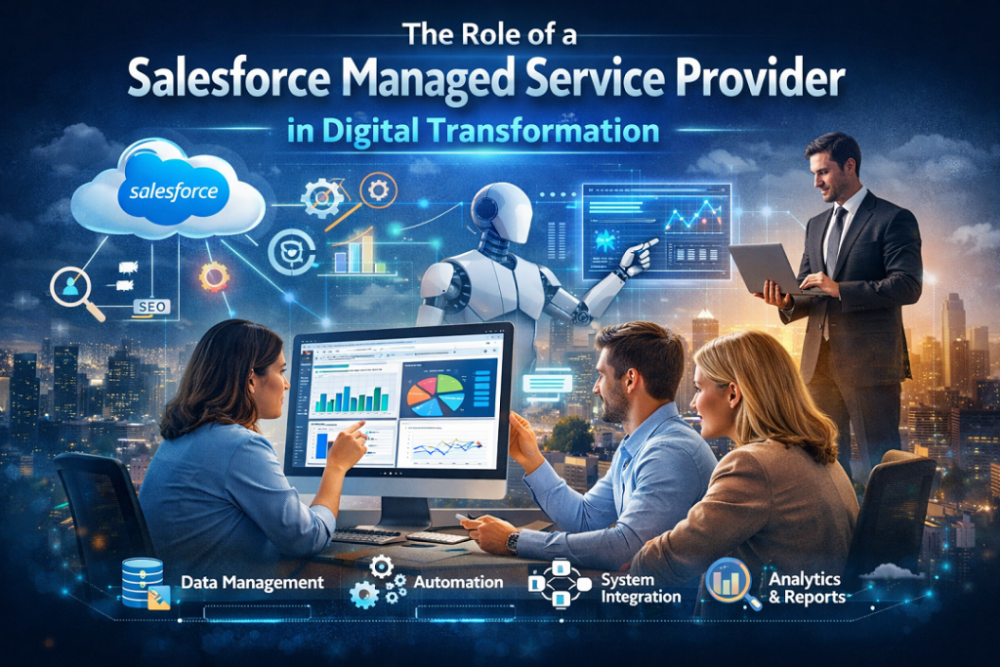
- Data Management: Ensuring clean, accurate, and well-structured data for reliable reporting and insights.
- Automation: Reducing manual work through automated workflows, approvals, and notifications.
- System Integration: Connecting Salesforce with marketing tools, ERP systems, payment platforms, and communication apps.
- Advanced Reporting & Analytics: Delivering real-time dashboards and reports for data-driven decision-making.
With expert support, businesses can implement these capabilities faster and more effectively, accelerating their transformation journey.
Real-World Business Impact
Consider the case of a mid-sized retail firm that has just adopted Salesforce to enhance customer interactions. First, they have difficulties in configuring the system, reporting, and training users. Work efficiency declines, and working groups get agitated.
Following the collaboration with a Salesforce Managed Service Provider, the company is provided with an in-depth audit of CRM, streamlined business processes, automated reports, and practical training of users. In several months, the response time to customers will be higher, sales will be more visible, and operational expenses will be reduced without the need to continue to expand the internal IT team.
This is an illustration that a Salesforce MSP will be able to transform investments in technology into quantifiable business results.
Choosing the Right Salesforce Managed Service Provider
When selecting a Salesforce MSP, businesses should evaluate:
- Industry Experience: Proven success with similar organizations
- Salesforce Certifications: Certified consultants and developers
- Support Model: Availability, response times, and communication
- Customization Approach: Solutions aligned with business goals
- Scalability: Ability to support long-term growth
The right partner ensures that Salesforce evolves alongside your business.
Final Thoughts
There is no longer such a thing as digital transformation as an option but rather a key to long-term success. However, Salesforce is the basis of the contemporary CRM and business processes, but the real potential is opened by professional management and constant optimization.
A Salesforce Managed Service Provider helps to overcome this gap by providing technical expertise, strategy, and continued support. Through the collaboration with the appropriate MSP, companies will be able to achieve the maximum Salesforce ROI, enhance customer experiences and develop a digitally prepared organization of the future.