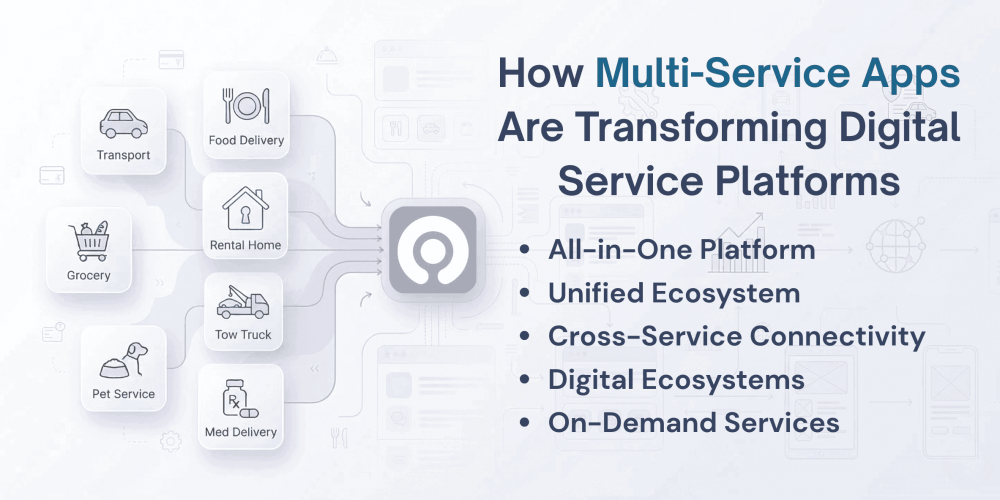
As the digital ecosystem continues to evolve in a fast-paced world, multi-service apps are transforming the consumer experience with digital services. These apps mash services across shopping, banking, and food delivery with communication within a single application. As users favor convenience, a multi-service platform enhances the user experience and drives engagement and loyalty. As users started to see digital services, there were so-called multi-service apps emerging. In this article, we’ll explore their characteristics, advantages, and challenges they create and illustrate them with successful case learning as well as speculate on what the future holds for such platforms.
Understanding Multi-Service Apps
Definition and Overview
Such multi-service apps are effectively digital Swiss Army knives that combine functions and services under one user interface. Rather than swapping between different apps for transportation, food delivery, payment, and socializing, users can find everything they need in one convenient location. Consider them the “one-stop shop” for your smartphone, condensing the digital experience and making life a little less hectic.
Components of Multi-Service Apps
These apps are made up of a multitude of building blocks that work seamlessly. At their center are functions such as messaging, e-commerce, ride-hailing, and payment systems. User accounts save user preferences and history: robust back-end systems manage your data and integrations. Oh, and let’s not forget about security features — you want your data unbroken and not shared across the whole of the internet!
The Rise of Digital Service Platforms
Market Trends and Growth
The digital service platform market is booming faster than a toddler in a candy store—projected to reach astronomical heights in the coming years. With more businesses realizing that consumers are moving toward online services, companies are desperate to hop on the multi-service train, building platforms for every whim and whine. It is a race, with the finish line being a highly interdependent digital ecosystem.
Consumer Demand for Integrated Services
Today’s consumers are more harried than ever, and they want integration. They want to run their lives without the need to open a dozen apps—they long for the kind of frictionless experience in which fixing an appointment, ordering dinner, and paying bills all take place in one fell swoop. The nearest analogy I can make is a magician who succeeds in pulling out your whole social life from your pocket instead of fetching a rabbit out of it!
Key Features of Multi-Service Apps
User Experience and Interface Design
The user experience (UX) of a multi-service app is like the first date gone right—or wrong: if it’s clunky, confusing, or full of surprises, you’ll never see it again. These apps need to have intuitive navigation, a nice design, and logical organization. The finest designs are clean and intuitive, to the point where even your aunt who hates technology can figure it out without having to request backup.
Integration with Third-Party Services
If multi-service apps don’t want to become one-trick ponies, they have to treat third-party integrations like long-lost friends. These partnerships allow the app to have features from payment gateways to health services and an AI assistant. Smooth integration means impactful user experience—be it peanut butter or jelly, they complement each other.
Personalization and Customization Options
Multi-service apps thrive on personalization. These use cases may provide recommendations for content personalized to derive a user experience based on users’ past usage behaviors. The ability to personalize the app—from changing colors of the theme through layout and links to what services they use most frequently—lets them create a perfect outfit for themselves. so that they never feel like strutting around in a pair of shoes that doesn’t fit them.
Benefits of Multi-Service Apps for Users
Convenience and Accessibility
Let’s be real: convenience is king. Users see the benefits of using different services without downloading many apps and managing them. Then all those mega-service apps swipe everything onto your palm, and life stops being a 3D version of juggling. it was walking in the park, and ideally with an ice cream cone.
Cost-Effectiveness
Who doesn’t love saving a few bucks? A multi-service app would technically give you a better deal, discounts, and packaged services. Instead of forking over ten different subscriptions or services, you can condense your spending into one simple package and get some scratch back for that fancy dinner you’ve been wanting.
Enhanced User Engagement
Multi-service apps offer huge potential in terms of engagement. With social elements, gamified features, and push notifications, these apps create a cycle—one that lures the users. Such experience makes users feel like what’s in the app is something that they would actually want and therefore exposes them more to it—a win-win for both user and developers. It’s such a party, you don’t want to leave the dance floor and go home; everybody is just dancing and having fun.
Challenges in Implementing Multi-Service Apps
Technical Complexity and Development Costs
If a multi-service app is the IKEA of your life, which you want to assemble (no instructions), it can be like a puzzle that you’re thinking about, racking your brains, and don’t know how to assemble. Merging the range of services into a single, fluid platform comes down to some high-level technical skill, which doesn’t come cheap. This means that development teams need to deal with a multitude of issues, including providing compatibility across services and ensuring an easy-to-use interface. Companies on tight budgets, budgeting for their wallets to be lighter than they “should” have been expecting.
User Privacy and Security Concerns
Consumers also have an understandable wariness about how their information is shared across services, and that practice has been inspected more by watchdogs and privacy groups. This can remarkably cost much more than we think, such as investing in technology and training to keep high security measures to hide user data. Otherwise, user trust could melt away in a flash at the next data breach.
Maintaining Service Quality Across Platforms
It’s like ordering a pizza on an app that also happens to be your ride-share and grocery delivery system; you want the pizza hot, not cold. Maintaining the same quality of service in all your services is one of the most difficult parts while building multi-service apps. If one aspect of a feature is behind or breaks, it starts to ruin the entire user experience, which ultimately pushes consumers into the arms of niche competitors who are great at what they do.
Case Studies: Successful Multi-Service Apps
Example 1: Grab
Grab began as a ridesharing app but has now turned into Southeast Asia’s multi-service app, dipping into food delivery, grocery shopping, and even financial services. By utilizing its massive user base while solving local problems, Grab has introduced the juncture of combining multiple services under a single banner while maintaining an efficient experience for the users—a perfect example of multi-service app development.
Example 2: WeChat
WeChat is more than a messaging app — it’s the Swiss Army knife of digital services, combining social networking and payments with ride-hailing and online shopping. Its success comes from a strong ecosystem where almost everything is done inside one app, showing that servicing can be integrated and both user loyalty and convenience increase.
Lessons Learned from These Case Studies
Successful multi-service apps don’t just throw everything into a blender and hope for the best. They open for user experiences where the substantiated local demand meets national needs. You want strong feedback loops, regularly published products, and good visibility into how people use the service. These cases represent that these barriers to near-multi-service integration can be addressed through preparation and groundwork with enough intention.
The Future of Digital Service Platforms
Emerging Technologies and change
As technologies have evolved through digitalization, the technology harnessed behind service platforms has also transformed. This means that revolutionary systems such as AI, machine learning, and blockchain are emerging technologies based on this exceptional set of points. Imagine these AI-generated recommendations that understand you better than you do, or decentralized organizations making us more secure, stable, and private. The future is bright — and maybe a little sci-fi.
Predictions for Market Evolution
As consumer demand for convenience continues, the market of multi-service apps is likely to grow. As more players enter the field, competition becomes even wilder and will lead to innovative new features and pricing strategies. And niche players will begin to sprout, searching for the markets they can dominate, while established brands continue to compress services in order to become the one-stop shop you go to every day.
Conclusion: The Impact of Multi-Service Apps on Digital Services
Summarizing Key Insights
Multi-service apps have changed the game by grouping several services together into one digital space. These allow for unprecedented convenience and effective life, but sometimes they lead to new privacy, security, and service quality challenges. Effective forerunners such as Grab and WeChat have emerged brighter than ever in leading guidance for carving out the value processes of developing innovations.
The Long-Term Implications for Businesses and Consumers
Multi-service apps are a threat and an opportunity for businesses. In a competitive environment, organizations must push themselves to improve or become obsolete. For consumers, these platforms offer more convenience and better experiences — but they must be on guard regarding privacy and security. Ultimately, it will be the power of multi-service apps that defines our interaction with digital services in the coming years. As multi-service apps dominate the world of digital service platforms, convenience and seamless user experience are among the necessities that have arisen. Those devices must weigh implementation and user privacy concerns against the access and engagement segmentation advantages they afford. However, the trend will not stop; only companies that are willing to adopt this (this being reforming themselves at their core so they fit consumer lifestyles) will succeed in an omnichannel world. There is no doubt the next ride will be more thrilling for end users and dealers alike in this inspired setting.
FAQ
What are multi-service apps?
Multi-service apps are those that multiplex different features and services into one application, allowing a user to do several things without jumping between multiple applications—shop, bank, and communicate.
Why Should You Opt for Multi-Service Apps?
Some of the advantages of multi-service applications are greater convenience, improved user interaction, economy, and providing alternative services to the users on one platform, which increases user experience.