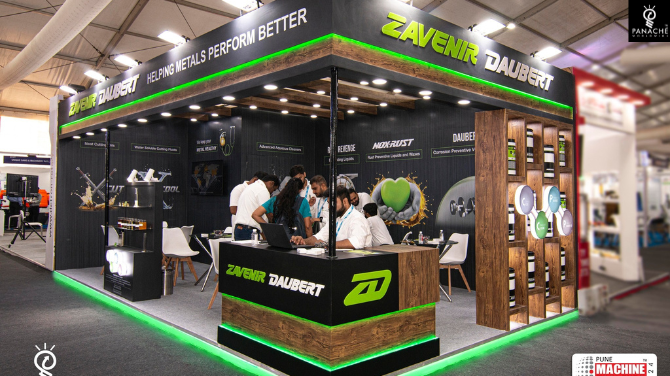
At a crowded exhibition hall, brands need to create their first impression in the first few seconds. The decision to stop, explore, or pass by an exhibition stall is made unconsciously within a few seconds. This is no chance judgment, but one that is ingrained in psychology. The colours evoking emotions, the design that can make you move, the lighting that sets the mood, all the design choices contribute to the perception that your brand creates. Good exhibition stall design is not about aesthetics, but about influencing attention, behaviour, and memory.
Knowledge of human brain behavior in response to visual and sensory stimuli will enable brands to make the exhibition space look intuitive, engaging, and memorable. We will discuss the way colour, layout, and lighting are integrated to influence the experience of visitors and have them take action.
First Impressions and the Psychology of Layout
The visitor behavior is guided by layout. The retail stores are made in such a way that they guide the customer through a path, and the same has to be done in the exhibition stalls within a short period of time. Whenever a visitor gets to a stall, his brain automatically conducts a scanning of the stall to find clarity. Open and well-organized areas indicate confidence, whereas clutter results in cognitive overload and avoidance.
On the psychological level, humans like working in environments where they know what to do next. Having a clear entry point will decrease hesitation, and having visual points of focus (hero products or bold messaging) will draw visitors deeper into the stall The division of the space into specific zones, such as product displays, interactive zones, and meeting corners, provides meaning to all the parts. Such orderliness of flow also makes sure that the visitors have certain preconceived ideas of where to stand, explore, or even talk.
Creating a good exhibition stall design does not oblige people to interact, but it welcomes them. When movement is natural, visitors remain longer, interact more, and result in better conversions.
Colour Theory: How Emotions Influence Decisions
The strongest psychological tool in an exhibition setting is color. Various colors evoke certain emotional and mental reactions, and in most cases, remain unnoticed to the viewer. Color decisions in an exhibition hall that is visually noisy can either cut through or blend with the clutter.
- Blues and greens translate to trust, calm, and reliability, hence their suitability in technology, health, education and financial brands.
- Red and orange arouse action, excitement, and energy attracting attention and raising the energy levels.
- Sophistication and focus is achieved through neutral palettes with accent colours, which would be particularly effective with high-end or design-based brands.
Consistency is critical. When colours are used consistently on the walls, furniture, Signage and printed materials, the brain will perceive that space as being cohesive and professional. This predictability reinforces brand memory and creates subconscious trust-important elements in situations where exhibition stakes are high.
Lighting: Designing Mood and Focus
Lighting does not simply light up; it narrates. Psychologically, lighting determines the mood of the visitors in a space. A warm-colored light will make one feel comfortable and ready to talk, whereas a cool light will make you alert and focused on details.
Strategic lighting can:
- Draw attention to products or messages of interest.
- Establish various areas that are not physically defined.
- Enhance the richness and drama of materials.
- Enhance professionalism and perceived quality
The elements of the hero are spotted to attract the eyes by default, and the rest of the ambient light is kept soft to produce a warm background. The lighting must be considered during design as opposed to being an afterthought, and it works as a potent emotional device in the experience of the visitor, whether entering or leaving.
Interactivity and Memory Retention
Tourists recall experiences much better than visual representations. Interactions trigger an interest and engages various portions of the brain, resulting in enhanced memory encoding. Touch screens, AR displays, live demonstrations, or even touchable materials will make passive viewers become active participants.
This is in line with the psychological concept referred to as the IKEA effect; people value more experiences that they have been actively involved in. Interaction enhances the dwell time, emotional attachment, and brand attachment. Visitors will also retain your message better once they feel that they were a part of the process.
Way-finding and Reducing Cognitive Load
Exhibitions are hectic places of distractions. When tourists are forced to guess your booth, you have lost customers. Clear wayfinding saves the mental load and maintains the focus of attention on the areas that need it the most.
Good wayfinding encompasses:
- Headlines at eye level that are brief in content.
- Minimal Text with icons and images.
- High level of visual priority to direct attention.
- Use indicators or directional signs to control circulation.
You can eliminate stress by accepting short attention spans and simplifying decisions, which will result in a stress-free atmosphere where the visitors can question and retain the information Quickly and comfortably.
Multi sensory Design: Beyond What You See
Although images take up the greatest role in exhibition design, the brain perceives experiences in a multi-sensory way. Sound, texture, and even smell can play a great role in emotional response and memory. Light background music may energize or soothe an area, whereas rough-textured materials introduce depth and tradition.
A feel-good brochure, a woven wall finish, or a silent meeting area can produce a contrast in a high activity hall. Emotional appeal: It is more impactful when you involve more of your senses to make your brand experience richer and more engaging.
Measuring Psychological Impact
Exceptional exhibition design is not based on appearance but Measured by result Footfall, dwell time, interaction rates, lead capture, and post-event brand recall are some of the metrics that give an insight into the effectiveness of psychological principles at work.
The interpretation of such data will enable the brands to optimize layouts, messages, and Sansory Elements in future events to make design a dynamic and performance-oriented strategy, but not a single investment.
Conclusion: Designing with Intention
The exhibitions do not occur successfully by chance. They are well designed spaces with an insight into human behavior, perception, and feelings. Once color brings the appropriate emotion, layout drives movement in the easiest way, and lighting puts the mood in the right place; visitors do not see a stall, but they experience a brand
Considerate production in exhibition stall fabrication makes sure that these psychological factors are carried out with accuracy, converting imaginative ideas into a high-impact space. Based on the design decision based on human psychology, brands can produce exhibition experiences that attract people, promote interaction, and create a long-term memory way after the show is done.