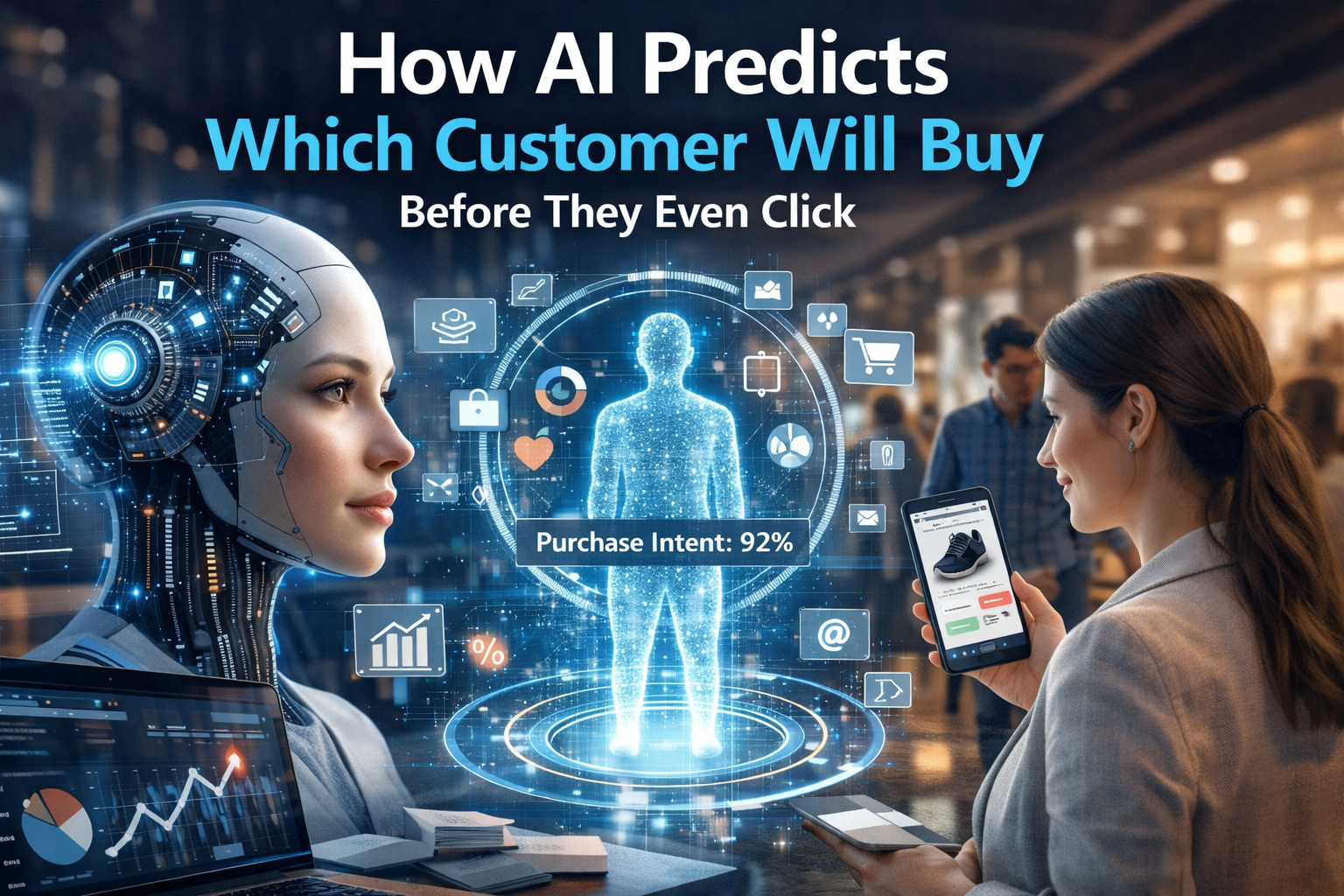
Imagine knowing which customer is ready to buy before they open an ad, click a product page, or even start comparing options. It sounds like a marketer’s superpower, but this is exactly what modern AI systems are doing today.
Thanks to predictive analytics, machine learning, and pattern recognition, businesses can now forecast buying intent with remarkable accuracy. This shift isn’t just improving sales; it’s transforming how brands understand their audiences, allocate budgets, and create meaningful customer journeys.
If you’ve ever wondered how AI seems to know a customer better than the customer knows themselves, you’re about to find out.
Why Predicting Buying Intent Matters More Than Ever
Digital interactions have exploded: clicks, scrolls, searches, online behavior, past purchases, abandoned carts, and even subtle signals like dwell time. All these micro-behaviors create enormous data trails.
But here’s the challenge:
Humans simply can’t analyze this much data at scale.
AI, however, thrives on patterns. Give it millions of data points, and it quickly identifies:
- Who is likely to buy
- What they’ll purchase
- How soon will they take action
- Which channels will they respond to
- What messaging will tip them over the edge
This predictive power helps businesses optimize everything, from marketing spend to customer experience, without ever feeling “salesy.”
The Science Behind Predictive Buying: How AI Sees Intent Before Clicks Happen
AI doesn’t magically guess. It forecasts buying behavior using a combination of three powerful technologies:
1. Machine Learning Models Trained on Historical Behavior
AI learns from patterns of past buyers:
- What did they search for before purchasing?
- How many times did they visit the site?
- At what time of day did they convert?
- What device were they using?
- Which product categories did they explore?
Once the system understands these paths, it can match them with new customers who exhibit similar behaviors, even if those customers haven’t clicked yet.
2. Real-Time Data Signals
AI monitors real-time micro-signals like
- Time spent hovering over content
- Repeated website visits without interacting
- Engagement on social channels
- Scroll depth
- Device changes (mobile → desktop = high intent)
- Ad impressions visibility time
These subtle indicators often reveal intent before a customer takes any direct action.
3. Predictive Scoring Algorithms
Every customer gets an AI-generated “intent score.”
This score predicts:
- How likely the user is to buy
- What stage of the funnel are they in
- Which type of message will convert them
Marketers can then customize the journey based on that score, resulting in higher conversions and a more seamless experience.
What AI Knows Before a Customer Clicks
Modern AI systems can estimate purchasing likelihood by analyzing:
✔ Behavioral patterns
Has the user demonstrated past interest or similar product behavior?
✔ Demographic indicators
Age, location, and spending potential, all anonymized for privacy.
✔ Psychographic tendencies
What motivates them? Are they impulsive buyers? Value-driven? Researchers?
✔ Engagement breadcrumbs
Even not clicking is data. Viewing an ad multiple times without clicking often means interest without urgency.
✔ Contextual cues
What time of year is it?
Is there a holiday coming up?
Has the user purchased similar items previously?
Together, these factors create a remarkably accurate prediction of customer intent long before a traditional analytics tool would notice anything.
Real-World Examples: AI Predicting Buyers Before They Click
1. E-commerce: Knowing Who Will Abandon a Cart Before It Happens
Retail AI can now identify customers who are likely to leave without buying, even before they add an item to the cart.
This allows businesses to trigger:
- Personalized discounts
- Limited-time offers
- Chat support
- Product comparisons
Sometimes a small nudge, targeted at the right person, makes all the difference.
2. SaaS: Predicting Which Visitors Will Convert Into Trial Users
AI tools can analyze website behavior and determine which visitors show strong buying signals.
Businesses then present high-intent users with:
- Case studies
- ROI calculators
- Demo prompts
- Chat reps
Meanwhile, lower-intent users may see educational content instead.
3. Banking and Finance: Identifying Loan Applicants Before They Apply
Banks use predictive analytics to identify customers who may need:
- Loans
- Credit cards
- Insurance
- Investment products
They then personalize outreach, creating a more supportive and timely experience.
How AI Personalizes Content Without Feeling “Creepy”
A major misconception is that AI invades customer privacy. But in reality, advanced systems use anonymous data, patterns, and trends, not individual personal details.
The goal isn’t to stalk the customer.
It’s to help brands deliver relevant, helpful experiences that feel natural.
Imagine receiving:
- The exact product suggestion you needed
- A discount right before you planned to buy
- A reminder when you forgot something important
- Support before frustration hits
This kind of proactive experience builds trust and loyalty.
What Businesses Gain From AI-Driven Buying Predictions
1. Higher Conversions at Lower Costs
Knowing who will buy lets marketers spend only where it matters. No more guessing, no more wasted ad spend.
2. Better Customer Experience
When messages match intent, customers feel understood, not targeted.
3. Smarter Product Recommendations
AI-generated recommendations are no longer generic; they are personal, timely, and hyper-relevant.
4. Reduced Churn
Predictive models can detect when a customer might cancel or disengage, giving companies time to retain them.
5. Future-Proof Decision Making
This data-driven foresight helps companies:
- Forecast demand
- Plan inventory
- Optimize marketing campaigns
- Improve product offerings
Predictive analytics turns insights into a competitive advantage.
How to Start Using AI for Customer Intent Prediction
Whether you’re a small business or an enterprise, you can start with:
✔ Customer behavior data analysis
Even basic web analytics provides signals.
✔ AI-powered CRM tools
Many CRMs now include predictive scoring features.
✔ Automated marketing workflows
Trigger emails, offers, and ads based on AI predictions.
r✔ Partnering with AI-driven automation platforms
Working with expert teams can accelerate deployment and accuracy.
The Future: AI That Reads Intent With Zero Clicks
The next era of AI will make buying predictions even sharper using:
- Multimodal data (voice, image, text, behavior patterns)
- Emotional AI
- Real-time personalization engines
- Autonomous marketing agents
Soon, businesses won’t wait for customers to click; AI will predict needs before they are fully formed.
The future of marketing will be anticipatory, not reactive.
Final Thoughts
The idea that AI can predict a purchase before a customer clicks may have seemed futuristic a decade ago. Today, it’s quickly becoming a standard for high-performing businesses.
By understanding micro-behaviors, historical patterns, and real-time signals, AI gives companies a powerful ability to anticipate customer needs and deliver value at the perfect moment.
The brands that embrace predictive AI now will be the ones leading customer experience in the years ahead.