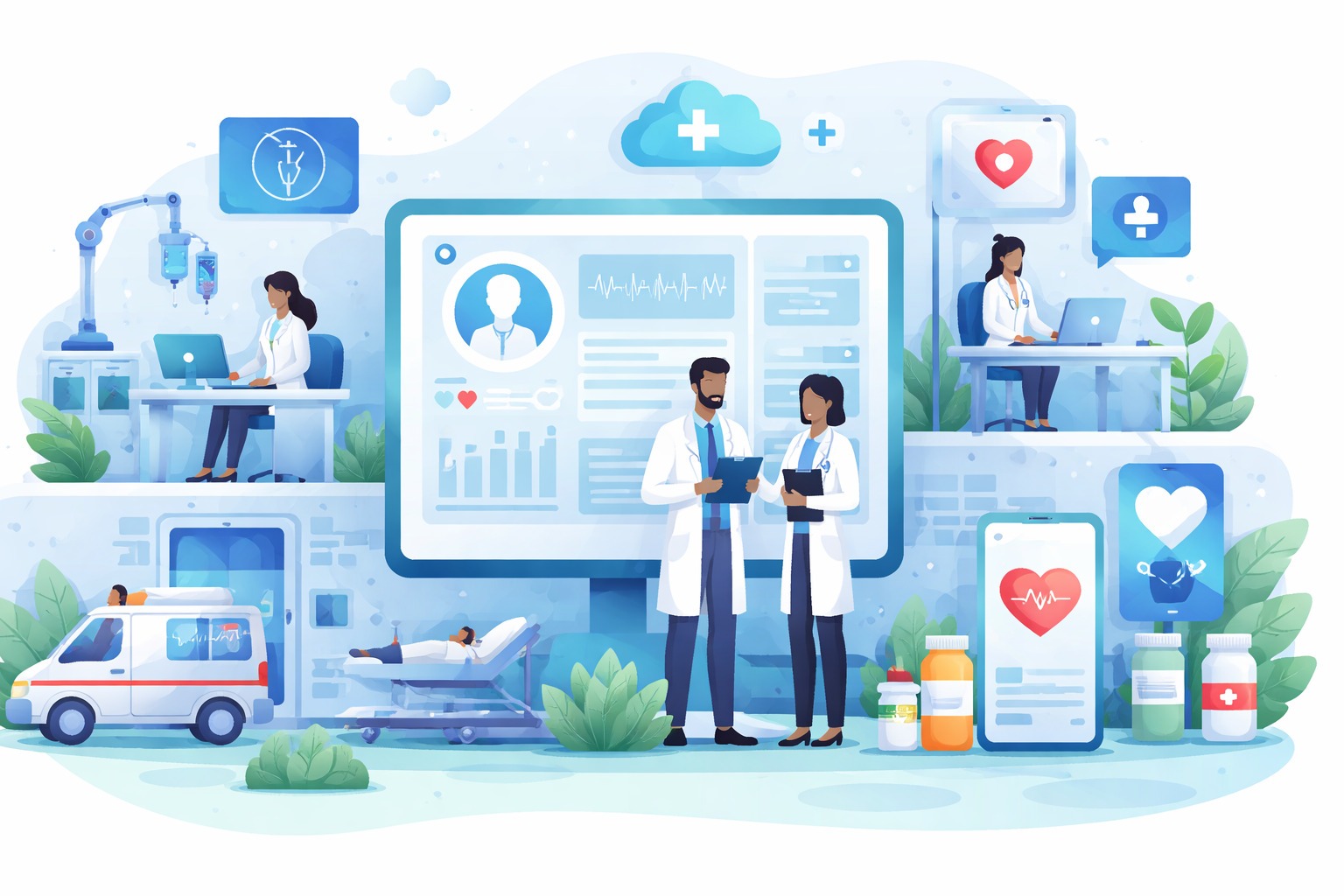
Today’s hospitals are the front line, every day working to provide better patient care and streamline operations while remaining compliant with ever changing health regulations. Even off-the-shelf software can be of some help, but it frequently is not up to the task of accommodating modern hospitals’ individual workflows and expanding abilities. This is where healthcare software development services can specifically help.
Tailor-made solutions are developed specifically with hospitals in mind, giving them better performance, scalability and long term value. In this article, we will examine all of the advantages that hospitals have from using custom healthcare software.
1. Tailored Solutions for Hospital-Specific Needs
Every hospital operates differently. Processes can be wildly different, from patient intake and billing to lab management and discharge workflows. Generic software typically requires the hospital to conform their workflow into the system’s model. Conversely, custom medical software fits your hospital.
Hospitals can customize canned functions and automate to exactly what they need, rather than being burdened with unnecessary bells and whistles. The net effect is smoother running, less mistakes, and greater efficiency.
2. Improved Patient Care and Experience
Custom healthcare software means that hospital staff can spend their time with patients, not paperwork. With the help of capabilities such as electronic health records (EHR), patient portals, appointment scheduling, and real-time alerts, medical personnel are able to quickly fetch precise information.
For patients this also means faster service, improved communication and clear access to their medical information. If systems are built around the patient journey, of course satisfaction rates will get higher.
3. Enhanced Data Security and Compliance
Hospitals have a lot of very sensitive patient data so, you know, security is key. Custom healthcare software development can have enterprise-grade security measures such as data encryption, role-based access, secure authentication, and so on.
In addition, custom solutions could be built for healthcare regulation standards such as HIPAA and other local data protection regulations. This mitigates the risk of data breach, maintains legal compliance and does not depend on any third party limitations.
4. Seamless Integration with Existing Systems
Healthcare organizations already have numerous systems – lab software, pharmacy management anything about billing and medical devices. Yet, a tailored healthcare software solution can easily be integrated with those fleets of existing systems.
This breaks data siloes and enables the smooth flow of data from one department to another. Physicians, nurses and administrative staff can share consolidated information resulting in increased collaboration and quicker decision making.
5. Scalability for Future Growth
Hospitals are constantly evolving. Facilities get bigger, new departments are opened and technology becomes sophisticated. Custom healthcare software is developed with scalability in mind, so hospitals can add new features and functionalities over time.
Custom systems expand with the hospital as opposed to needing expensive upgrades or replacements over time as is often the case with box solutions, making them a lasting investment.
6. Cost Efficiency in the Long Run
At the first sight, custom development of health tech software may appear to be more costly than using off-the-shelf solutions. But, in the end, it is often cheaper.
Hospitals won’t be incurring any recurring license fees, features they don’t need nor expensive work-arounds. Tailor-made software eliminates business operation inefficiencies, decreases errors and control maintenance costs for better ROI in the long run.
7. Better Workflow Automation
Manual procedures slow hospital operations and add the possibility for human error. Custom healthcare software allows for smart automation of processes like scheduling appointments, billing, inventory management and reporting.
Automated processes save healthcare workers time, who can concentrate on the patients and not waste their valuable time in administration.
8. Advanced Analytics and Reporting
To ensure timely information, evidence-based practice is critical in contemporary healthcare. Custom software may offer sophisticated analytics and reporting capabilities that allow hospitals to gain insight into patient outcomes, staff efficiency, resource utilization, and financial metrics.
Hospitals can leverage this type of insight to fine-tune operations, refine treatment plans and better forecast growth needs.
9. Improved Staff Productivity and Satisfaction
When medical professionals operate equipment that was created specifically for them, productivity naturally increases. Personalized software simplifies the system, speeds up training, and makes sure you don’t get stuck on irrelevant features.
This allows doctors, nurses and administrators to be more effective at their jobs leading to improved job satisfaction and decreased burnout.
10. Competitive Advantage in the Healthcare Market
Hospitals now have a substantive advantage over competitors when they invest in their custom built healthcare software. Personalized digital solutions enable hospitals to provide care more effectively, integrate new innovations rapidly, and earn stronger trust of patients.
Collaborating with a professional Healthcare App Development Company ensures that hospitals are provided with robust, scalable, secure and high-performance solutions adapted to their business needs.
Final Thoughts
The days of custom healthcare software development being seen as a luxury are in the past and more of a necessity for hospitals looking to provide quality care in a digital-first era. And the advantages are obvious, from better patient experience and more security to improved scalability, not to mention long-term cost savings.
With custom applications, hospitals invest in simplifying operations and enriching experiences for healthcare providers, while making it possible to offer a patient-centric environment that addresses today’s needs and allows for future expansions.