The eCommerce market is evolving dynamically today. And the reason behind this change is rising customer expectations, wherein shoppers expect more fluidity, speed, and performance from eCommerce channels.
That being said, personalized shopping suggestions, fast-loading pages, and consistent user experiences are essential expectations that every commerce channel has to stand by. Herein, companies can either choose a traditional model or a headless architecture.
- While headless commerce development provides better efficiency for managing multi-channel operations, many enterprises still rely on the traditional model for simpler operations and a lower cost structure.
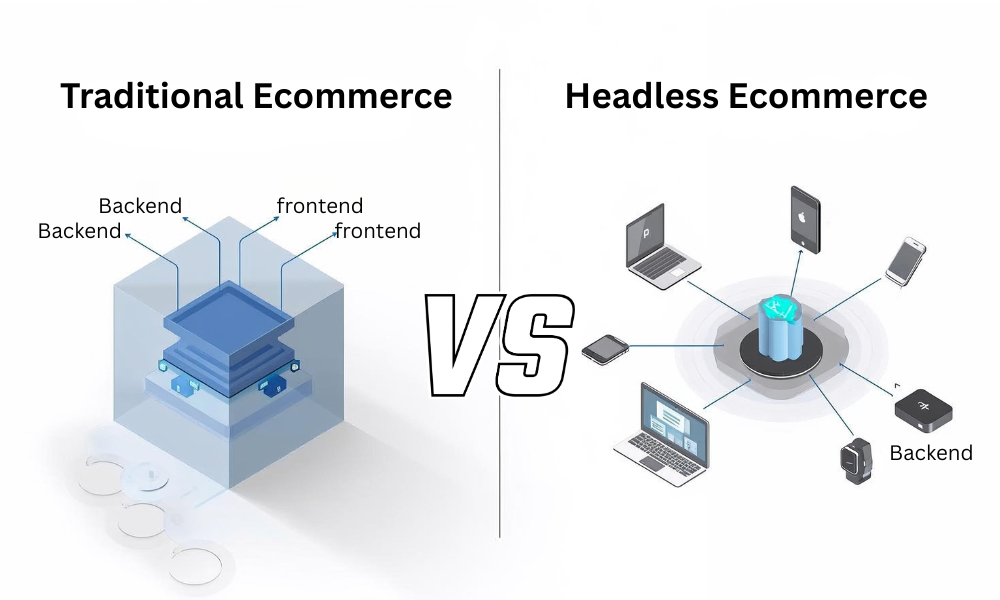
- Elaborating further, this approach has a decoupled architecture where front-end and back-end functionality are independently managed.
- Moreover, it allows systems to flexibly manage content updates across various platforms like websites, apps, kiosks, and even IoT-integrated devices.
- On the contrary, a traditional eCommerce framework manages the front-end and back-end functions together, where many customizations are not needed.
That being said, this article closely studies both headless and traditional commerce from a business viewpoint, considering its analogy, and features in detail. Mainly, this analysis will help leaders understand which framework suits their organization better, while supporting their digital goals and ensuring better scalability in 2026 and beyond.
Understanding Traditional eCommerce Architecture
Traditional eCommerce architecture can be better understood as a platform where the front-end interface and the back-end engine are tightly connected in one single system.
So, this means that from store management to design to operations, everything runs through a centralized framework.
Technically, it follows a monolithic approach, including aspects like:
- Simplified deployment.
- Reduced architectural flexibility.
- Easier operational management because of a single codebase.
- Fewer maintenance costs.
On the contrary, this approach also restricts scalability and feature customizations. This is because changes are difficult to integrate without affecting the whole system.
Overall, this is why the traditional eCommerce framework is relatively easy to manage in the early stages of a business, but later, as expansion is needed, this architecture may face technical issues regarding scalability and customization.
Understanding Headless eCommerce Architecture
Headless eCommerce framework is a relatively modern concept that follows a decoupled architecture approach. This means that here the front-end and the back-end operations are separately managed through independent layers through APIs.
Basically, this gives the teams more control over the operations, as change can be easily integrated in this case.
Here, technically, the headless commerce development has the following key components:
- The backend layer manages products, pricing, inventory, checkout, payments, and orders.
- The frontend layer is built separately using modern frameworks.
- They are connected through an API-first ecosystem.
- Additional services such as CMS, search, personalization, and analytics can be integrated into the framework independently.
As compared to monolithic platforms, this creates a more modular and flexible system that can be easily updated and managed by technical teams. Hence, we can say that a headless eCommerce structure is more suitable for growing brands that need to manage complex operations and enterprises that require a higher level of customization and scalability in their operations.
Comparative Analysis of Headless and Traditional eCommerce
At its core, traditional commerce bundles all functions together, while headless commerce development manages the system in independent parts.
That being said, let us understand their comparison closely to help leaders research the best eCommerce frameworks based on their digital goals, cost-wise investment, resources that they want to invest further, operational flexibility, and other aspects. Mainly, this will help them decide the most suitable approach for their operations.
So, let us find out more about these frameworks through the following table.
| Key Differences | Traditional eCommerce | Headless eCommerce |
| Architecture | Single unified system. Easy to manage and structurally predictable. | Decoupled architecture, which means that the front-end and back-end operate independently.Moreover, they communicate through APIs. |
| Timeline for Initial Launch and Updates | The framework has a faster launch time.Offers less flexibility. Takes up more time for feature innovations. | This framework may be relatively slower to deploy.Allows faster updates. Offers more flexibility. |
| Customer Experiences | It follows a template-based design that allows fewer customizations.Better for delivering less personalized user experiences. | This approach follows a custom template design that is fully flexible to integrate architectural changes.Helps offer better omnichannel user experiences. |
| Scalability | The framework leaves less room for scalability. This is because for a single change in the system, the whole framework needs to be affected. | Here, scalability is higher, as front-end and back-end operations can be managed separately. |
| Integrations | The traditional framework has built-in tools due to which integrations are fewer. | This framework allows more integrations to support performance. |
| Cost Structure | Upfront cost is relatively lower.Maintenance and long-term development costs may be higher to manage growth. | The upfront cost is higher.Maintenance costs and long-term development costs are optimized for scalable operations. |
| Technical Complexity | This approach is relatively simpler to manage. | This approach is technically advanced and highly complex. |
Hence, we can say that if an enterprise needs fast deployment and an easily managed list of catalog and products, then a traditional eCommerce framework may suit the firm better. However, if your organization needs to manage multiple digital channels that require more personalization and scalability, then headless commerce development is the way to go.
Final Thoughts
Wrapping up, we can say that a business framework is developed keeping certain digital goals and business needs in mind.
- That being said, the traditional approach is less complex. Moreover, it is a better choice for organizations that need to simply market their products with more simplicity and limited customizations.
- On the contrary, a headless eCommerce framework emerged as a technical solution for firms managing many product lines and digital channels. So, they can operationally manage more updates, personalization, and growth in the long run.
That being said, this choice depends on the company’s digital transformation goals and the level of operational complexity that they foresee.
Hence, the right way to move ahead with this choice in 2026 is to brainstorm this decision in the boardroom with leadership and stakeholders, considering the digital goals that they have in mind for the future. And this step decides the progress you should make in deciding on a certain eCommerce framework.