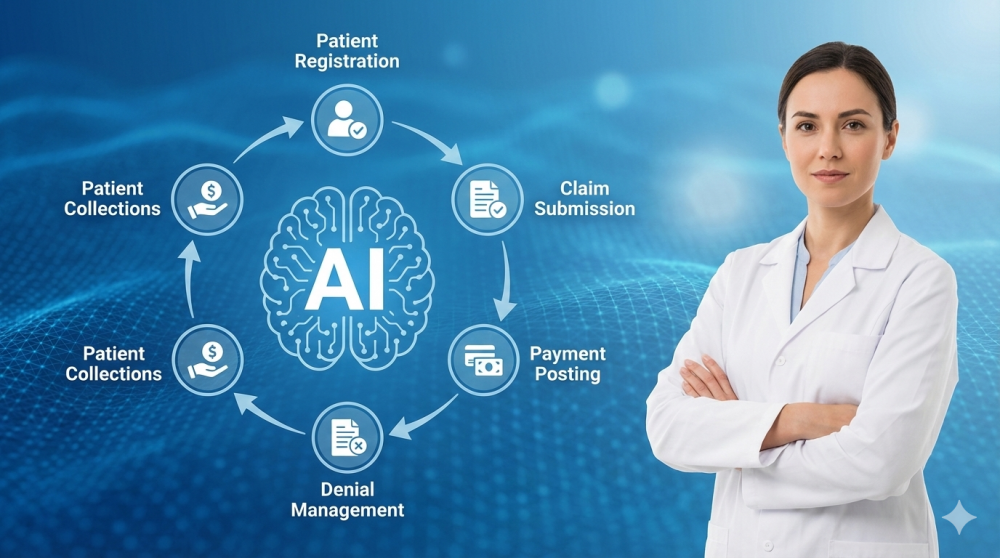
The revenue cycle in the healthcare industry is at a breaking point. Margins are shrinking, denial rates are up, ever-changing payer regulations outpace the industry’s ability to keep up, and administrative costs continue to increase. Simultaneously, the industry possesses massive amounts of data in the form of structured and unstructured data, clinical documents, claims submissions, payer responses, and remittance that cannot be processed and interpreted in any way effectively with existing automation technology.
The generative AI model represents a revolutionary transformation in the landscape.
In contrast to rules-based RPA and traditional analytics, generative AI systems are capable of contextual understanding, reasoning over data sources, content generation, and learned adaptation from outcomes. Proper application of generative AI not only optimizes RCM processes but transforms revenue operation activities entirely.
Why Traditional RCM Automation Is No Longer Sufficient
In the majority of healthcare enterprises, a level of automation in RCM will already have been adopted. The process of checking eligibility, claim scrubbing, coding validation, and posting of payments will have been partially automated. Denials, rework, and burnout still continue.
The reason is quite simple:
Classic automation is rule-based. Medical finance operates on exceptions.
RCM is dominated by:
- Payer-specific policies that are constantly changing
- Clinical subtlety as reflected in physician documentation
- Sending Unstructured Letters of Denial and Other Appeal Responses
- Inconsistencies in data between EHRs, clearinghouses, and billing
Rules-based systems decompose a moment when context becomes important. Exactly this type of environment is where generative AI performs well.
How is Generative AI Unique within Healthcare RCM scenarios
AI models that are generative can interpret language, patterns, and intent in addition to data fields. In the RCM model, this is important because some capabilities were not available or affordable in the past.
Key differentiators are:
- Context-aware decision-making as opposed to traditional logic
- Natural Language Processing for Clinical Notes, Denial Responses, & Payer Communications
- Appeals, document summary, and reminder content generation
- Learning based on outcomes rather than solely on rules
When such capacities are implemented within the framework of enterprise-level development for generative AI solutions, they can be adjusted based on payer mix, specialty, region, and regulatory requirements.
Core Generative AI Applications Throughout the Revenue Cycle
1. Intelligent Eligibility & Prior Authorizations
Based on past authorization results and guidelines from the payer and the healthcare industry, the generative AI model is capable of analyzing and drawing
- Predict the probability of authorization before this submission.
- Insignis documentation, or lack thereof
- Provide real-time recommendations for corrective actions
This works to minimize downstream denial and revenue leak claims.
2. Clinical Documentation Intelligence
Incomplete or unclear documentation is one of the most common reasons for the denial of claims. Generative AI models can:
- Review provider documentation for coding and billing appropriateness
- Provide documentation improvements aligned with the requirements of the payers
- Summarize encounters in payer-friendly language
Significantly, these tools help, not hinder, healthcare providers in a manner that does not significantly interrupt
3. Automated, Contextual Claim Scrub
Instead of claims being measured against sets of rules, Generative AI analyzes the following:
Patterns of historical denial:
- Historical denial patterns
- Payer-specific language preferences
- Clinical-to-financial alignment
Overcoming the challenges in claim validation will result in adaptive claim validation accuracy.
4. Denial Classification & Root Cause Analysis
Generative AI is very good at dealing with unstructured data in denied information, such as
- Explanation of Benefits (EOBs)
- Letters from Payors, Notifications through Portals
- Appeal Responses
Models can stratify denials by root cause, identify systemic problems, and make recommendations to prevent them from shifting from a remedial to a preventive approach in managing denials.
5. Automated Appeal Writing
One of the most useful usages of generative AI in RCM is the automation of appeal processes. AI is capable of:
- Create payer-specific appeal letters
- Reference Clinical Evidence and Prior Authorizations When considering a treatment
- Adjust the style and format depending on the history of success with the payer
This has led to a substantial decrease in the appeal turnaround time, as well as an increase in
6. Predictive Cash Flow & Revenue Forecasting
Based on historical collections data, denial trends, and payment information, AI technology can:
- Make cash flow predictions more accurately
- Identify at-risk revenues earlier
- Enhance financial planning and resource allocation
This shifts finance teams from retrospective reporting to forward-looking strategy.
Compliance, Privacy, and Trust: Unnegotiables for Healthcare AI
Healthcare RCM applications of Generative AI require responsible use. The involved risks are too great for black box solutions or consumer-level AI.
Enterprise-ready solutions must address the following:
- The HIPAA laws and their impact on PHI protection
- Provide secure model training and inference environments
- Explainability for financial and audit decisions
- Clear human-in-the-loop controls
That’s why healthcare organizations are teaming up more frequently with companies that have expertise in developing generative AI based on knowledge of healthcare regulatory requirements and enterprise AI architecture.
Measuring ROI: What Our “Smarter RCM” Actually Means
When done properly, generative AI means measurable results, and not innovation for innovation’s sake.
Some typical performance enhancements include:
- Increased first-time fix rates
- Increased first-pass yield rates
- Faster days in accounts receivable (DAR)
- Reduced cost-to-collect
- Higher staff productivity and lower burnout
- Improved payer satisfaction and response times
The best-performing companies think of generative AI more as a revenue enablement system and less as a cost reduction solution.
Common Pitfalls to Avoid
Although it holds much promise, “generative AI is not a silver bullet. Organizations will fail when they:”
- Deploy generic AI tools without healthcare-specific training
- Ignore data quality and governance
- Over-automate without human oversight
- Treat AI as an IT project instead of a revenue strategy
It’s a success strategy to consider alignment across technology, process, and people, often accomplished by working with experienced implementation partners
The Future of RCM: Intelligent, Adaptive, and AI-Powered
As the complexity of payers continues to increase and new models for reimbursement emerge, manual RCM processes will increasingly fail. What generative AI brings to healthcare is not evolution but revolution.
The future of RCM will be:
- Be proactive rather than reactive
- Predictive rather than retrospective
- Instructed vs. directed attention
Those organizations that invest in healthcare-grade generative AI expertise today not only ensure their revenue streams but, in fact, gain a competitive edge.
Final Takeaway:
Applications of Generative AI in healthcare revenue cycle management are now beyond research and experimentation. This technology is soon going to become a base functionality for players seeking perfection and scalability in a complicated environment of reimbursements. The question is no longer whether or not to use generative AI in RCM, but rather in what way it is to be leveraged.