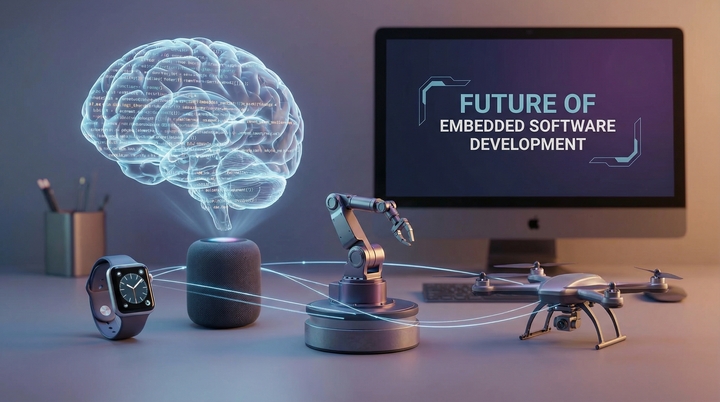
Embedded software is not something most people consider. They look at the smart thermostat on the wall, the fitness band around their wrist, or the control system on the inside of a car. What they fail to notice is the fact that those devices are being powered by the software.
Modern technology is made to work through embedded software. It manages the medical devices within hospitals. It takes care of sensors in factories. It operates in smart speakers, security cameras, and even in kitchen devices. Embedded software is no longer supporting technology as more devices are being linked to one another via the internet. It is shaping it.
Embedded software is a major factor in the future of smart devices.
Why Embedded Software Is Crucial Today
The smart devices in the modern world are not some remote machines. They gather information, distribute it, and react on the spot. At this point, a smart home is able to automatically change the light, temperature, and security settings.
On the same note, sensors in industries are able to record faults before a machine malfunctions. Additionally, wearable devices are able to monitor heart rate and give notifications in case something does not look right.
And, all this does not occur without embedded software.
With the migration to automation and interconnectedness of industries, the complexity, reliability, and intelligent nature of the embedded system are in high demand. The devices will be estimated to react immediately, remain safe, and use low power consumption. This puts a strain on devs to create systems that are efficient and reliable.
The Emergence of Connected Things.
The Internet of Things is one of the largest sources of change. Connected devices have been introduced in homes, hospitals, farms, and factories. These devices exchange information with one another in order to enhance efficiency and minimize manual labor.
Industrial sensors, as an example, can be used to monitor the temperature and pressure in real time. The system can also inform instantly in case of something abnormal. Smart thermostats interpret user patterns and automatically increase or decrease the temperature of the home.
The data collection, processing, and communication of these systems is done through embedded software. As the number of devices goes online, software within them has to cope with bigger networks and more intricate interactions.
The notion of connectivity is no longer an option.
Edge Computing Is Minimizing Delays.
It is not always possible to send all data to remote servers. In most instances, the devices are required to make judgments immediately. Here, processing data nearer to the source will be significant.
As an example, a wearable health device that measures the heart rate cannot afford the delays. It should act on the spot in case it identifies any anomalies. Likewise, industrial devices do not have the time to wait until there are cloud instructions in the event of a malfunction.
Local computing of data minimizes delay and enhances reliability. It also provides an added privacy level, as not all information has to flow through networks.
Since the use of smart systems is becoming more widespread in regions with weak connectivity, local processing will contribute more to embedded software design.
Open-Source Tools Are Changing Development
Embedded development used to take a great deal of special tools and time to develop. The process is being made more accessible today by the open-source platforms.
Embedded operative systems enable developers to develop and test systems on a quicker scale. Improvements and fixes are disseminated among communities, accelerating innovation.
This change is assisting startups and other companies in the smaller market to venture into the smart device market. Development is getting more participatory. That opens up to the new ideas and quicker product releases.
Impact Across Major Industries
Embedded software does not apply to any single sector. Its influence is wide.
Embedded systems are used in pacemakers, ventilators, and wearable monitors in healthcare. These devices handle real-time data and aid in life-saving decisions. Such a delay or a malfunction cannot be tolerated, and this is where reliability is of paramount importance.
Modern cars have dozens of embedded systems in the automotive sector. They take control of engine functions, braking, navigation, and safety. Such companies as Tesla count on embedded systems to implement predictive maintenance and driver assistance.
Embedded software is used in consumer electronics or everything that brings convenient living. It depends on smart TVs, game consoles, and voice-controlled speakers. Embedded processing acts when a smart speaker has detected a voice command.
Embedded systems are also required in industrial automation. Production lines would be controlled in real-time to enhance accuracy and reduce downtime. Thus, manufacturers use these systems to sustain a steady production without having to face the expensive disruptions.
In all these industries, the element that is similar is the use of reliable software that is operating inside devices through reliable embedded software development services.
Security Cannot Be Ignored
With increasing connectivity, there is an increase in security threats. Devices, which are tied to networks may fall victim unless they are secure.
There should be a lot of protection incorporated in medical equipment, vehicles, and home security systems. Security is no longer an addition to be made later. It needs to be involved in design.
Secure boot processes, encrypted communication, and frequent firmware updates are now the concerns of developers. The problem is to enhance security without reducing speed.
In the new era of embedded software, security will continue to be one of the largest concerns.
The Ongoing Push for Energy Efficiency
A lot of smart devices utilize batteries. Wearables, agricultural sensors, and remote monitoring systems, among other such products, need to have a long lifespan without regular changes of batteries.
The design is becoming energy efficient. Microcontroller developers engage in low-power microcontroller development and code optimization. Devices are made to go to sleep when not in use and wake when required.
Sustainability is enhanced through the management of energy in a better way and lower operational costs. It also renders products more convenient to the users.
Key Takeaway
Embedded software may not be visible, but it sits at the core of modern smart devices. As industries continue to rely more on connected systems, automation, and real-time data, the importance of embedded development will only grow.
The future will demand secure, efficient, and intelligent systems that work quietly and reliably. Devices will become more capable, but expectations will also rise.
In the end, the success of smart technology depends on the strength of the software running inside it. Embedded software is no longer just supporting innovation. It is driving it.