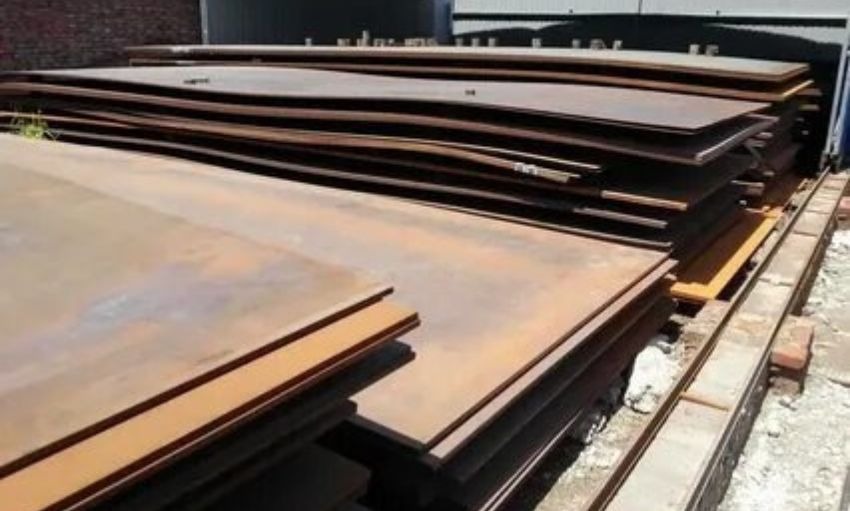
If you have been around heavy equipment or material-handling equipment, you understand that all types of steel do not respond equally. Some grades look strong on paper but fail early once real impact and abrasion are involved. This is where manganese steel plates stand apart.
Manganese steel does not get selected because it is popular or easy to work with. Manganese steel gets selected because it can withstand what regular steel cannot withstand or survive conditions that would normally destroy regular steel.
What Makes Manganese Steel Different in Practice
Manganese steel contains a high level of manganese combined with carbon. On its own, that doesn’t sound unusual. What matters is how the material reacts once it is put into service.
Most steels wear down as they are used. Manganese steel does the opposite. When its surface is hit repeatedly or rubbed by abrasive material, it hardens. At the same time, the inner structure stays tough and flexible. This combination is rare and extremely valuable in high-impact environments.
That is why manganese steel plates are mostly found where the cost of replacement is high and where failure is simply not an option.
Different Types Of Manganese Steel Plates
- Hadfield Manganese Steel Plate
- ASTM A128 12 – 14% Sheets
- Creusabro® M Sheets
- Creusabro® M Steel Plate
- Manganese X120Mn12 Plates & Sheets
- 12 – 14% Manganese Hot Rolled Steel Plates
- 1.3401 Manganese sTEEL Sheets & Plates
- Low Manganese Steel HR Plates
Manganese Steel Plate Equivalent Grades
| STANDRADS | EURONORM | DIN | ASTM | AFNOR | IS:2000 | IS:1993 | BS |
| GRADES | X120Mn13 | 1.3401 | A128 GR B2 / A128M | X120Mn13 | 276 | 2708 | 3100 |
Manganese Steel Plate Chemical Composition
| Grades | C (%) | Mn (%) | Si (%) | S (%) | P (%) |
| ASTM 128 Gr B2 | 1.05 – 1.2 | 11.5 – 14 | < 1.0 | – | <0.070 |
Mechanical Properties of High Manganese Steel Plate
| YIELD 350 MPa51 KSI | TENSILE UTS 20° C (68° F) | ELONGATION | CHARPY Kcvl 20°C (4°F) | HARDNESS BHN |
| 940 MPa 136 KSI | (5d) 40% | >140J/cm2 100 ft. lbs | 220 to 540 |
How It Performs in Real Industrial Conditions
In mining plants, crushers and hoppers are constantly struck by stone and ore. In these conditions, conventional steel plates lose material quickly and need frequent replacement. Manganese steel plates gradually develop a hardened outer layer that slows wear instead of accelerating it.
The same behavior is seen in earthmoving equipment, rail crossings, and bulk material conveyors. The harder the working conditions, the better manganese steel performs — provided it is used for the right application.
Where Manganese Steel Plates Are Commonly Used
Manganese steel plates are not general-purpose materials. They are selected for very specific roles.
In mining and quarrying, they are used for jaw plates, liners, and impact zones. In construction equipment, they protect buckets, blades, and wear surfaces exposed to repeated shock loads. Rail infrastructure relies on manganese steel for crossings and switches that experience continuous mechanical stress.
Cement plants and power stations also use manganese steel plates in chutes and transfer points where abrasive material flow causes rapid wear to standard steels.
Advantages Over Standard Steel Plates
Compared to carbon steel, manganese steel plates last significantly longer under impact conditions. Compared to hardened alloy steels, they are far less likely to crack or fail suddenly.
Their initial purchase cost is higher, but in most occasions, their total cost of ownership is lower. The few shutdowns, fewer replacements, and less maintenance usually clear justification for the investment.
Important Fabrication Considerations
Manganese steel is not easy to fabricate, and this is where problems often occur. It is difficult to machine and requires controlled welding procedures. Improper cutting or welding can damage the material’s structure and reduce its performance.
This is why it has been generally agreed that must be worked by the fabricator. When processed correctly, the plates retain their properties and perform exactly as intended.
Conclusion
Not every application calls for manganese steel plates, but for the right ones, they are incomparable. The ability of the material to harden under stress while remaining tough inside makes it one of the most reliable materials under extreme conditions of service. For industries where wear, impact, and consequent downtime are constant headaches, manganese steel remains a tried and practical solution.