Building a mobile app for your business is a critical step aimed at scaling your operations and entering the digital arena. For most businesses, mobile apps become their backbone, enabling them to engage with clients and customers more directly, boost loyalty among them, and increase overall revenue.
Therefore, if you are a budding entrepreneur, a startup founder, or an established business owner, building a mobile app is no longer just about the coding efforts you put in. Instead, app development requires a structured roadmap for turning a unique idea into an operational, sustainable, and working product.
On average, users prefer to spend around 3.5 hours every day on diverse mobile apps. However, with such high overall engagement, there are still 75% of mobile apps that are downloaded & used for less than 10 times. Moreover, a lot of apps continue to struggle with retaining users, as the rate drops by 20-27% after a month.
This indicates the importance of adhering to a proper plan of action while building mobile apps. May it be concept validation, planning, UI/UX designing, development, QA, deployment, or post-launch maintenance, every stage has its unique purpose. In this article, you will learn about the importance of end-to-end app development and how each stage plays a crucial role.
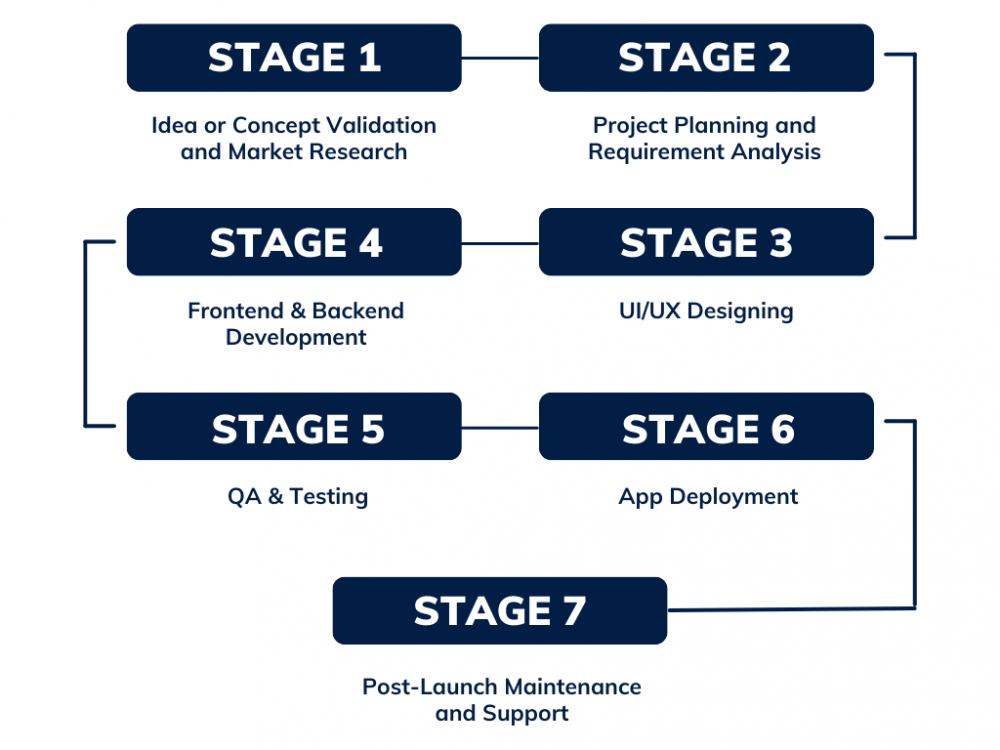
7 Stages of End-to-End App Development
Here is the detailed explanation of the 7 practical stages that comprise end-to-end app development, covering all fundamental and technical aspects:
1. Idea or Concept Validation and Market Research
Around 80% of the software products that skip the early research stage will perform below expectations. Therefore, it is the most crucial stage to begin your app development project with, as here is where your idea will either succeed or fail, even without writing a single line of code.
Core Activities of this Stage:
- All the problems that your app intends to solve will be defined and highlighted clearly.
- Target users will be identified.
- Competitor and market analysis will be executed to determine the best & worst attributes of similar existing apps.
- Understand the market demand and determine if the app can position itself to accommodate the same.
- Define the business goal of the app, such as automation, engagement, growth, revenue generation, or all of them.
Impact on Business:
Upon prioritizing idea validation and market research in your end-to-end app development, you can expect to attain:
- A great app that fits well amidst the market demand. An app that is not required in the market will guarantee your business failure.
- A perfect business idea that won’t waste your app development budget.
2. Project Planning and Requirement Analysis
In Simpalm’s opinion, an app development company in DMV area, project planning and requirement analysis stand as a critical decision-making stage. Once the idea has been validated, founders must then work towards converting it into a proper development plan.
Core Activities of this Stage:
- Decide whether you need an MVP first or want to build a full-scale app directly.
- Determine if you want to add all the core features right from day one, or prioritize future enhancements through updates in the long run.
- Choose either Android, iOS, or cross-platform development for your project.
- Make high-level budget estimation depending on the project complexity.
- Plan the development timeline associated with your preferred deployment deadline.
Note: Most successful startups often prefer not to build full-scale apps from the start. They prefer building MVPs for testing the market first and then scaling accordingly.
Impact on Business:
With proper planning and requirement analysis, you will be able to:
- Control the cost of your project, its scope, and delivery speed.
- Avoid budget overruns in the middle of your project.
- Prevent avoidable delays in the launch.
- Prepare a blueprint of your app’s technical architecture
- Create workflow diagrams for your app development project.
3. UI/UX Designing
A good app design isn’t simply about the visual aesthetics, but the way it engages the users, makes them understand what you offer, and earns their trust. In this stage, you will be getting the real feel of your app, prior to its deployment.
Core Activities of this Stage:
- UI/UX designers will create wireframes defining the structure of your app.
- Build interactive design prototypes.
- Make use of journey mapping
- Achieve brand consistency in design.
- Drive focus on achieving a simple, responsive, and usable app design.
- Ensure the touch areas and buttons are all user-friendly.
- Create consistent typography and color schemes throughout the app.
- Prevent design errors and create recovery mechanisms.
- Minimize the number of steps the user must take to complete core tasks on your app.
Impact on Business
With proper UI/UX design, you can expect to attain:
- Apps with well-tested UI/UX design prototypes will record 30-40% higher user engagement rates.
- Avoid negative reviews and uninstalls because of poor UX.
- Prototyping can help you reduce your app development time by 20-30%. It is because you will be able to catch any design flaws beforehand.
4. Frontend & Backend Development
All your planning, requirement analysis, and design efforts will now be brought together to build a functional product.
Core Activities of this Stage:
Frontend:
- It is the part that the users see & interact with!
- Implement the app screens and establish navigation.
- Ensure design responsiveness and integration of smooth animations.
- Integrate the finalized UI/UX design elements into the frontend of your app.
Backend:
- Design and manage the database.
- Create & integrate APIs for better data flow and internal communication.
- Enable user authentication, roles, and permissions.
- Implement business logic.
Others:
- Make third-party integrations, including payment gateways, push notifications, analytics, and maps.
- Making the choice between native development and cross-platform development.
- Adapt the agile development approach for faster feedback and improved flexibility.
- Enable version control for better code management.
- Conduct frequent code reviews to maintain its quality throughout the development stage.
- Leverage modular coding for better scalability and prioritizing easier updates.
Impact on Business:
- A professional app development approach will ensure your digital product stays scalable and maintainable in the long run.
- Developing MVPs for the start can also help you achieve 30% higher user retention later when you launch a full-sized app.
- An agile approach can help speed up the overall development process by 30%.
5. QA & Testing
The QA & testing stage will confirm that your app is built to perform under all conditions, ensuring it adheres to the user expectations. Upon proper execution of this app development stage, you will be saving on your long-term costs and protecting your brand reputation.
Core Activities of this Stage:
- Conduct functional testing to verify if the app features work as expected.
- Performance testing for measuring the speed, memory usage, and responsiveness of your app.
- Compatibility testing to check your app’s performance on different devices, OS versions, and screen sizes.
- Security testing to ensure that the user data and APIs are safe & protected.
- UAT or User Acceptance Testing to evaluate your app by involving real users who will be testing the workflows.
- Security testing to identify potential vulnerabilities.
- QA will run in parallel with the development share for enabling quick bug fixes and seamless deployment.
Impact on Business:
- Early testing helps businesses prevent budget overruns.
- Fixing bugs found in the production environment will cost 100x more than when you identify them during the design phase.
- Rigorous testing will minimize the need for emergency post-launch amendments.
6. App Deployment
With all the test cases executed, your app is now ready to move from development to the production stage and be released to the public. Launching your app implies that it facilitates technical readiness and is in compliance with the App Store and/or Play Store guidelines.
Core Activities of this Stage:
- Ensure compliance with the App Store or Play Store app submission guidelines.
- Create app assets, descriptions, visuals, and metadata.
- Initiate beta testing of your app with real users.
- With Android app development, you can enable staged rollouts for flexible testing.
- Handle all the common rejection reasons, such as incomplete submissions or policy violations.
- Optimize the app build for size and performance.
Impact on Business:
- Well-optimized App Store or Play Store listings with appealing visuals and good descriptions will encourage 25% more downloads.
- Thorough launch preparation backed by a quality app will ensure your users don’t abandon the app right after their first use.
- Proper adherence to the App Store or Play Store submission guidelines will minimize the chances of rejection and do-overs.
7. Post-Launch Support
Launching your app is not the end of the process, but is just the beginning! Almost every app that has been built with a growth vision in mind will continue to evolve after launch. Therefore, every app that strives to be successful will need periodic maintenance to ensure it stays secure, stable, and relevant for users.
Core Activities of this Stage:
- Fixing the user-reported bugs or issues.
- Updating the app compatibility for newer OS versions.
- Adding features based on the scalability plans or user feedback.
- Monitor user analytics to determine engagement rate on your app.
- Build user feedback loops.
- Tune and optimize performance over time to maintain user engagement on the app.
- Monitor security and integrate required patches to establish robust protection of user data.
- Plan the budget accordingly to spend 15-25% of the initial development cost on annual maintenance of the app.
Impact on Business:
- Using the user feedback loops can help boost your app retention rate by 25%.
- Prevent frequent app crashes, which are common after the OS updates.
- Preserve your app’s reputation over time by keeping it relevant for users.
- Fix technical issues and enhance features or functionalities by considering the present market demands.
Conclusion
These were the seven stages of end-to-end app development that will not just help you build a quality product to represent your business operations, but will also determine your success in the industry.
Upon adhering to this roadmap, you will be able to launch faster, save costs, deliver improved UX, and scale proactively. All you need is a team of professionals with robust expertise to help you manage and work through every stage with utmost sophistication.
Turn your business idea into a successful app, all by following this straightforward roadmap!