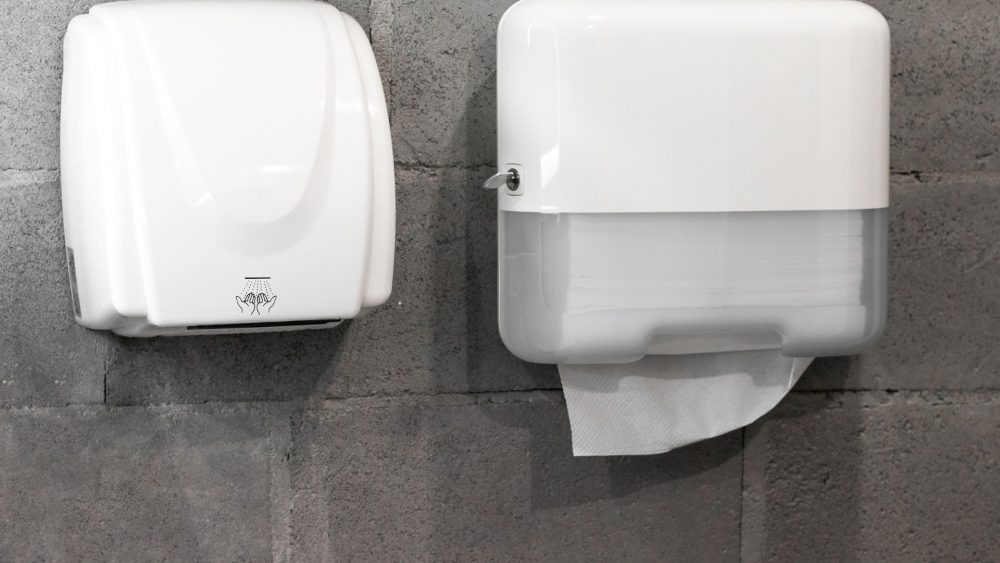
Can one smart restroom upgrade make your sustainable office cleaner, greener, and easier to manage?We believe it can. Efficient hand drying systems cut waste, reduce maintenance stress, and turn everyday hygiene into a sustainability win your team actually feels.
Sustainability choices in offices are evident through lighting decisions, HVAC renovations, or material selections. Yet, much less attention is given to the sink, despite the fact that hand drying influences waste, cleaning workload, hygiene standards, and long-term operating costs on a daily basis. In today’s office environment, a hand dryer is not a fancy tool. It is an operational decision repeated every day, and it affects how efficiently the workplace runs.
This is the reason why the installation of efficient hand drying systems cannot be deemed a cosmetic upgrade. They are a practical decision. The correct system can minimize waste, ease the management of the restroom, facilitate hygiene standards, and reduce long-term running expenses. The wrong system may cause sound complaints, wet floors, user frustration, and low value in the long run.
In the context of modern offices, which are concerned with sustainable functioning, the relevant question is not whether hand drying matters or not. It does. The actual question is which electric hand dryer is the most suitable for offices with regard to the level of traffic, layout, maintenance, and office expectations.
Why Hand Drying Belongs in Office Sustainability Planning
Headline initiatives do not define a sustainable office. It is also characterized by the efficiency of everyday systems. Bathrooms are included in that calculus since they create continuing activity of operation: supplies have to be bought, stored, replenished, and disposed of; floors have to be cleaned; and fixtures have to work efficiently during peak traffic.
Paper towel systems create a cycle of continuous ordering, handling, and waste removal. That model is familiar, but it is not very lean. Each roll or pack is a component of a repetitive procedure, which includes the stock verification, storage space, bin liners, waste pickup, and cleaning time.
Effective hand dryers alter that paradigm. They minimize reliance on disposable products and change the decision to performance, energy behavior, access to service, and durability. This makes them relevant not only to sustainability teams, but also to the facilities managers, office designers, procurement teams, and finance leaders who require a cleaner long-term operating model.
That is, hand drying is not a bathroom problem alone. It belongs to the way a contemporary office organizes resources.
Hand Dryers vs Paper Towels: The Practical Office Comparison.
The standard comparison between paper towels and hand dryers is too shallow. It usually ends with the claim that paper generates waste and dryers reduce waste. It is true, but it will not help an office make a smart specification decision.
The more significant comparison is what each system requires from the building over time.
| Decision factor | Paper towels | Efficient hand dryers |
| Waste profile | Continuous everyday waste stream | Minimum routine waste |
| Recurring spend | Ongoing purchase of consumables | Higher initial equipment, less continuous consumable spending |
| Janitorial workload | Restocking, bin checks, waste removal | Surface cleaning, periodic servicing, and filter checks where applicable |
| Peak-use performance | Can the capability cause overflow when stock or bins are not controlled tightly | Requires the speed of drying, unit count, and traffic planning |
| Restroom appearance | Overflowing bins soon affect the quality of cleanliness of the restroom environment | Poor placement can cause splash or wet-floor problems if not managed properly |
| Best fit | Smallest sites, or hybrid systems, or areas where paper still has advocates | Offices trying to cut waste and reduce long-term restroom operating expenses |
This is the key difference: paper towels rely on ongoing consumption, while hand dryers rely on installed infrastructure. That alters the way offices are to compare cost, sustainability, and user experience.
The cost of a towel dispenser can be cheaper at the point of sale but that is not the actual price. Repetitive purchasing, storage, replacement, and disposal are included in the actual cost. A hand dryer will generally involve a higher initial capital purchase, but it is capable of saving those repeated requirements when it is chosen correctly.
Which Efficient Hand Drying System Fits Which Office?
Not all offices need to purchase the same type of hand dryer. What matters are the traffic pattern, restroom location, design expectations, and building constraints. The best specification is the one that suits the actual use of the space.
| Office setting | Best-fit approach | Why it works | What to watch |
| Small office with light to moderate use | Compact high-speed dryer | Reduces consumables without over-specifying the office space | Prefer quieter models where restrooms are near desks or meeting rooms |
| Medium office with moderate daily traffic | Fast touchless dryer with balanced noise and power options | Supports daily use without excessive maintenance required | May not seem slow on paper, but feel slow in practice |
| Busy office, HQ, or shared commercial floor | High-throughput dryers, sometimes more than one unit per restroom | Eliminates congestion and keeps user traffic moving during peak times | Under-specified capacity causes queues and user frustration |
| Client-facing or executive office | Softer, aesthetic unit with dependable sensors and regulated airflow | Promotes a better, higher-quality restroom experience | Do not forsake service access in favor of a polished look only |
| Retrofit in an older building | Surface-mounted unit with controllable electrical needs | Easier installation where wall modifications or power upgrades are constrained | Confirm power supply, mounting conditions, and space before selection |
This is where a lot of office projects fail. They select a hand dryer based on a single headline claim, most often, speed, and disregard the context of the actual operating environment of the unit. Practically, the most suitable office hand drying system is not the one with the most powerful marketing line. It is the one that accommodates the building’s actual operating conditions.
What Makes a Hand Drying System Really Efficient?
A good hand dryer is not the one that has the highest speed in a brochure. Efficiency, in the context of office settings, must be evaluated across several factors simultaneously.
Drying Performance
When a dryer takes too long, the user disengages. They go with wet hands, rub them on a garment, or find another place. That undermines hygiene performance and lowers the equipment payback. Real efficiency refers to drying hands quickly to allow user traffic, particularly in rush hours.
Energy Per Dry, Not Wattage.
Low wattage is appealing, but not an exhaustive measure of efficiency. A more efficient unit with lower wattage can be less efficient in practice than another unit that completes the drying cycle faster. Offices ought to consider the amount of energy that the dryer consumes to carry out a complete drying cycle, the ability to change the heat settings, and whether the system avoids drawing unnecessary power between uses.
A low-power-rated model is not efficient because it has a low power rating. It is productive when it fulfills the task at a good balance of speed and controlled power consumption.
Sensor Reliability
Touchless operation is only important when the sensor is reliable. Late activation, spurious activation, or units that abruptly malfunction irritate users and slow restroom use. Sensor reliability is not a technical aside in an office. It directly impacts the judgment of the equipment.
Noise Control
Noise is a factual office specification problem. When bathrooms are located in close proximity to meeting rooms, reception areas, focus zones or executive offices, sound output is added to the purchase decision. There are high-speed units that are very effective in drying but are not suitable for use in acoustically sensitive environments. A slightly less powerful unit can be the better choice in quieter working environments.
Water Management
Quick air circulation facilitates the drying process, which may also blow water off the hands and onto walls, floors, or other surrounding surfaces. This is why water control is important. The offices should examine how the dryer handles drips, whether the floor stays dry and safe, and whether the unit can be installed in such a way that the wash and dry area is confined, rather than spreading moisture into circulation zones.
Filtration and Hygiene Design.
There are models with filtration capabilities that enhance the air quality during the drying process. That may be useful in offices where hygiene perception is important. Another critical factor is the ease of cleaning of the housing, intake, and other surfaces. The hygienic design is not simply what the machine says it is. It is also whether the facilities team will be able to keep it in good condition.
Service Access and Durability.
Bathrooms in offices are repeat-use areas. Motors, sensors, mounts, and housings should be able to tolerate the everyday traffic without causing frequent service problems. Office decision-makers should look past the finish and look at warranty, replacement parts, cleanability, and the ease or difficulty of maintenance. A hard-to-service dryer will silently add friction to labor in the long run.
The Trade-Offs Offices Must Weigh Before Purchases.
The optimal hand drying choice often comes down to trade-offs, not absolutes.
The best unit should not necessarily be the fastest one when the restroom is located in close proximity to quiet work areas. A cheaper model is not economical when it breaks down or annoys the user. A well-polished designer unit can fit well in a high-end office, but that benefit will soon be lost when the time to have it serviced comes or when the finish is not suited to the setting.
The most important trade-offs are these:
Speed vs acoustics
High airflow may enhance throughput, but it may also increase sound. The appropriate balance depends on the restroom’s location in the office.
Lower initial cost compared to lower total operating cost.
A less expensive unit can be made more costly when it is poor in performance, maintenance or life cycle.
Low power consumption versus actual drying performance.
A very low-energy machine is not a good option when it leaves users waiting.
One unit vs real traffic demand.
The same dryer can be used in a low-traffic bathroom and not at all in a crowded office.
Dryer-only model vs hybrid provision.
Certain offices continue to enjoy limited paper backup in executive restrooms, in layouts that emphasize accessibility, or in areas where user preference matters.
The latter point is significant as it brings the necessary realism. A sustainable office need not adopt a one-size-fits-all approach to restrooms. A hybrid arrangement is more feasible in certain designs. The idea is not to eliminate paper entirely. This is aimed at minimizing waste and streamlining operations without causing new issues.
How to Compare Suppliers Without Falling for Generic Claims
The poorest hand dryer selections tend to start with imprecise supplier wording: “eco-friendly,” “high performance,” “premium experience,” or “advanced hygiene.” Those are not the phrases that can help a facilities team reach a defensible decision.
An improved assessment procedure asks practical questions:
- What is the count of hand-drying activities that this restroom will accommodate on a typical day and peak times?
- Will the unit be placed close to desks, meeting rooms or reception where sound is more important?
- Is the maintenance team able to access filters, internal components, and replacement parts easily?
- Will the dryer maintain nearby walls and floors reasonably dry with repeated use?
- Is the electrical requirement already supported in the building, or will it be more complicated than anticipated to install?
- How many units are needed to provide sufficient throughput for the level of traffic, or does the restroom require additional units?
- Will the unit fit the office interior design, or will it stand out like a sore thumb in a luxury location?
An authoritative supplier must provide answers to those points clearly and precisely. When the response remains in general marketing terms, the office is not yet in a position to make a good decision.
Total Cost of Ownership Is the Number That Matters.
In order to assess a hand drying system, it is more important to compare the annual operating impact than the purchase price alone.
An acute evaluation would involve:
- equipment purchases and installation.
- electricity use during normal operation.
- cleaning and regular service.
- filter replacement or other maintenance materials where applicable.
- savings in or added janitorial time.
- waste management, liners and disposal expenses saved or retained.
- likely repair frequency and the impact of downtime.
The decision can be summarised as follows:
TCO = installation + energy + servicing + cleaning labor + risk of downtime – avoided consumables and waste costs.
That equation is much more practical than comparing the price of a dryer to that of a towel dispenser. It indicates whether the office is purchasing a less expensive or a more efficient working model.
The Mistakes to Avoid When Specifying Hand Drying Systems for a Modern Office.
The performance of hand drying projects usually fails predictably because of certain reasons.
A frequent error is to select based on wattage only. Power rating is important, yet complete performance is much more important.
The other is sound profile neglect. A model that works perfectly well in a transport hub or industrial setting may feel completely out of place in a quiet professional office.
A third is not estimating traffic. When a restroom serves a big floor plate, user throughput and queue management are more significant than brochure language in modern design.
A fourth is neglecting serviceability. When filters, housings, or internal components are hard to reach, regular maintenance is more time-consuming and costly.
The fifth is assuming that user acceptance will take care of itself. Human beings make judgments in bathrooms. When someone feels that the dryer is slow, loud, messy, and sometimes inconsistent, that impression has an overall impact on the workplace.
Why Effective Hand Drying Systems Can Be the Key to Sustainable Office Operation.
Efficient hand drying systems can contribute to sustainability in a practical rather than a symbolic sense when properly specified. They reduce reliance on single-use items. They reduced the day-in, day-out waste stream that the janitorial teams had to deal with. They can enhance restroom consistency by reducing overflow and restocking issues. They facilitate touchless operation and simplify the control of long-term operating costs.
That matters because optimal sustainability practices are those that enhance day-to-day performance, and not policy language only. The hand drying systems work numerous times daily. Their effect is cumulative. In the long run, that makes them much more important than they look.
Sustainability in a contemporary office is not merely what the workplace claims to appreciate. It concerns whether routine systems are set up to consume less, produce less waste, and produce less preventable operational overhead. One of those systems is hand drying.
Selecting an efficient hand drying system does not mean choosing the fastest or the lowest-wattage unit on a specification sheet. It is about aligning performance with the reality of the office: traffic volume, sensitivity to acoustics, access to maintenance, hygiene expectations, and long-life operating cost. For some workplaces, that translates to a small, low-maintenance unit. To others, it would be increased throughput dryers or, at a minimum, a mixed system that would be more operationally efficient.
When that match is correct, the outcome is larger than a restroom renovation. There is less waste, less maintenance, and sustainability becomes not just a policy statement, but an operational reality. The real value lies not in installing a modern-looking machine, but in a system that functions well, improves the experience of using a cleaner restroom, and enhances the office’s long-term functioning through its operating model.