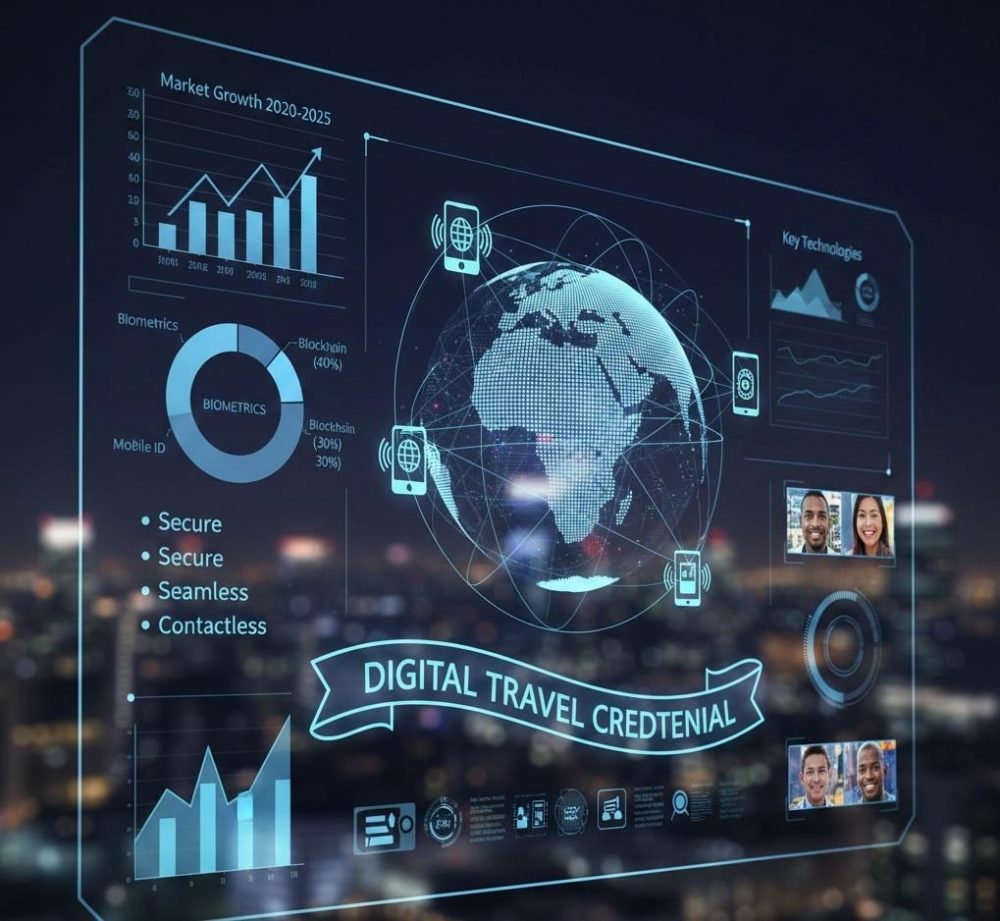
According to our latest research, the Global Digital Travel Credential Market size was valued at $1.8 billion in 2024 and is projected to reach $8.7 billion by 2033, expanding at a robust CAGR of 18.9% during the forecast period of 2025–2033. The primary growth driver for the Digital Travel Credential market is the increasing global focus on seamless, secure, and contactless travel experiences, spurred by rapid advancements in biometric authentication and digital identity management technologies. As international travel rebounds and digital transformation accelerates across the travel ecosystem, demand for secure, interoperable, and user-friendly digital credentials is surging, fundamentally reshaping how travelers interact with border control, airlines, and government agencies worldwide.
Introduction: From Paper Passports to Portable Digital Trust
Travel has always been about movement—but identity has remained stubbornly static. For more than a century, travelers have relied on paper-based passports, visas, and boarding passes to prove who they are. Today, as global mobility rebounds and digital ecosystems mature, a quiet but profound transformation is underway: the rise of Digital Travel Credentials (DTCs).
The Digital Travel Credential Market is not merely about digitizing documents; it is about redefining trust, security, and personal control in global travel. At its core, this market represents the convergence of digital identity, biometrics, cryptography, and international governance.
Understanding Digital Travel Credentials: Beyond a Digital Passport
A Digital Travel Credential is a secure, cryptographically verifiable digital identity issued by a trusted authority—typically a government—that enables travelers to authenticate themselves digitally across borders.
Key Characteristics of Digital Travel Credentials
- Mobile-first identity stored on secure devices
- Biometric binding (face, fingerprint, or iris)
- Cryptographic assurance preventing tampering or forgery
- Selective disclosure, allowing travelers to share only required information
- Interoperability across airlines, airports, and border agencies
Unlike scanned documents or e-visas, DTCs are machine-verifiable and trust-native, designed for real-time validation.
Why the Digital Travel Credential Market Is Gaining Momentum
1. Rising Passenger Volumes and Border Bottlenecks
As international travel volumes surpass pre-pandemic levels, traditional manual identity checks are becoming operational choke points. Airports and border agencies face increasing pressure to process travelers faster without compromising security.
2. Global Push for Seamless Travel Experiences
Airlines, airports, and governments are collectively pursuing frictionless journeys—from check-in to immigration clearance. DTCs enable identity verification before travelers even arrive at the airport.
3. Security Demands in a Digitally Connected World
Identity fraud, document forgery, and impersonation risks have grown alongside digital connectivity. DTCs introduce end-to-end trust, ensuring identities are authentic and traceable without central data exposure.
Market Architecture: How the Ecosystem Works
Governments as Trust Anchors
Governments issue and validate Digital Travel Credentials, ensuring compliance with international travel and security standards.
Technology Providers as Enablers
Specialized technology firms supply biometric capture, secure wallets, encryption frameworks, and interoperability layers.
Airlines and Airports as Adoption Accelerators
Carriers and airport operators integrate DTCs into passenger processing systems, transforming check-in, boarding, and immigration workflows.
Travelers as Identity Owners
For the first time, travelers gain greater control over their identity, choosing when, where, and how their credentials are shared.
Technology Foundations Powering the Market
Biometrics as the Identity Glue
Facial recognition and multi-modal biometrics bind digital credentials to the individual, reducing impersonation risks.
Cryptography and Public Key Infrastructure (PKI)
Advanced encryption ensures credentials are tamper-proof and verifiable without exposing sensitive data.
Decentralized Identity Principles
Rather than storing identities in central databases, DTC systems increasingly adopt decentralized models, minimizing breach impact.
Challenges Shaping Market Evolution
Interoperability Across Borders
For DTCs to succeed globally, countries must align on standards, trust frameworks, and verification protocols.
Privacy and Data Sovereignty Concerns
Balancing national security with individual privacy remains a defining challenge, particularly across jurisdictions with differing data laws.
Digital Divide and Accessibility
Ensuring inclusion for travelers without advanced smartphones or digital literacy is essential for equitable adoption.
Competitive Landscape
- Thales Group
- IDEMIA
- Entrust Corporation
- Veridos GmbH
- Gemalto (now part of Thales Group)
- Infineon Technologies AG
- De La Rue plc
- Giesecke+Devrient (G+D)
- HID Global
- Oberthur Technologies (OT-Morpho/IDEMIA)
- SITA
- Vision-Box
- Zetes Industries
- 3M (now part of Gemalto/Thales for travel documents)
- Secunet Security Networks AG
- NEC Corporation
- Deloitte
- Accenture
Future Outlook: From Travel Credential to Global Identity Layer
The Digital Travel Credential Market is poised to evolve beyond travel. Over time, DTCs may become foundational digital identity layers usable for visas, work permits, healthcare access, and cross-border financial services.
What the Next Decade Digital Travel Credential Market To Reach $8.7 Billion by 2033May Bring
- Pre-cleared international journeys with zero physical documents
- AI-assisted border risk assessment using verified identities
- Universal digital identity wallets governed by global standards
- Traveler-centric identity ecosystems with minimal data exposure