In a sense, smartphones have taken control. They have completely changed the way businesses function, and I’m not kidding. You are losing money if you are not there with your customers, who spend their entire day on their phones. The popularity of mobile applications is growing, and this trend is not expected to decrease anytime soon.
Why are companies investing so much money in mobile app development? because it works. You can design experiences that websites simply cannot match, provide notifications, measure behaviour, and have direct access to clients.It makes sense for both big businesses and startups to invest in mobile app development. In fact, due to modern frameworks like Flutter app development, this method is currently less expensive than it was in the past.
What Does Mobile App Development Mean?
Let’s define what we actually mean. The process to create software applications especially for use on phones and tablets is known as mobile app development. Applications are different from web applications because they are installed directly on devices in place of only running in a browser.
The key difference is that mobile apps are faster and more powerful. Your phone’s contacts, GPS, and camera are all accessible to them. When you’re not online, they function. Web apps always require a browser and an internet connection.
In terms of platforms, there are iOS and Android. They are whole distinct ecosystems with various programming languages and specifications. Traditionally, this meant creating two entirely different apps, which quickly became costly and complex.
Types of Mobile App Development
There are essentially four methods to do this.
1. Native mobile app development
The process of creating apps only for one platform. iOS apps are made with Swift, and Android apps are made with Kotlin or Java. The benefit? They can perform any task that a phone can, and they are extremely quick. The drawback? You’re working on two different projects.
2. Hybrid mobile app development
Compromise. You are capable of writing code using web technologies and have it run on both platforms by covering it in native containers. The performance isn’t as smooth, but it’s less expensive than developing two native apps.
3. Cross-Platform Mobile App Development
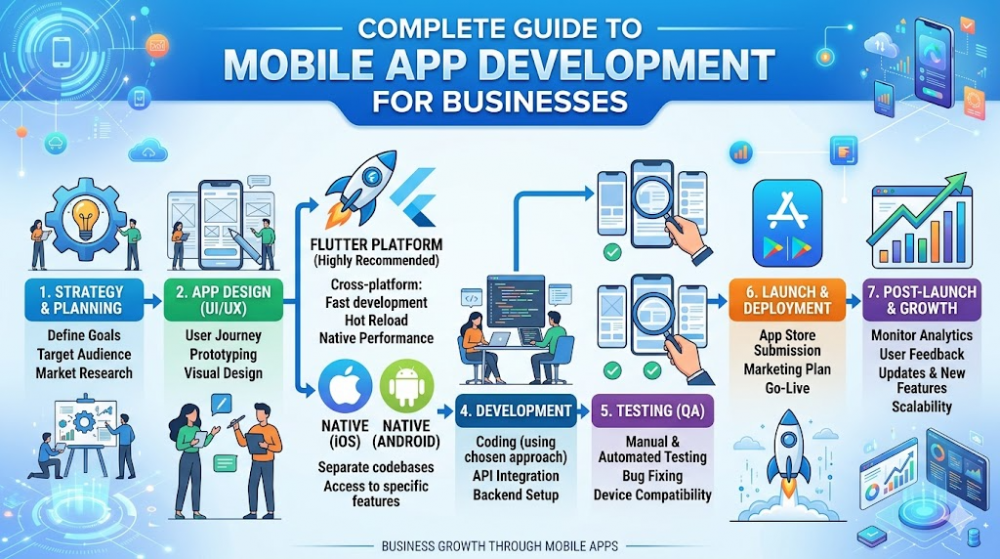
Your code only needs to be written once to provide authentic, high-performing applications for a variety of platforms. Here, Flutter app development is in the lead. With only one codebase, developers can create desktop, web, iOS, and Android apps. For timetables and finances, it’s revolutionary.
4. Progressive Web Apps (PWA)
Web-based programs that function similarly to mobile apps are called Progressive Web Apps (PWA). Although they lack certain native functionality, they are inexpensive to construct and quickly available through browsers.
Stages of Mobile App Development
Building an app actually follows a pretty clear path.
- Idea Validation & Market Research comes first. Talk to potential users. Research competitors. Make sure people actually want what you’re building. This phase prevents expensive mistakes.
- Next is UI/UX design Your app must be aesthetically pleasing and intuitive. It should be easy for users to utilize right away. Design is far more important than most people realize.
- Developers design functions and write code during the development stage. Because developers can equally design iOS and Android apps from a single codebase, this is where Flutter app creation really benefits. Everything is happening more quickly.
- Prior to launch, testing and quality assurance are conducted. Devices, operating systems, network speeds—everything is tested by developers. Either you find bugs here or, worse, your users find them in reviews.
- Submitting an app to the Apple App Store and Google Play Store is known as app deployment. Your software launches after you adhere to their rules and receive clearance.
- Updates and maintenance are ongoing. Based on customer feedback, you’ll update for new OS versions, add features, correct bugs, and enhance performance.
Popular Tools & Frameworks for Mobile App Development
The mobile app development community has built some excellent tools. Flutter is Google’s framework for cross-platform development. React Native works similarly. Swift dominates iOS development. Kotlin is the modern choice for Android. Android Studio and Xcode are the main development environments where developers actually write code.
The popularity of Flutter app development makes it worthwhile to emphasize. Hot reload allows developers to view changes rapidly, which greatly reduces development time. The final apps feel truly seamless and native, and the framework offers lovely UI elements right out of the gate.
Best Mobile App Development Platforms
1. Android Platform
Reaches the most people. Over 70% of smartphones globally run Android. If you want maximum reach, Android is essential. The ecosystem is flexible, and there’s room for different approaches.
2. iOS Platform
Serves a smaller but wealthier audience. Users spend more money on apps and in-app purchases. If you’re targeting premium customers or certain markets, iOS absolutely matters.
3. Flutter Cross-Platform Development
Begins to provide the best option. Flutter was invented by Google to remove the requirement of developers to choose between iOS and Android. Flutter creating apps allows you to fast and beautifully create apps for desktop, web, and mobile platforms with just one build. It costs more money and takes more effort to maintain distinct iOS and Android projects.
Key Challenges & Considerations in Mobile App Development
Real talk—mobile app development isn’t always smooth. Device compatibility is messy. Hundreds of Android devices exist with different specifications and OS versions. Security matters a lot. You’re handling user data, so encryption and proper authentication aren’t optional.
Performance optimization takes work. Users uninstall slow apps without hesitation. App store approval guidelines, especially Apple’s, can be restrictive. And maintenance is constant. New OS versions come out. Security threats appear. Users want new features. It’s ongoing work forever.
Mobile App Development Benefits for Businesses
Companies that invest in mobile app development see real benefits. Customer engagement improves dramatically. Apps create direct communication channels through notifications. They strengthen brand loyalty. Users feel more connected to brands they access on their phones.
Better customer experience means better retention. You can track user behavior and personalize experiences. It is easy to offer premium features that generate income. In conclusion, businesses who invest in excellent apps see visible improvements in sales and customer loyalty.
Future Trends in Mobile App Development
Artificial Intelligence integration is becoming standard in apps. Mobile apps with IoT capabilities link users to their physical environment. 5G technology will enable features that we haven’t even begun yet. Additionally, as more developers become aware of Flutter’s potential and efficacy, Flutter app development continues to increase in demand.
Conclusion
What matters is that creating mobile apps is now essential instead of optional. It’s likely that your rivals already have apps. You’re losing clients every day if you don’t. The good news? Thanks to technologies like Flutter app development, creating high-quality apps is now faster, cheaper, and more accessible than ever.
Whether you are a startup launching your first MVP or a company scaling your platform, there is a way forward. Don’t worry about it too much. Get to work building. Your clients are waiting on their phones right now.