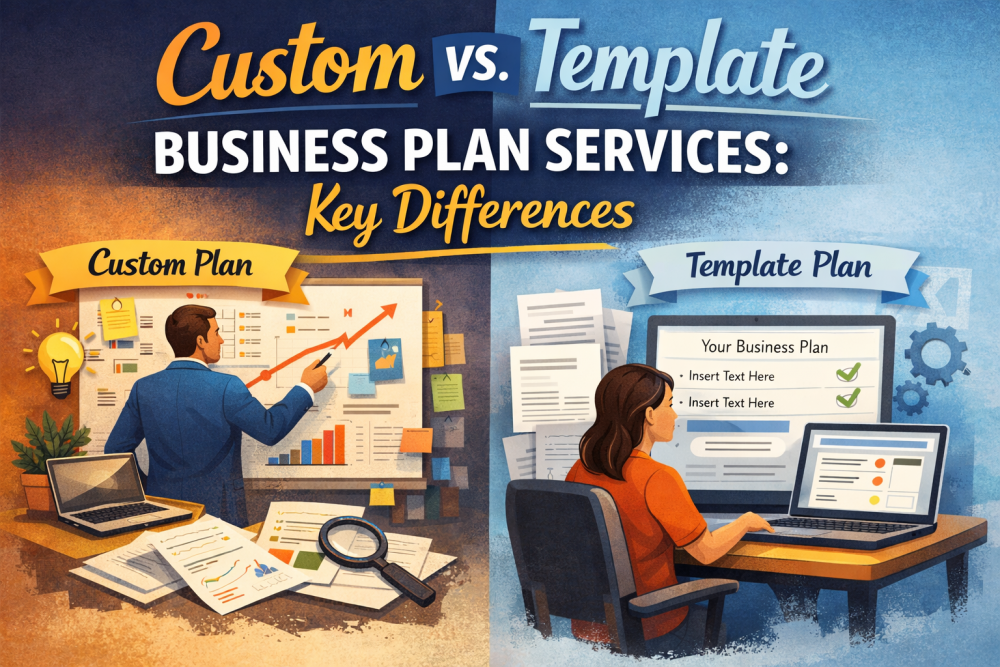
You are starting a business. Big idea. Bigger dreams. And then comes the hardest decision. Custom vs. template business plan. Do you build it from scratch or pick a ready-made template and fill in the blanks?
At first glance, both look the same on paper. Sections, charts, projections. But one of these tells your story. The other tells a story that has been told a hundred times before.
Imagine pitching to an investor who has already read ten plans that week.
Will yours feel personalised, thoughtful, and sharp? Or familiar enough to skim?
That single difference could decide whether they lean in or move one.
Where the real difference begins
A template business plan saves you time and is easy to set up. They provide a generic structure. Using templates, the only changes will be the individual’s figures and a small change in wording, resulting in an apparently complete document.
A custom business plan differs from a template business plan in that it starts with questions, such as what your market is, who your competitors are, how you intend to grow, and what risks you face.
Every section of the business plan is written specifically for your business and does not follow a preset structure. Rather than forcing you into a rigid structure, the strategy is tailored to your unique business.
The biggest difference between template and custom plans is that template plans are format-driven, while custom plans are fit-driven.
To attract the best investors, creditors, or partners, your business must demonstrate a strong fit with them. This fit is what attracts their attention and establishes your credibility.
Understanding template business plan services
Fast but familiar
Template-based business plans are fast and simple.
You’ve picked a format, simply input your information, and there you go. You could be finished in as early as 24 hours.
For new founders simply testing their business ideas and fulfilling a basic requirement, this could actually be considered a win. Templates provide standard sections such as Executive Summary, Market Overview, Operations, etc., which allow for a clean, organised, and predictable business plan.
But predictability has a downside. According to a survey by CB Insights, 38% of startups fail because they run out of funds, often due to weak planning and unrealistic projections.
Templates rely on averages, not your reality. They rarely question assumptions or dig into what makes your business different.
For example, a coffee shop and a SaaS startup may use the same template, but their risks, margins, and growth paths are worlds apart. A template won’t flag that. A human strategist will.
Custom business plan services
Custom business plan Ireland starts with conversation, not forms. It is built according to your industry, audience, revenue model, and long-term goals.
Professional custom services research your market, analyse competitors, and build financial projections personalized to your goals. This matters because investors don’t just fund ideas, but also clarity.
Harvard Business Review reports that founders who write detailed, research-backed plans are 16% more likely to achieve viability than those who don’t.
·For example, a fintech startup seeking venture capital needs a very different narrative than a family-run logistics company applying for a bank loan. A custom plan adjusts tone, depth, and strategy based on who is reading it.
That is the human touch. It adapts, questions, and sharpens.
Custom vs. template business plans
| Feature | Template Business Plan | Custom Business Plan |
| Turnaround Time | Very fast | Moderate |
| Research Depth | Minimal | In-depth market & competitor research |
| Financial Projections | Generic assumptions | Tailored, data-backed forecasts |
| Investor Appeal | Basic | High |
| Flexibility | Limited | Fully adaptable |
| Storytelling | Standardized | Brand- and vision-driven |
| Best For | Internal use, early drafts | Investors, lenders, serious growth |
What investors and lenders actually look for
Here is a quiet truth many founders learn late:
Most investors skim. Then they stop where something feels real. Custom business plans answer the questions readers don’t always ask out loud:
- Why this market, right now?
- What makes you different from competitors?
- How will you survive when things go wrong?
Research from SCORE shows that businesses with clearly documented strategies grow 30% faster than those without. That growth comes from planning that is specific, honest, and grounded, not copied.
When a template might be enough
Templates aren’t the villain of the story. Sometimes, they are exactly what you need.
If you are in the idea stage, still figuring out what you want to build, a business plan template Ireland helps organise thoughts without overthinking. It gives structure when everything in your head feels scattered. Clean sections. Clear prompts. No pressure.
Templates also work well for internal use.
Maybe you are aligning with a co-founder. Or explaining the concept to a small team. Or completing a basic academic or incubator requirement. In these cases, speed matters more than polish.
They can even be useful when funding isn’t on the line yet. If no investor, bank, or partner is scrutinising every assumption, a template is fine. Think of it as a rough sketch that is good enough to see the shape, but not detailed enough to hang in a gallery.
The key is honesty.
If the plan is meant to guide you, a template works. If the plan is meant to convince others, that is where templates usually fall short.
When custom is the smarter choice
Custom business plans step in when the stakes are real and visible.
If you are pitching to investors, banks, or grant committees, a custom plan isn’t optional. It shows you have done the work. The research. The thinking. The uncomfortable questioning. Decision makers want to see that you understand your market better than a template ever could.
Custom is also the smarter choice when your business model isn’t straightforward.
- Multi-revenue streams.
- New markets.
- Regulatory challenges.
- Aggressive scaling.
Templates struggle here because they are built for the average business, and yours isn’t average.
When does it matter?
It matters even more when competition is tight. In crowded industries, clarity is currency. A custom plan highlights what truly differentiates you and backs it with data, not buzzwords.
Most importantly, custom makes sense when the plan will guide real decisions.
- Hiring
- Expansion
- Pricing
- Risk management
A personalized strategy doesn’t just impress readers. It protects founders from costly blind spots. If a template is a sketch, a custom business plan is the blueprint. And when you are building something meant to last, blueprints win.
Wrapping it up
At the end of the day, it is not about custom vs. template business plan. It is about intention.
Templates are useful starting points. They help you think, organise, and move forward quickly. For early ideas or internal clarity, they do the job and do it well.
Custom business plans, however, are built for moments that matter. Funding conversation. Growth decisions. High-stakes pitches. They reflect your reality, your risks, and your ambitions with honesty and depth.
So choose wisely. Not based on speed or price, but on purpose. Because a business plan isn’t just something you submit. It is something you stand behind.