Walk into any hotel that genuinely impresses you and try to figure out why. The lobby does something to you before the front desk even looks up. The room feels considered, not assembled. The bar pulls you in before you have decided to stop for a drink.
Most of that is furniture. Not just the style of it – the scale, the material, the way pieces sit in relation to each other. Furniture is the first physical thing a guest touches, and it communicates more about a hotel’s positioning than any marketing material ever will.
That is why the shift toward custom hospitality furniture has accelerated across every hotel segment – from boutique independents to major brand conversions. Ready-made solutions are getting harder to justify when the competitive pressure is on guest experience, and guest experience lives in the details.
What is custom hospitality furniture and why it matters
Custom hospitality furniture is furniture designed and manufactured specifically for a property – built to the hotel’s spatial dimensions, brand specifications, material preferences, and usage requirements, rather than selected from a standard catalogue.
The difference between ready-made and custom is not just visual. A ready-made sofa for a hotel lobby is sized for a general market. A custom piece is sized for the actual lobby, with the actual ceiling height, the actual traffic flow, and the actual light conditions taken into account during design. The distinction matters because hospitality furniture operates in conditions that residential and even most commercial furniture is not built for – daily heavy use, repeated cleaning with industrial products, and the expectation that it holds its appearance for 7 to 10 years without visible wear.
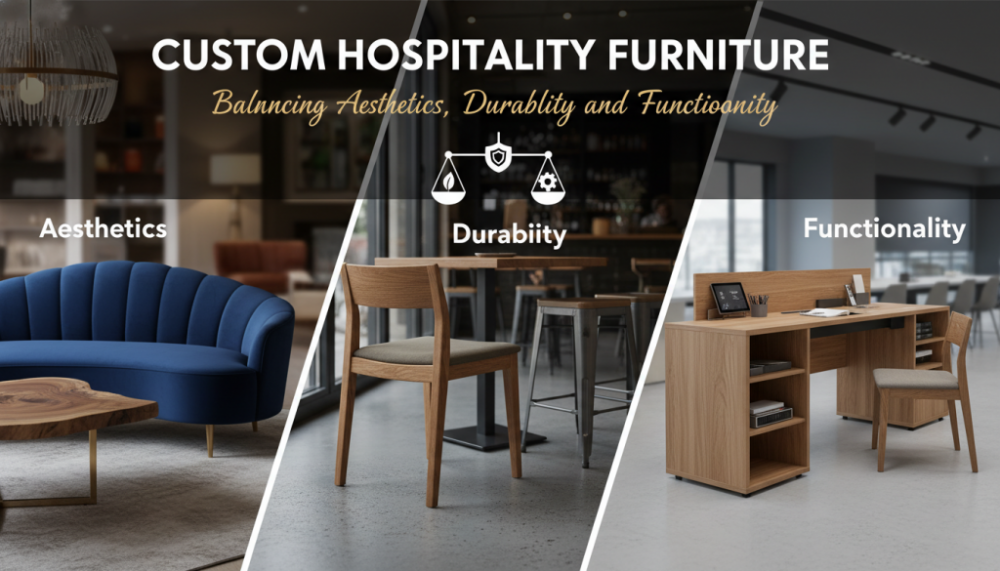
Hotels prefer custom hotel furniture today for three reasons that compound each other. First, brand identity. A hotel that has invested in a positioning – whether that is urban luxury, coastal leisure, or design-forward boutique – cannot fully express that positioning through catalogue furniture that three other hotels in the same city are also using. Second, spatial fit. Hotels are built to specific footprints, and custom furniture makes use of those footprints instead of working around them. Third, durability specification. Custom manufacturing allows the operator to specify frame construction, joint type, foam density, fabric grade, and finish hardness to match the actual usage environment – not a residential assumption about what “heavy use” means.
The impact on branding, comfort, and durability is not incremental. It is the difference between a hotel that feels thought through and one that feels assembled from available parts.
Types of commercial hospitality furniture used in hotels
Commercial hospitality furniture covers a broad scope across a hotel property. Let’s break it down by area, because the requirements shift meaningfully from one space to the next.
Guest room furniture
The guest room is where custom specification pays the most obvious dividends. Beds, headboards, wardrobes, desks, and bedside pieces all need to work together within a specific room module, and they need to survive daily housekeeping, heavy bag placement, and the full range of how guests actually use a hotel room.
Headboards in particular are a signature piece. A custom headboard built to the exact wall width of the room, in a material and profile that reflects the hotel’s design language, costs more than a standard option and communicates something entirely different to the guest. Wardrobes and storage need to be dimensioned to the room – not to a standard carcass size that leaves awkward gaps or imposes on floor space. Desks need to work for both traditional laptop use and the charging-heavy, multi-device reality of how guests work now.
Frame construction for guest room casegoods in a commercial environment should be hardwood or engineered hardwood core – not particleboard, which fails at joints under the mechanical stress of daily use in ways that a guest room schedule accelerates significantly.
Lobby & reception furniture
The lobby is a brand moment. It is also the highest-traffic zone in the building, which means the furniture there absorbs more use per square foot than anywhere else on the property.
Sofas and lounge chairs in a hotel lobby need commercial-grade upholstery rated for tens of thousands of rub cycles – not the residential 15,000 rub cycle standard. Seating clusters need to be arranged and sized for how lobby use actually works: some guests waiting for a check-in, some meeting externally, some simply passing through. Reception desks are a custom piece almost by definition – they need to be dimensioned to the actual counter space, accommodate the technology behind them, and align visually with the brand aesthetic the hotel is building.
This also is helping explain why lobby furniture gets replaced most frequently in hotels that bought off-the-shelf initially. The usage volume exposes durability shortfalls faster here than anywhere else.
Restaurant & dining furniture
Dining furniture in a hotel carries a specification layer that general hospitality furniture does not always address. Tables need to resist the cleaning chemicals used in food service environments, which are more aggressive than general hospitality cleaning products. Chair frames need to handle the mechanical stress of being pulled across hard floors repeatedly – something that destroys standard leg tips and floor protection in a matter of months. Bar stools need to be height-engineered to the actual bar counter height, which varies by design.
And that is not all. Restaurant seating in a hotel needs to work for multiple meal periods and multiple uses – a dinner chair that works for a business breakfast, a bar stool that is comfortable for a 90-minute stay, a banquet chair that stacks without marking the chair above it. Custom commercial hotel furniture built around the operational reality of a hotel restaurant performs differently than furniture sourced from a retail dining supplier.
Outdoor & poolside furniture
Weather-resistant seating for outdoor and poolside areas carries specific performance requirements that vary by U.S. climate zone. Marine-grade aluminium, recycled HDPE, and powder-coated steel with appropriate UV and salt spray ratings are the baseline material categories. Fabrics for cushioned outdoor pieces need solution-dyed acrylic with drainage construction – not printed polyester that fades and degrades under bleach cleaning.
Custom outdoor furniture for hotels also allows for the finish and profile coordination with interior pieces that creates a coherent guest experience from the lobby to the pool deck. That visual continuity is one of the things guests register without being able to articulate it, and it is something catalogue outdoor furniture makes almost impossible to achieve.
Benefits of choosing custom hotel furniture
The business case for custom hotel furniture is clearer than it used to be, and it is not purely aesthetic.
Unique design aligned with brand identity is the most visible benefit. A hotel cannot differentiate its physical environment using the same product lines its competitors are buying. Custom furniture is what makes a property look like itself rather than like a brand standard template – and in a market where guests compare properties on Instagram before they book, visual distinctiveness is a direct commercial advantage.
Better space utilisation follows from custom specification. Hotel rooms, lobbies, and F&B spaces are not built to standard furniture dimensions. Custom pieces fit the actual space, which means more usable floor area, better flow, and rooms that feel appropriately sized rather than crowded or sparse.
Higher durability for heavy usage is a function of specification control. When a hotel operator can define the frame material, joint construction, foam density, and fabric grade, they can match the product to the actual usage environment rather than accepting what a catalogue product was built for. Commercial hospitality furniture built to the right spec holds its structural and visual integrity for 8 to 10 years. Catalogue furniture in the same environment often shows meaningful wear within 3 to 4.
Flexibility in materials and finishes allows a hotel to maintain a consistent design language across phases of renovation, expansion, or refresh – something that is impossible with catalogue products that get discontinued or updated between orders.
Long-term cost efficiency closes the argument. Custom hotel furniture has a higher unit cost and a lower total cost of ownership. The replacement frequency difference over a 10-year period, at commercial hotel furniture volumes, is a significant capital line item.
Trends in modern hospitality furniture design
Modern hospitality furniture design has moved in a direction that is harder to achieve with standard product lines and easier to achieve with custom manufacturing. A few things are consistent across the current market.
Minimalist and functional design has replaced the heavy, ornate aesthetic that dominated hotel interiors through the early 2000s. Clean profiles, honest materials, and pieces that do not overfill a space are what the current generation of hotel guests responds to – particularly in the mid-scale and upscale segments where design-consciousness is now the norm rather than the premium tier differentiator.
Sustainable and eco-friendly materials are moving from a talking point to a specification requirement. FSC-certified wood, recycled content metals, low-VOC finishes, and fabrics produced with responsible processes are increasingly part of procurement briefs across all hotel segments. Custom manufacturing is where sustainability commitments can actually be specified and verified – not assumed from a brand’s general marketing language.
Smart furniture and technology integration is a growing area. Desks with built-in charging surfaces, beds with integrated reading light channels, lobby seating with embedded power points – these are not future features. They are current specifications in new builds and conversions across the upper-midscale and upscale segments.
Multi-purpose and modular furniture addresses the operational reality that hotel spaces serve multiple functions across a day. A lobby that works for breakfast service, informal working, afternoon social seating, and evening drinks needs furniture that can be reconfigured quickly and looks coherent in multiple arrangements.
Local craftsmanship meeting global aesthetics is a trend that plays directly into the custom category. Boutique hotels and lifestyle brands are building furniture programmes that reference local materials, local craft traditions, or local design heritage – something that is only possible with custom specification and a manufacturer with the capability to execute it.
How to choose the right commercial hotel furniture
The procurement decision for commercial hotel furniture involves more variables than most categories. A few principles hold across hotel type and segment.
Understand your target audience first. A luxury property and a select-service property have different use patterns, different cleaning protocols, different staff-to-room ratios, and different guest expectations. The furniture specification needs to be built around the actual property – not a general standard for “hospitality” use. A high-traffic select-service hotel needs higher durability specification than a boutique property with lower occupancy and a longer replacement cycle by design.
Focus on durability and maintenance together. A beautiful piece that requires specialist cleaning or cannot withstand the disinfection products your housekeeping team uses is a liability. Durability is not just structural – it includes finish resistance to cleaning agents, fabric performance under repeated washing, and hardware that holds up under daily use without requiring adjustment.
Balance aesthetics with comfort, because guests notice both. A chair that looks right and sits uncomfortably will generate negative comments. Furniture that is physically comfortable but visually out of step with the property’s aesthetic undermines the design investment everywhere else.
Compliance with safety standards is non-negotiable, and varies by state and property type. Flammability standards for upholstered furniture, structural load ratings, and ADA requirements for accessible spaces all need to be confirmed in writing from any supplier before purchase.
Vendor reliability – specifically their ability to deliver consistently at volume, meet lead times, and provide replacement components post-delivery – is where procurement decisions often go wrong when price is the primary selection criterion.
Top hospitality furniture manufacturers to consider
What separates a top hospitality furniture manufacturer from a furniture supplier who serves the hospitality market is a meaningful distinction. The difference shows up in the specifics.
Experience in commercial hospitality specifically – not retail, not residential, not general contract – matters because the performance requirements are different and the manufacturing decisions that affect long-term performance are made at the production stage, not visible at the time of purchase. A manufacturer who has built furniture for hundreds of hotel rooms understands how that furniture fails in commercial use and how to prevent it. A furniture supplier adapting residential or retail products to hospitality specifications does not carry that knowledge in the same way.
Portfolio depth tells you what a manufacturer can actually execute, not just what they are willing to quote. A manufacturer whose portfolio includes projects across multiple hotel segments, multiple climate regions, and multiple brand standards has demonstrated range. Ask to see specific projects, not just product photography.
Customisation ability is the category-defining capability for this conversation. The ability to work from a design brief, produce samples, iterate, gain brand approval, and deliver to specification at commercial volume is not a standard capability. Many suppliers quote customisation and deliver modifications. True custom manufacturing – building to a unique specification at commercial scale – requires investment in design capability, tooling flexibility, and quality systems that not every supplier has made.
Timely delivery and after-sales support close the picture. Lead times for custom hospitality furniture typically run 8 to 16 weeks depending on scope and volume. A manufacturer who cannot give realistic lead time commitments, or who has no structured process for handling replacement components and warranty claims after delivery, creates ongoing operational risk.
Sara Hospitality USA is an example of a manufacturer who covers this full picture. Based in Atlanta, Georgia, with over 550 completed hospitality projects across the U.S., Sara Hospitality provides tailored FF&E solutions across the full scope of hotel furniture – guestroom casegoods, lobby pieces, custom commercial furniture, and outdoor furniture – with in-house design capability, brand approval experience across major chains including Marriott, Hilton, IHG, Wyndham, and Best Western, and a manufacturing process that handles design, production, and delivery under one roof.
Their Atlanta showroom runs six vignette settings – built like working hotel spaces, not a product display – which means operators and procurement teams can evaluate how pieces actually feel and perform at scale before committing to a volume order. That is the kind of project support that reduces procurement risk and protects the investment in a custom furniture programme over the long term.
Conclusion
Furniture is where a hotel’s identity becomes physical. A guest cannot touch a brand strategy or experience a positioning statement. They can touch the arm of the chair in the lobby, the surface of the desk in the room, and the texture of the barstool at check-in. Those moments either deliver on the promise the hotel is making or they do not.
Custom hospitality furniture is how hotels make sure they do. The investment is higher per unit, the process takes longer than pointing at a catalogue, and the specification requires more from the procurement team. What it returns is a property that looks and feels like itself – and holds that quality for years rather than seasons.
For hotels that take the guest experience seriously, commercial hospitality furniture built to a custom specification is not the expensive option. It is the one that actually delivers on the investment.