Introduction:
Data is only useful for the users when it is accurate and honest. But most of the time it carries hidden flaws that quickly distort the results of any analysis. Well, these flaws are called Data Bias, and they are the biggest challenges in the field today. Many organizations are looking for professionals with a deep understanding of these topics.
Whether you are looking to begin your career as a Data analyst, understanding the data bias won’t be optional. Taking the Data Analyst Course can be a great help for the same and build the skills that you may require. As you are going to learn about Data Bias, you need to understand that Bad data does not just produce wrong answers. So let’s begin by discussing the meaning of data bias.
What Is Data Bias?
Data bias is all about a dataset that continuously learns in the same direction due to the errors in how the data is gathered, recorded, or used. Here, the bias won’t come out as this stay hidden and keeps pushing the result in the wrong way.
The tricky part is that biased data can look perfectly clean on the surface. There are no missing values, no obvious errors, yet the conclusions drawn from it are still off. This is why finding bias is a skill that every Data Science Classes puts serious emphasis on.
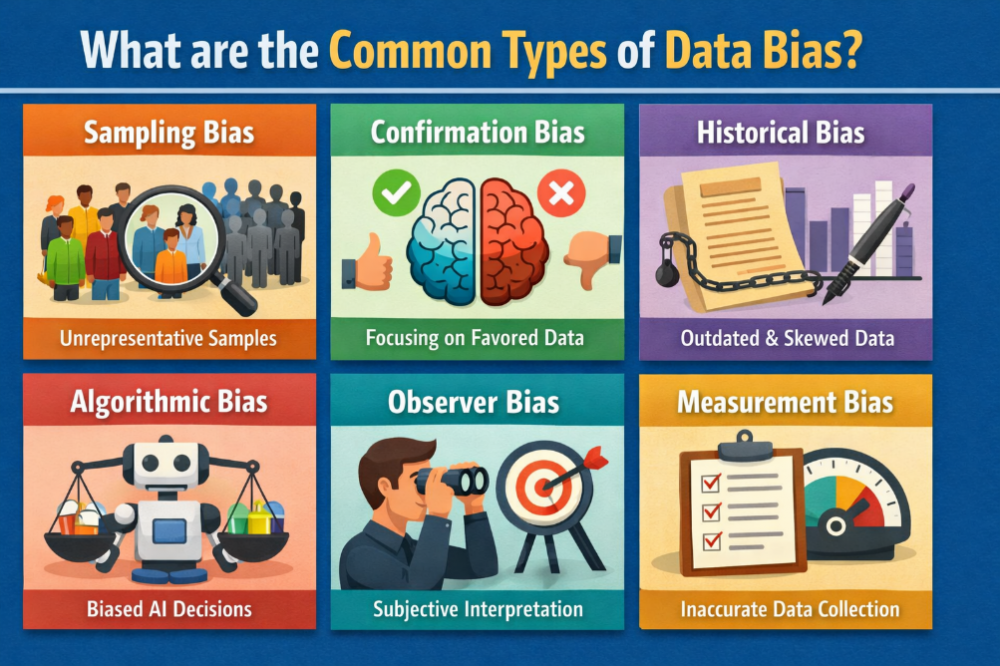
Common Types of Data Bias:
1. Selection Bias:
This happens when the data collected does not fairly represent the full group being studied. Certain people or records end up included more than others, not because of any logical reason, but because of how the data was gathered.
The result is that the analysis only tells part of the story, and often the wrong part. Awareness of selection bias is a core lesson in any solid Data Analytics Certification Course, because it affects almost every field from healthcare to marketing.
2. Confirmation Bias:
This one starts in the human mind before it ever reaches a spreadsheet. Confirmation bias is the habit of focusing on data that supports what you already believe, while brushing past anything that challenges it.
It is surprisingly common among experienced analysts, not just beginners. You start an analysis with a gut feeling, and without realizing it, you steer toward numbers that back it up. The fix is simple in theory but hard in practice. Always let the data lead, not your assumptions.
3. Survivorship Bias:
This type of bias comes from only looking at the outcomes that “made it through” a process, while completely ignoring everything that did not. The picture that remains looks far more successful than reality actually is.
It gives a false sense of what is possible and what is normal. Professionals who study a Master’s in Data Analytics are trained to always ask: what is not showing up in this data, and why?
4. Sampling Bias:
When the method used to collect data favors some groups over others, you end up with sampling bias. The dataset may be large, but if it was gathered in a way that left out certain segments of a population, size does not help.
A bigger biased sample is still a biased sample. Proper sampling methods, especially stratified random sampling, are taught early in any Data Science Course because getting this right is foundational to everything else.
5. Measurement Bias:
Measurement bias happens when the tools or methods used to collect data are consistently off in one direction. The data is recorded faithfully; the problem is that what is being recorded is not accurate to begin with.
This kind of bias is particularly dangerous because it is easy to trust data that was carefully collected, even when the collection process itself was flawed. Regular audits of data collection methods are one of the best defenses against this.
6. Reporting Bias:
Not all findings make it into the final report. Reporting bias occurs when positive or impressive results get shared, while flat or negative results quietly disappear. Over time, this creates a very skewed picture of what is actually true.
This is a well-known problem in research and business analytics alike. A good Data Analytics Certification Course will stress the importance of documenting all outcomes, not just the ones that look good.
7. Algorithmic Bias:
When a machine learning model gets trained that already has bias in this, it won’t just repeat the bias but also amplifies this. Well, this model gets learn from the past, and if the past is unfair, then the model may carry forward in each of the predictions that it makes
Algorithmic bias has real consequences when these models are used to make decisions about people. Auditing datasets before training and testing model outputs across different groups is now standard practice covered in depth in a Masters in Data Analytics program.
8. Aggregation Bias:
Combining data from different groups into one overall number sounds efficient. But this hides the important differences that really matter. So when you average out the groups that are quite different, you may lose the data that is useful in the first place.
Disaggregating data, breaking it back down by relevant segments, is one of the most practical habits any analyst can develop. It is a skill reinforced throughout every strong Data Analyst Course.
Conclusion:
Data bias is not always a result of carelessness because it can happen even when people are trying their best. But the difference between an average analyst and a great one is the ability to question the data in front of them, not just work with it. Each of the datasets has a story about how this was collected, who collects, and what has been left out.