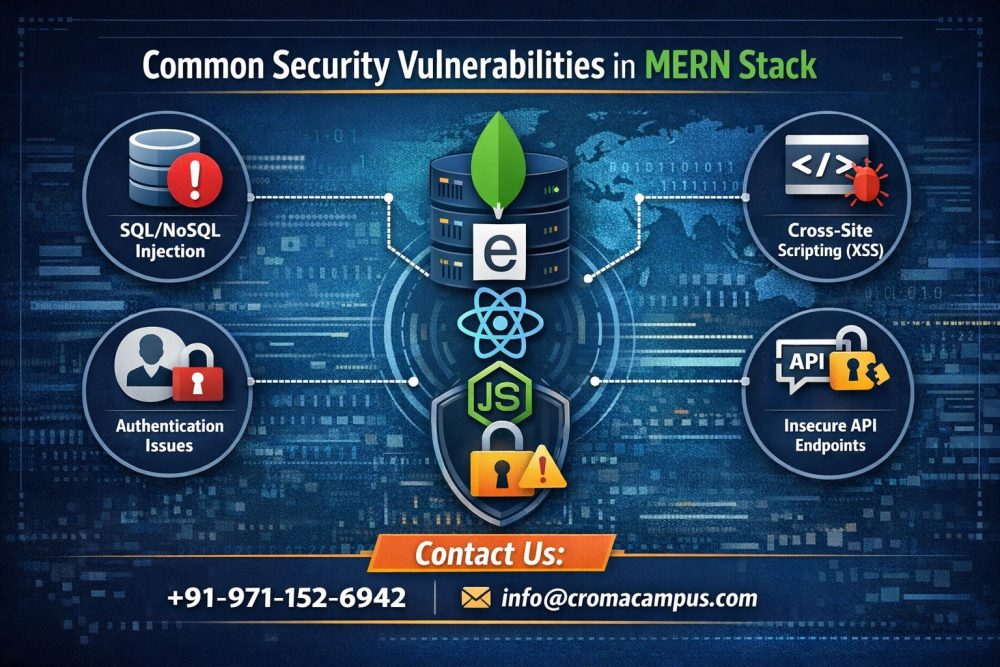
In the current time, there are many developers who are building MERN Stack applications focuses mainly on making the app work. But all in this, security gets pushed to the end or gets ignored completely. This creates a real problem in app development.
Well, the MERN stack is one of the most powerful and flexible. But sometimes this flexibility also means there are a number of places where things can go wrong if you don’t pay attention. If you are looking to learn about these vulnerabilities, then having basic knowledge of the MERN stack is required. Taking the MERN Stack Training in Noida can be a great help in this, as it can help solve the security issues easily and get essential tips from the professionals.
Common Security Vulnerabilities and Their Solution:
1. NoSQL Injection in MongoDB
Most developers do not think about this one until something goes wrong. MongoDB queries are flexible, and that flexibility can work against you.
There are more chances of your query being manipulated when the application takes input from a user and puts it directly into the query without checking it. Sometimes this can alter the structure of the query and pull the data that was never meant for them. This may include user details, admin credentials, or records that should be completely locked down.
What to do:
Do not let invalidated input anywhere near your database queries. Clean and check every piece of data that comes in from the outside before it reaches MongoDB. The express-validator library is straightforward to set up and handles most of this work. Also, keep MongoDB operators like $where out of queries that users can influence, means they create more problems than they solve.
Security-focusedMERN stack courses address this early on because the damage it causes in a live application is hard to reverse once it happens.
2. Poor JWT Authentication Setup
JWT-based authentication works well when it is set up correctly. When it is not, it creates a straightforward path for attackers.
Storing tokens in localStorage is the most common mistake. That storage is accessible to any JavaScript running on your page, which means a single XSS vulnerability can expose every token. Weak secret keys, no expiry on tokens, and no refresh system compound the problem further. One stolen token can give an attacker full access to a user account for as long as that token stays valid.
What to do:
Move token storage to HTTP-only cookies. These are not accessible through JavaScript, which cuts off one major attack route. Set a short expiry on every token and build a refresh token system alongside it. Pick a long, random secret key. It should e not be something simple and guessable, and keep it in your environment variables. It should never appear directly in your code.
3. Cross-Site Scripting (XSS)
This cross-site scripting can take place when an attacker’s script ends up running inside the app. Anywhere can be the entry point, which is usually a field where a user can type something in the comment section, search bar, as well as profile name inputs.
If your application takes that input and displays it back on the page without cleaning it, the script runs. Anyone who loads that page is now affected.
React does protect against this in most cases because of how it handles JSX. The issue is dangerouslySetInnerHTML. As soon as that property is in your code, React’s built-in protection is gone, and whatever content gets passed in will render as raw HTML.
What to do:
Avoid dangerouslySetInnerHTML If there is genuinely no way around it, run the content through DOMPurify. before it gets rendered. On top of that, set a Content Security Policy in your response headers. This tells the browser which scripts are allowed to run and blocks everything else.
4. Unprotected API Endpoints in Express
Express is built for speed. You can get an API running in a few minutes, and that is great until you realize some of those routes are completely open.
No authentication on sensitive routes, no checks on what data is coming in, and full error messages going back to the client are all common issues in MERN projects. Those detailed error messages are particularly risky. They often reveal database structure, file paths, or library versions that help attackers figure out where to push next.
What to do:
Every route that deals with sensitive data needs authentication middleware sitting in front of it. Check all incoming data before doing anything with it. In production, your error responses to the client should say as little as possible, and log the full details on the server, where only your team can see them. Helmet.js is worth adding to any Express project because it sets a range of security headers automatically with minimal configuration.
Securing Express routes is a core part ofMERN stack certification training for a reason. It is the kind of thing you only really understand once you have built it, broken it, and fixed it yourself.
Conclusion:
Well, you cannot add security after it is built already, or expect it to hold. It needs to be part of how you write the code from the beginning. If you are building an app using the MERN stack, don’t forget to add security sections. For those who are looking for structures, practical training that covers the real vulnerabilities alongside development, taking the relevant course in MERN can offer hands-on programs where these issues are covered in a real project setting