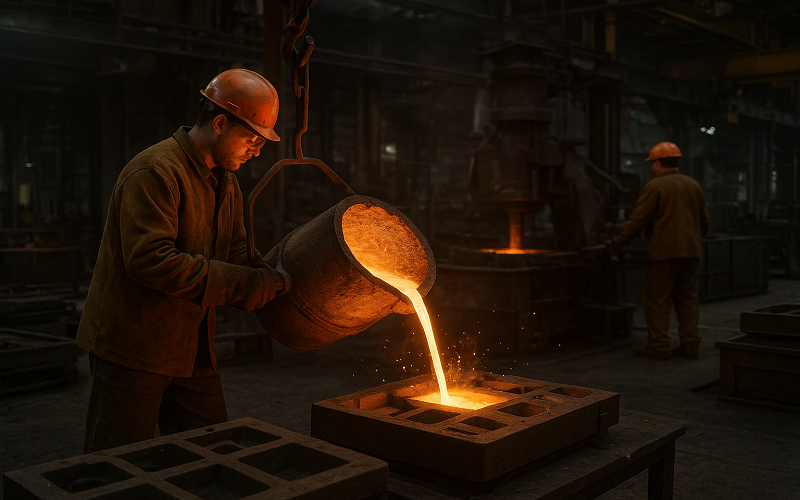
The Indian Casting Industry has evolved in the past one decade. Indian foundries are moving towards smarter processes. Though Indian foundries are known to be quick in speed and responsive, they have now started thinking big which means adoption of more sophisticated technology in their current manufacturing processes. Even with these advances, casting defects continue to be a problem for several industries automotive oil & gas, defence, pumps, valves and heavy machinery included. Knowing what causes this to occur and how it’s resolved by contemporary foundries such as top casting investment castings manufacturers is vital here you’ll want to keep a watchful eye on the consistency of your end product and its overall performance.
- Porosity and Gas Defects
Porosity is still a most common problem in the cast products regardless of being ferrous or nonferrous. The defect happens when gas is entrapped into the metal as it solidifies, creating little pockets that make your metal weaker. Indian foundries are overcoming this by introducing degassing treatments, controlling pouring temperatures and employing vacuum assisted systems. Simulation programmes also assist to predict gas entrapments so that gating systems can be reconfigured before production starts.
- Shrinkage Cavities
Shrinkage is caused when the metal pulls back during cooling and there was not enough metal to replace volume. This can result in hollow spaces or depressions. To deal with this, foundries use directional solidification and improved riser design, as well as the use of chills. Tools that are digital even allow a metallurgist to visualize temperature gradients and make fine-tuned changes. 3D software has been an essential tool for many investment castings companies to get the riser locations exactly right and eliminate shrinkage rejects.
- Incomplete Filling and Cold Shuts
Incomplete Filling occur when molten metal does not completely fill the mould; cold shuts occur where two metal flows do not join properly. These shortcomings are typically attributed to an inappropriate pouring temperature, gating design or low filling rate. The Indian casting plants are equipped with automatic pouring systems that allow more uniform metal flow and adapted gating geometries to ensure good fill. Such problems have been virtually eliminated due to preheating molds, utilization of melt superheat control and enhancement of metal flow.
- Sand Inclusion and Embedded Particles
Sand inclusion Sand inclusion is a type of defect which occurs when sand or other foreign particles become trapped in the casting and adversely affect appearance and mechanical properties. This is usually caused by mould surfaces that are too soft, or excessive metal turbulence. Modern foundries, however, reduce this risk by employing superior binder systems, resin coated sands and advanced mold hardening processes. Improved handling of the mould, robot cored setting and smooth gating transitions also reduce fighting conditions and contaminations.
- Hot Tears and Hot Cracking
Hot tears arise as casting cools and shrinks against unmoving moulds, causing it to crack. The above flaws are especially common in alloys that have a poor ductility in the solidification process. Indian manufacturers are combating this, through an optimized mould design, variation in alloy composition and by maintaining uniform cooling. Foundries are also employing soft mould materials in crucial areas and controlling cooling rates to avoid the build-up of stresses.
- Surface Roughness and Poor Finish
The problem of 5 A rough surface indicates problems with mould material, refractory coating or pouring condition. Indian foundries have adopted better refractory coatings, smoother mold surfaces and fine-tuned metal flow to meet the higher demands on finish quality. CNC finishing, shot blasting and precision fettling give a finish which meets the international appearance criteria. Investment castings manufacturers are creating near net shape surfaces that demand little or no machining for higher integrity components.
- Cold Laps and Flow Lines
The cold laps are formed when the semi-solidified metal creases back on itself to form a line or seam. Such lines reduce the ductility of the casting and can develop into hairline cracks in service. This is solved in Indian machines by maintaining optimised melt temperature; low turbulence of metal and by mould venting adjustment. With the utilization of up to date simulation systems, flow defects are now predicted before production thus simplifying and reducing cost for corrections.
- Blowholes and Pinholes
Blowholes are voids of gas that grow, whereas pinholes are small, uniformly spread cavities. Both are the result of moisture in the mould, lack of sufficient ventilation or too much gas in the liquid metal. To remove these, foundries have used moisture-controlled sand systems, better venting paths and more effective deoxidizers. The metal is to be made available in its purest form via degassing facilities, inert gas purging and real-time melt analysis.
- Metal Penetration
Metal penetration is the penetration of molten metal into a coarse or weak mould surface, and it has causes excessive roughness / sand sticking to casting. Indian manufacturers are resorting to finer sand grades, stronger binders and harder mould walls to achieve this. Controlled pouring speed and correct refractory coating also lower the penetration to a great extent.
- Improper Dimensions
There are problems of lack of accuracy in size and forming-draw from the movement or low accuracy displacement of molds, wrong pattern design, uneven cooling. As the global standards get higher, Indian foundries are incorporating 3D scanning, CNC patternmaking and automatic moulding line to increase dimensional stability. Thanks to AI powered inspection systems, inconsistencies are detected early. For those industries that use investment castings manufacturers, such tight tolerances really matter.